
We read your photo as:
A certain element is represented as X¹²6.
ScanSolve AI Answer
Here are the solutions to the questions:
-
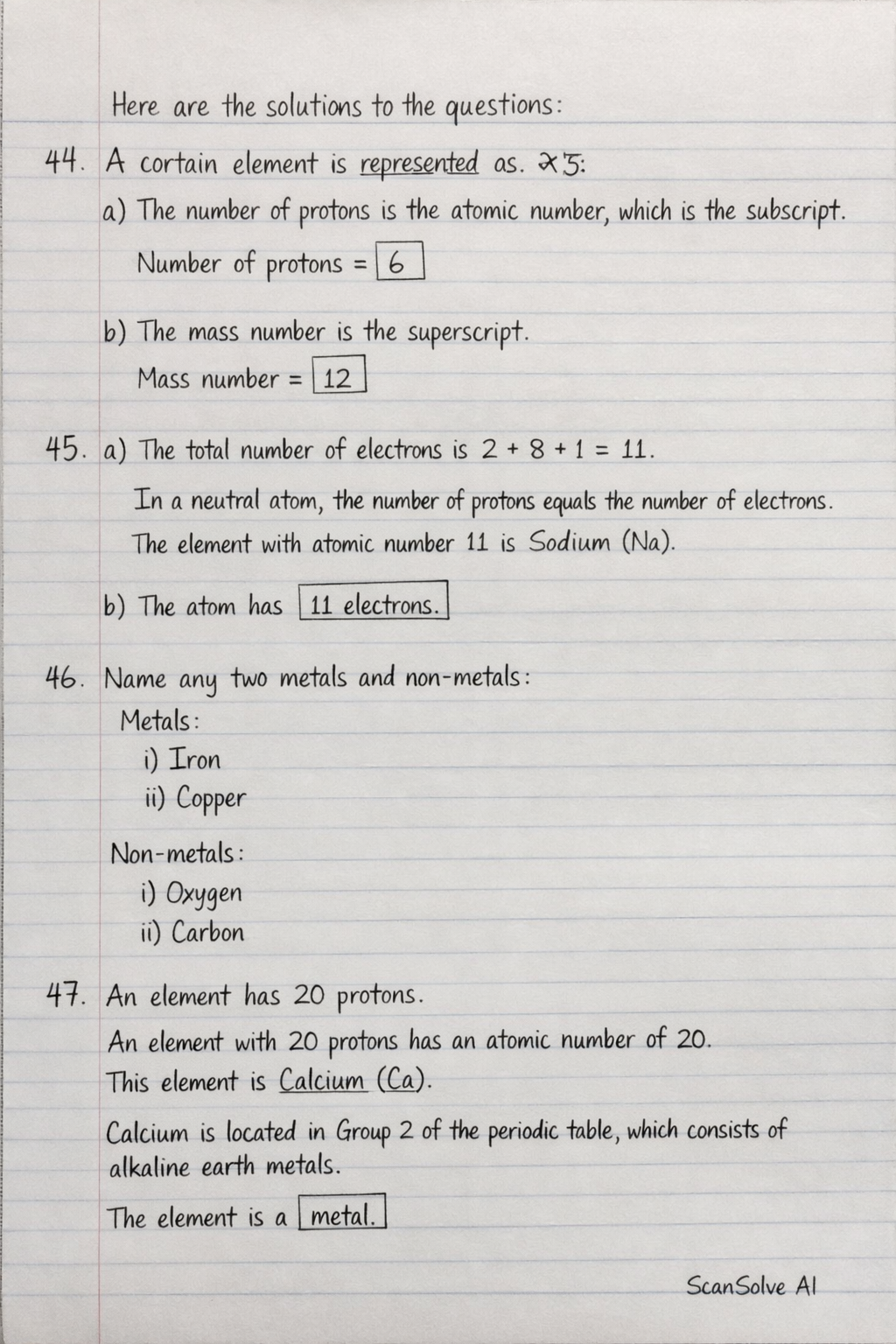
A certain element is represented as . a) The number of protons is the atomic number, which is the subscript. Number of protons = b) The mass number is the superscript. Mass number =
-
An atom of an element has an electron arrangement of 2.8.1 a) The total number of electrons is . In a neutral atom, the number of protons equals the number of electrons. The element with atomic number 11 is Sodium (Na). b) The atom has .
-
Name any two metals and non-metals: Metals: i) Iron ii) Copper Non-metals: i) Oxygen ii) Carbon
-
An element has 20 protons. An element with 20 protons has an atomic number of 20. This element is Calcium (Ca). Calcium is located in Group 2 of the periodic table, which consists of alkaline earth metals. The element is a .
-
Identify the element whose atomic structure is illustrated below. (The illustration of the atomic structure is missing from the provided image, so the element cannot be identified.)
-
We can use the following to classify elements as either metallic or non-metallic:
- Their physical properties such as electrical conductivity, thermal conductivity, malleability, ductility, luster, and state at room temperature.
- Their chemical properties, particularly their tendency to lose (metals) or gain (non-metals) electrons to form ions.
- Their position on the periodic table.
-
Different elements are important to us in different ways. Some of their importance includes:
- Oxygen is essential for respiration in living organisms and for combustion.
- Iron is used in construction and is a vital component of hemoglobin in blood.
- Calcium is crucial for strong bones and teeth, and is used in building materials like cement.
- Carbon forms the basis of all organic life and is used in fuels and materials like graphite and diamonds.
-
Two uses of phosphorus are:
- It is a key component in fertilizers to promote plant growth.
- It is used in the manufacturing of matches and fireworks.
-
Grade 8 learners will be preparing oxygen gas in the laboratory. They would require the following for the practical activity:
- Chemicals: Hydrogen peroxide () and Manganese(IV) oxide () as a catalyst.
- Apparatus: Test tube or conical flask, delivery tube, gas jar, trough of water (for collection by downward displacement), retort stand and clamp, and a stopper.
Still stuck on this one?
Ask a follow-up, and the answer starts from this question.
More Chemistry Questions
Handwritten Step-by-Step Solution
Get this as a handwritten image on WhatsApp — like a tutor wrote it for you.
Try on WhatsApp