
We read your photo as:
Construct a part of the modern periodic table and show the position of the given element X.
Chemistry
ScanSolve AI Answer
Step-by-step solution
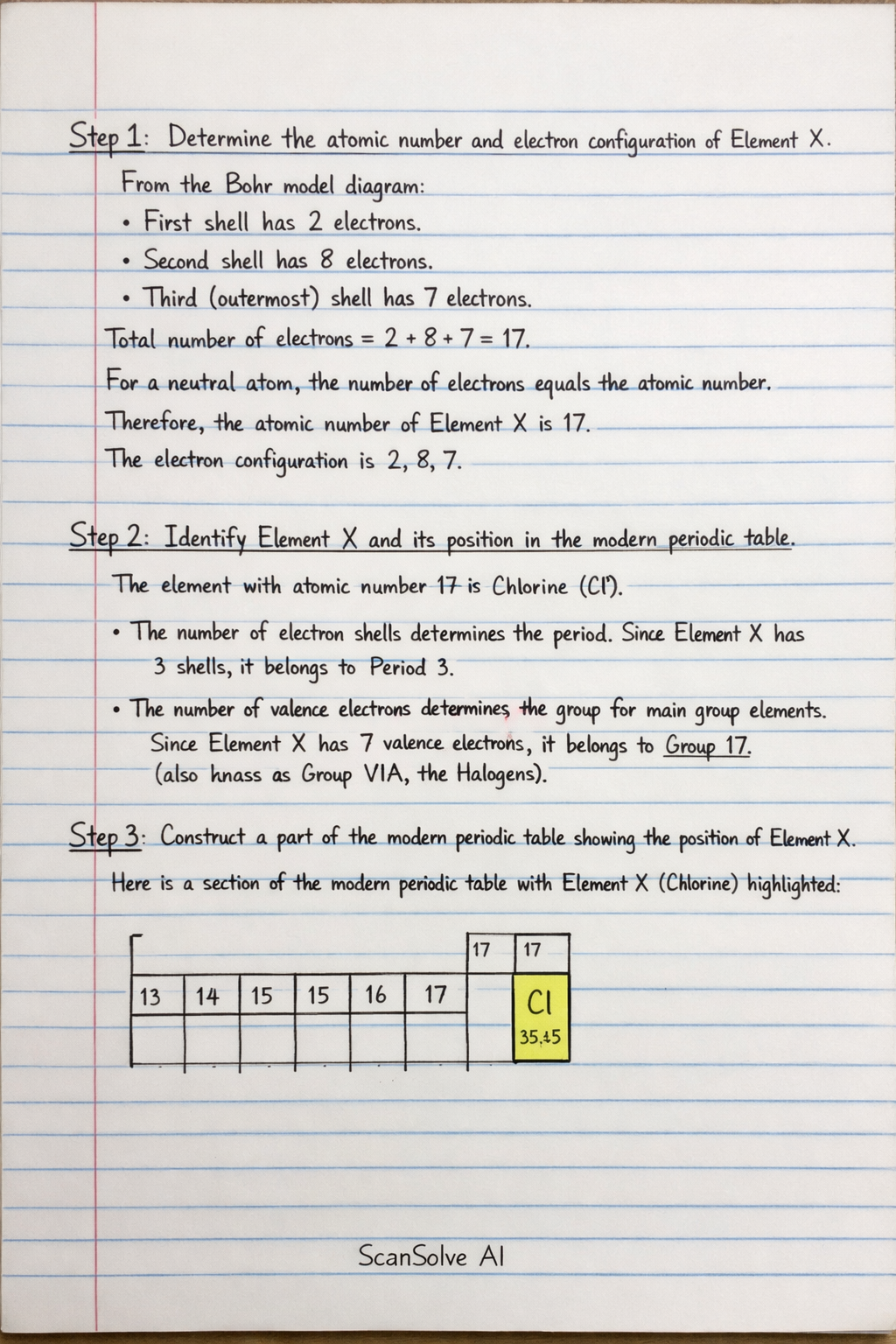
3 stepsDetermine the atomic number and electron configuration of Element X.
From the Bohr model diagram:
- First shell has 2 electrons.
- Second shell has 8 electrons.
- Third (outermost) shell has 7 electrons. Total number of electrons = . For a neutral atom, the number of electrons equals the atomic number. Therefore, the atomic number of Element X is 17. The electron configuration is .
Identify Element X and its position in the modern periodic table.
The element with atomic number 17 is Chlorine (Cl).
- The number of electron shells determines the period. Since Element X has 3 shells, it belongs to Period 3.
- The number of valence electrons determines the group for main group elements. Since Element X has 7 valence electrons, it belongs to Group 17 (also known as Group VIIA, the Halogens).
Construct a part of the modern periodic table showing the position of Element X.
Here is a section of the modern periodic table with Element X (Chlorine) highlighted:
Period Group 16 (Chalcogens) Group 17 (Halogens) Group 18 (Noble Gases) 2 Oxygen (O) Fluorine (F) Neon (Ne) 3 Sulfur (S) Chlorine (Cl) (X) Argon (Ar) 4 Selenium (Se) Bromine (Br) Krypton (Kr) The position of Element X is in Period 3, Group 17.
Was this helpful?
Still stuck on this one?
Ask a follow-up, and the answer starts from this question.
Got a different question?Ask your own question
More Chemistry Questions
QState the group and period for element X in the Periodic Table of Elements. Explain your answer.QIdentify element Y with atomic number 17, determine element X's electronic configuration and…QWhat property is used to arrange elements in the modern periodic table?QAn atom of an element is represented as 178X.QA certain element is represented as X¹²6.
Browse by topic:Inorganic Chemistry
Handwritten Step-by-Step Solution
Get this as a handwritten image on WhatsApp — like a tutor wrote it for you.
Try on WhatsApp