
We read your photo as:
An atom of an element is represented as 178X.
ScanSolve AI Answer
Here are the solutions to the questions:
-
An atom of an element is represented as .
- The atomic number (number of protons) is the subscript, which is 8.
- The mass number (protons + neutrons) is the superscript, which is 17.
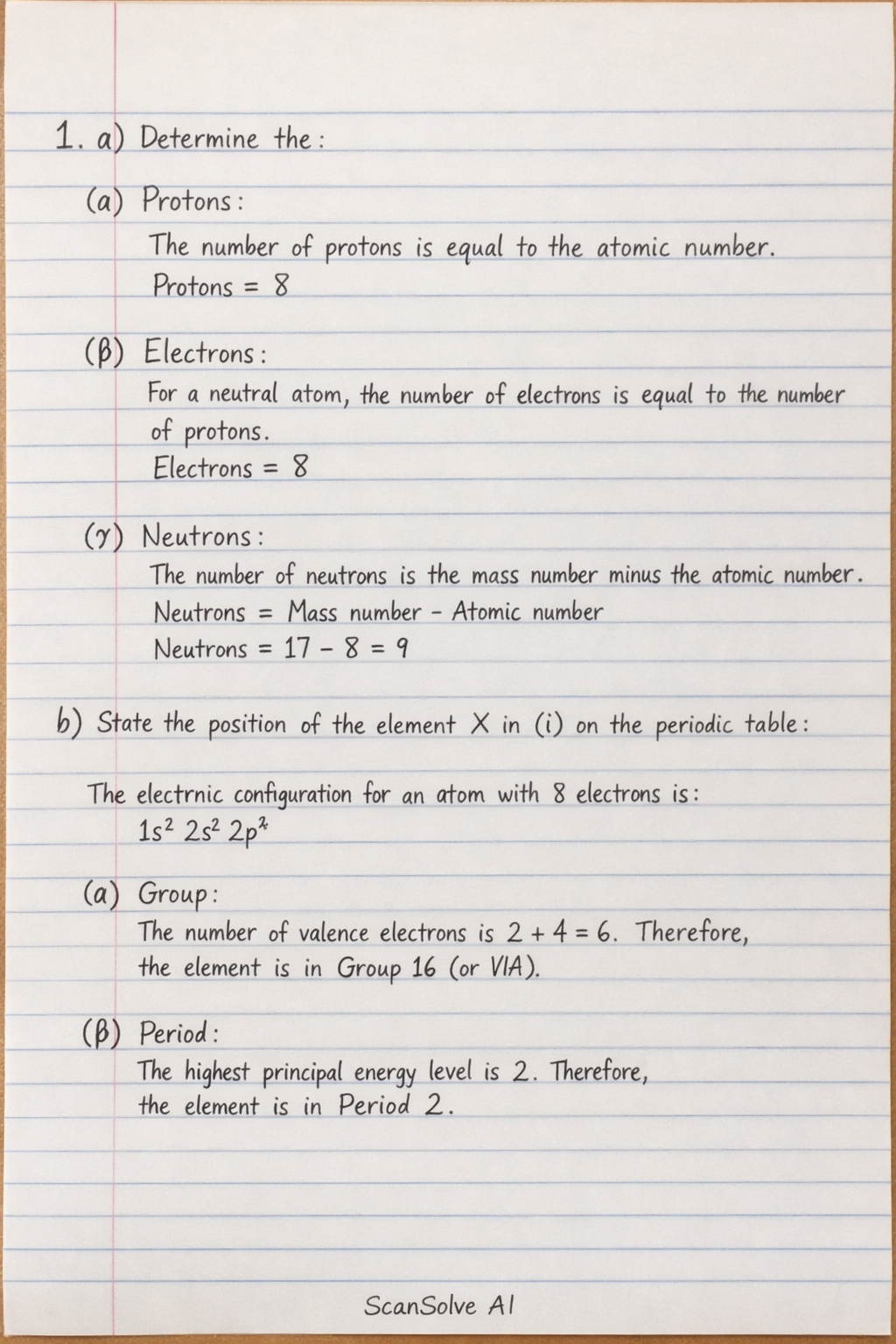
a) Determine the:
(α) Protons:
The number of protons is equal to the atomic number.(β) Electrons:
For a neutral atom, the number of electrons is equal to the number of protons.(γ) Neutrons:
The number of neutrons is the mass number minus the atomic number.b) State the position of the element in (i) on the periodic table:
The electronic configuration for an atom with 8 electrons is .
(α) Group:
The number of valence electrons is . Therefore, the element is in Group 16 (or VIA).
(β) Period:
The highest principal energy level is 2. Therefore, the element is in Period 2. -
a) Explain briefly heat transfer by conduction: Conduction is the transfer of heat energy through direct contact between particles of a substance, without any net movement of the substance itself. It occurs when vibrating particles transfer energy to adjacent particles. b) Name two other methods of heat transfer:
- Convection
- Radiation
-
a) Give two examples of water bodies:
- Rivers
- Lakes b) State two practices of humans that destroy water bodies:
- Discharge of untreated industrial waste and sewage
- Deforestation leading to soil erosion and sedimentation c) State two methods of conserving water bodies:
- Implementing strict regulations on waste disposal and treating wastewater before discharge
- Promoting afforestation and reforestation to prevent soil erosion
-
a) State three ways by which bacterial diseases are managed:
- Administration of antibiotics
- Vaccination to prevent infection
- Maintaining good hygiene and sanitation practices b) Give an example of a bacterial disease:
- Cholera
Still stuck on this one?
Ask a follow-up, and the answer starts from this question.
More Chemistry Questions
Handwritten Step-by-Step Solution
Get this as a handwritten image on WhatsApp — like a tutor wrote it for you.
Try on WhatsApp