
We read your photo as:
5 Which of the following are Arrhenius acids? 18.6 Which of the following are Arrhenius bases?
ScanSolve AI Answer
Answers
3 partsHere are the answers to your chemistry questions:
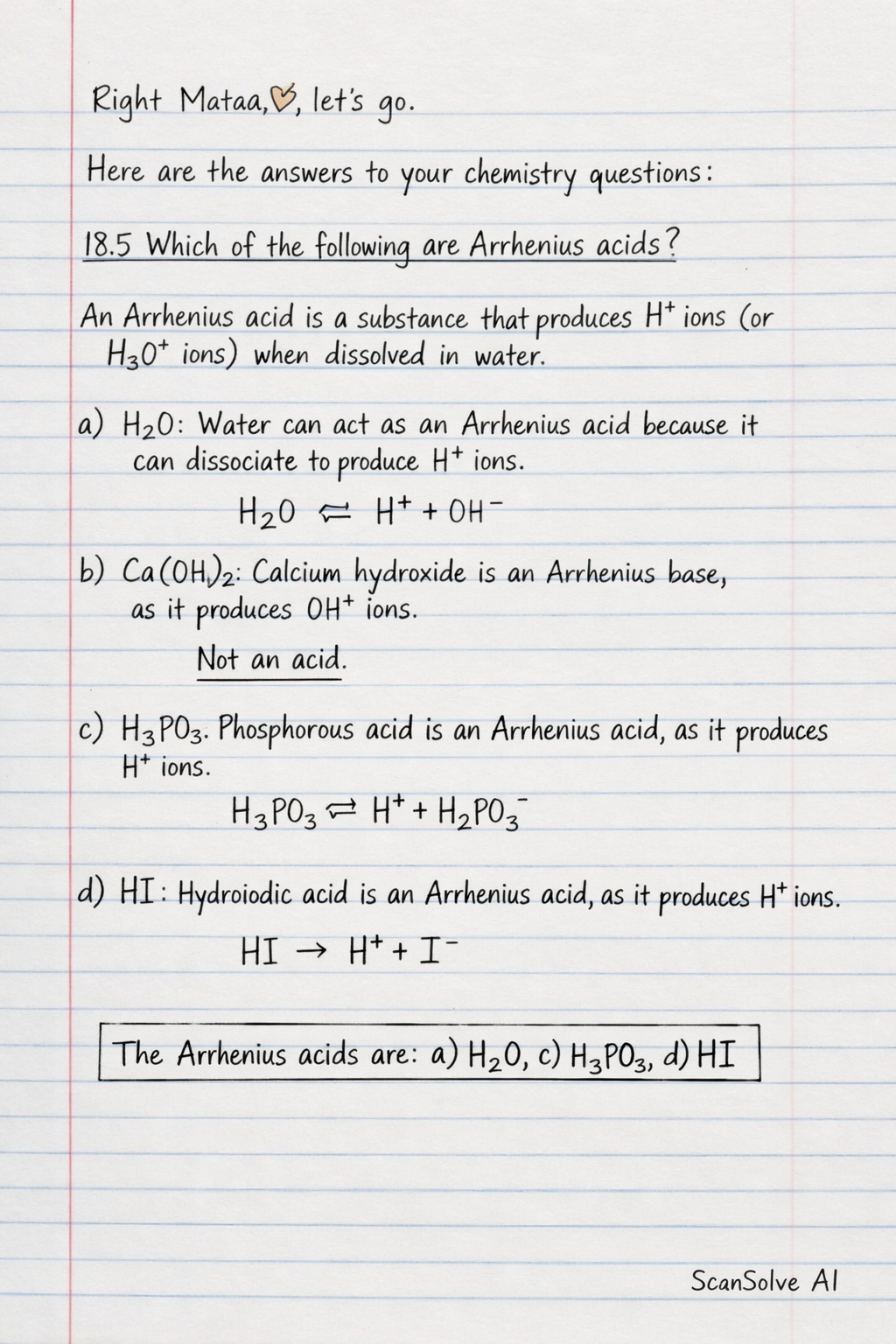
18.5 Which of the following are Arrhenius acids?
An Arrhenius acid is a substance that produces ions (or ions) when dissolved in water.
- a) : Water can act as an Arrhenius acid because it can dissociate to produce ions ().
- b) : Calcium hydroxide is an Arrhenius base, as it produces ions.
- c) : Phosphorous acid is an Arrhenius acid, as it produces ions ().
- d) : Hydroiodic acid is an Arrhenius acid, as it produces ions ().
The Arrhenius acids are:
18.6 Which of the following are Arrhenius bases?
An Arrhenius base is a substance that produces ions when dissolved in water.
- a) : Acetic acid is an Arrhenius acid, as it produces ions.
- b) (): Water can act as an Arrhenius base because it can dissociate to produce ions ().
- c) : Methanol is an alcohol and does not dissociate to produce ions in solution.
- d) : Hydrazine is a Brønsted-Lowry base (it accepts a proton from water to produce ), but it does not contain groups to dissociate, so it is not strictly an Arrhenius base.
The Arrhenius base is:
18.7 Write the expression for each of the following in water:
The general acid dissociation constant () expression for an acid reacting with water is:
-
a) (Nitrous acid)
-
b) (Acetic acid)
-
c) (Bromous acid)
Try one yourself
A new problem that tests the same skill.
Still stuck on this one?
Ask a follow-up, and the answer starts from this question.
More Chemistry Questions
Handwritten Step-by-Step Solution
Get this as a handwritten image on WhatsApp — like a tutor wrote it for you.
Try on WhatsApp