
We read your photo as:
I) Arrhenius theory: An Arrhenius acid is a substance that produces H^+ ions (or H3O^+ ions) when dissolved in water. An Arrhenius base* is a substance that prod
ScanSolve AI Answer
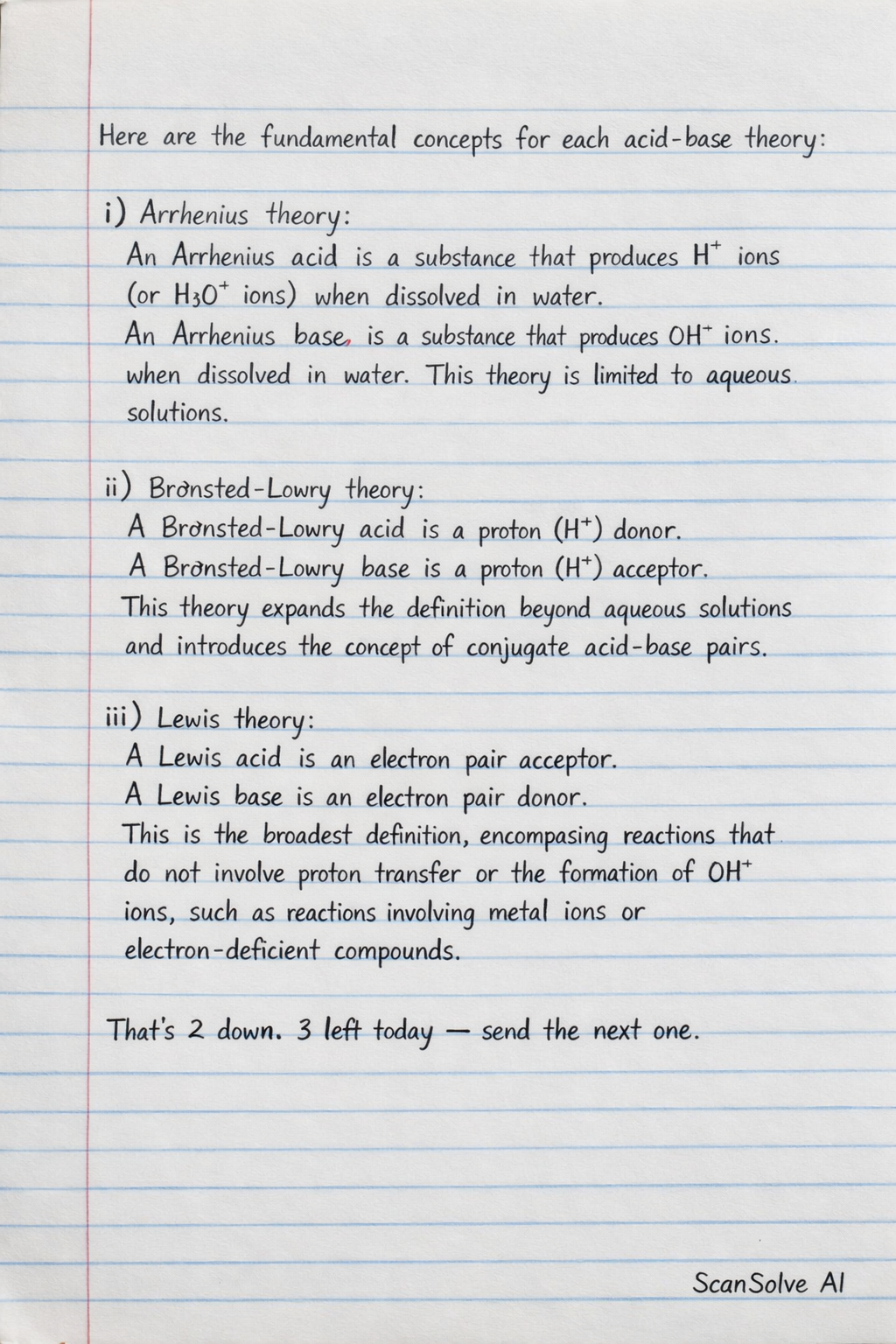
Here are the fundamental concepts for each acid-base theory:
-
i) Arrhenius theory: An Arrhenius acid is a substance that produces ions (or ions) when dissolved in water. An Arrhenius base is a substance that produces ions when dissolved in water. This theory is limited to aqueous solutions.
-
ii) Brønsted-Lowry theory: A Brønsted-Lowry acid is a proton () donor. A Brønsted-Lowry base is a proton () acceptor. This theory expands the definition beyond aqueous solutions and introduces the concept of conjugate acid-base pairs.
-
iii) Lewis theory: A Lewis acid is an electron pair acceptor. A Lewis base is an electron pair donor. This is the broadest definition, encompassing reactions that do not involve proton transfer or the formation of ions, such as reactions involving metal ions or electron-deficient compounds.
Still stuck on this one?
Ask a follow-up, and the answer starts from this question.
More Chemistry Questions
Handwritten Step-by-Step Solution
Get this as a handwritten image on WhatsApp — like a tutor wrote it for you.
Try on WhatsApp