
We read your photo as:
In the reaction NH3(g) + H2O(l) <=> NH4+(aq) + OH-(aq), identify an acid according to Arrhenius and explain why.
ScanSolve AI Answer
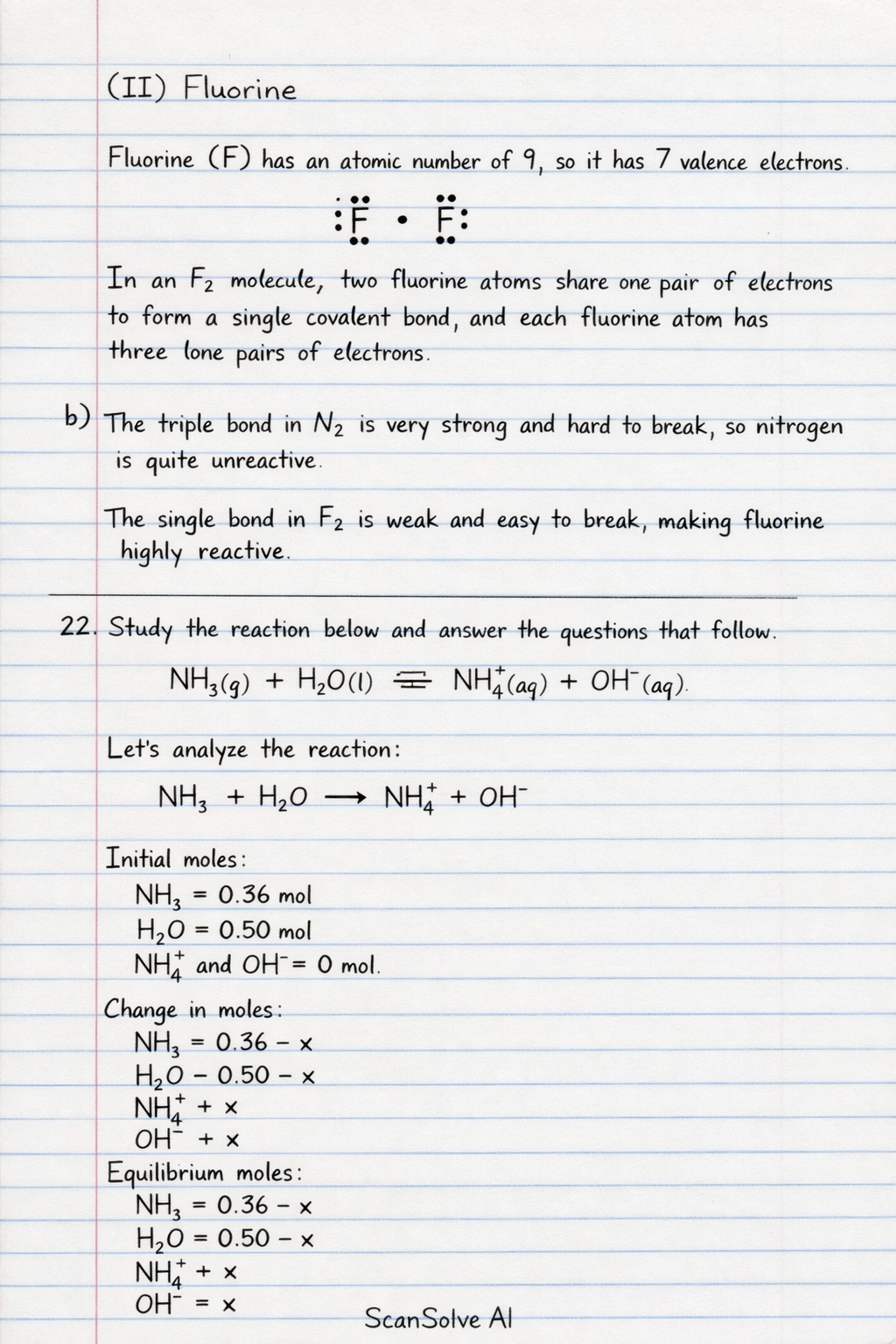
(II) Fluorine
Fluorine (F) has an atomic number of 9, so it has 7 valence electrons. In a fluorine molecule (), two fluorine atoms share one pair of electrons to form a single covalent bond, and each fluorine atom has three lone pairs of electrons.
b) With reference to the diagrams in (a), state why fluorine is more reactive than nitrogen.
The triple covalent bond in nitrogen () is very strong and requires a large amount of energy to break, making nitrogen relatively unreactive. The single covalent bond in fluorine () is much weaker and easier to break, which makes fluorine highly reactive.
- Study the reaction below and answer the questions that follow.
a) Define the term acid according to Arrhenius.
An Arrhenius acid is a substance that dissociates in water to produce hydrogen ions () or hydronium ions ().
b) Identify an acid in the forward reaction.
c) Explain your answer in (b) above.
Water () acts as an acid because it donates a proton () to ammonia () in the forward reaction, forming the hydroxide ion ().
- Give the IUPAC names of the following compounds:
(I)
Ethyl ethanoate
(II)
Propanoic acid
(III)
2-bromopropene
Still stuck on this one?
Ask a follow-up, and the answer starts from this question.
More Chemistry Questions
Handwritten Step-by-Step Solution
Get this as a handwritten image on WhatsApp — like a tutor wrote it for you.
Try on WhatsApp