
We read your photo as:
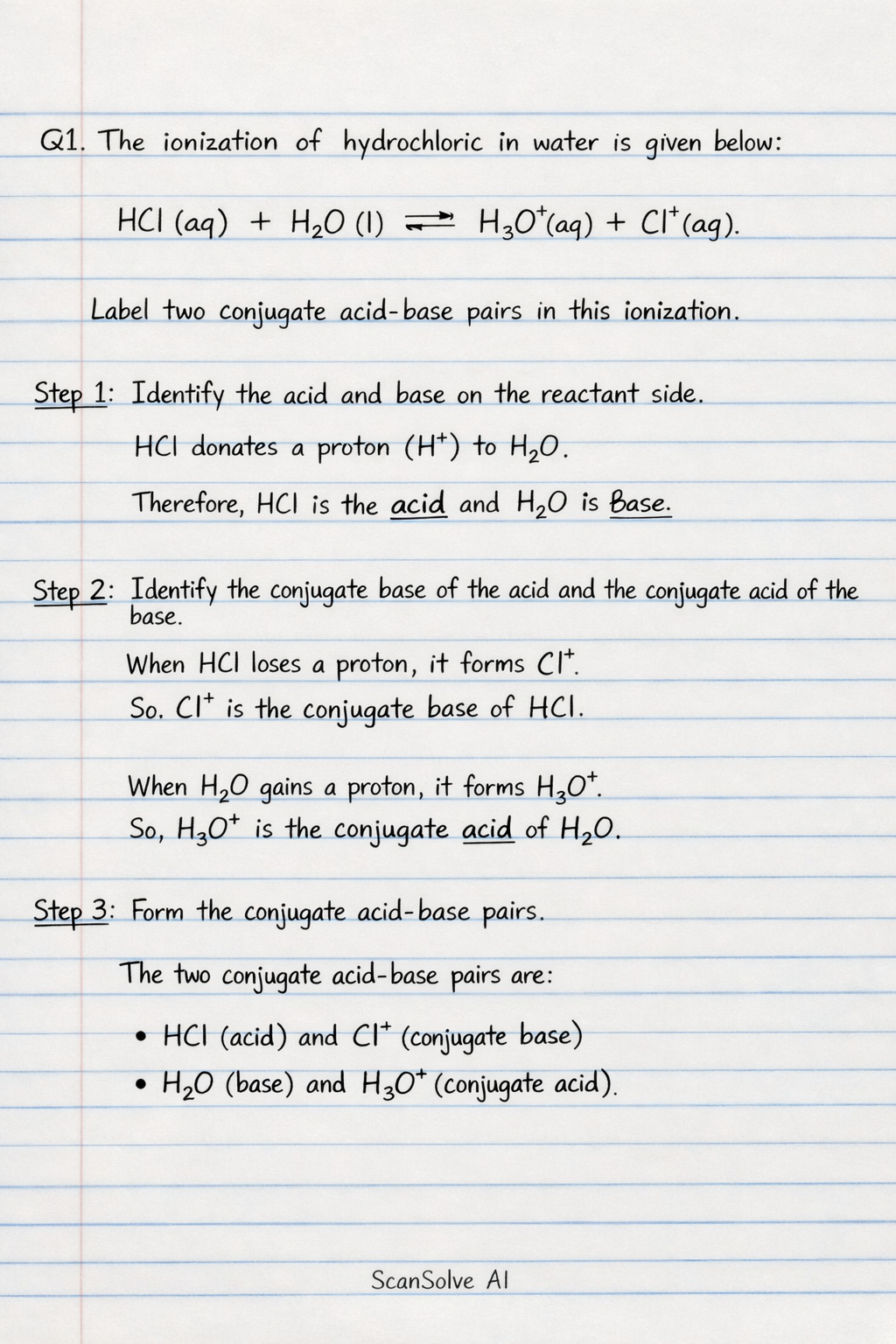
The ionization of hydrochloric in water is given below: HCl(aq) + H2O (l) <=> H3O+(aq) + Cl-(aq). Label two conjugate acid-base pairs in this ionization.
ScanSolve AI Answer
Step-by-step solution
3 stepsQ1. The ionisation of hydrochloric in water is given below:
Label two conjugate acid-base pairs in this ionisation.
Identify the acid and base on the reactant side.
In the forward reaction, donates a proton () to .
Therefore, is the acid and is the base.Identify the conjugate base of the acid and the conjugate acid of the base.
When loses a proton, it forms . So, is the conjugate base of .
When gains a proton, it forms . So, is the conjugate acid of .Form the conjugate acid-base pairs.
The two conjugate acid-base pairs are:
- (acid) and (conjugate base)
- (base) and (conjugate acid)
Q2. The aqueous solution of sugar does not conduct electricity. However, when sodium chloride is added to water, it conducts electricity. How will you explain this statement on the basis of ionisation and how is it affected by the concentration of sodium chloride?
Sugar is a non-electrolyte because it is a covalent compound that dissolves in water as molecules, not ions. Since there are no free mobile ions, sugar solutions do not conduct electricity.
Sodium chloride () is an ionic compound and a strong electrolyte. When dissolved in water, it undergoes dissociation into free, mobile ions ( and ). These mobile ions can carry electric charge, allowing the solution to conduct electricity.
The electrical conductivity of a sodium chloride solution is directly affected by its concentration. As the concentration of sodium chloride increases, the number of and ions per unit volume increases. More ions mean more charge carriers, which leads to a higher electrical conductivity. Conversely, decreasing the concentration reduces the number of ions and thus decreases conductivity.
Still stuck on this one?
Ask a follow-up, and the answer starts from this question.
More Chemistry Questions
Handwritten Step-by-Step Solution
Get this as a handwritten image on WhatsApp — like a tutor wrote it for you.
Try on WhatsApp