
We read your photo as:
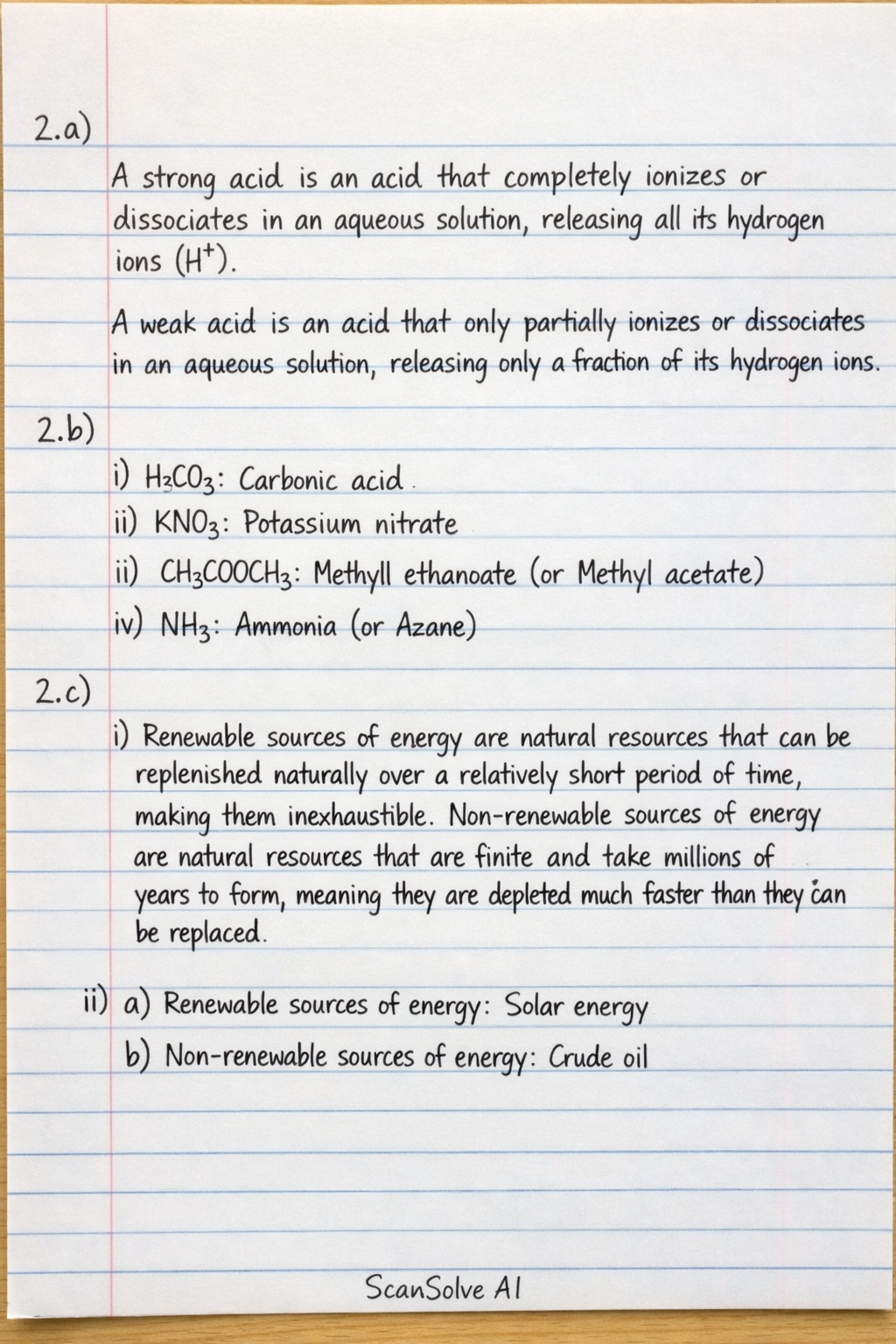
A strong acid is an acid that completely ionizes or dissociates in an aqueous solution, releasing all its hydrogen ions (H^+). A weak acid is an acid that only partially ionizes or dissociate
ScanSolve AI Answer
2.a)
A strong acid is an acid that completely ionizes or dissociates in an aqueous solution, releasing all its hydrogen ions (). A weak acid is an acid that only partially ionizes or dissociates in an aqueous solution, releasing only a fraction of its hydrogen ions.
2.b)
i) H₂CO₃: Carbonic acid
ii) KNO₃: Potassium nitrate
iii) CH₃COOCH₃: Methyl ethanoate (or Methyl acetate)
iv) NH₃: Ammonia (or Azane)
2.c)
i) Renewable sources of energy are natural resources that can be replenished naturally over a relatively short period of time, making them inexhaustible. Non-renewable sources of energy are natural resources that are finite and take millions of years to form, meaning they are depleted much faster than they can be replaced.
ii)
α) Renewable sources of energy: Solar energy
β) Non-renewable sources of energy: Crude oil
3.a)
i) The tip of needles are made pointed to increase the pressure exerted on a small area. Pressure is defined as force per unit area (). By having a very small tip area, even a small force can generate enough pressure to pierce skin or fabric easily.
ii) The wheels of earth-moving machines are made broad to decrease the pressure exerted on the ground. By having a large surface area, the weight of the heavy machine is distributed over a wider area, reducing the pressure and preventing the machine from sinking into soft ground.
3.b)
i) A base is a substance that can accept a proton () or donate an electron pair. An alkali is a soluble base that dissolves in water to produce hydroxide ions (). All alkalis are bases, but not all bases are alkalis.
ii)
α) Ammonia: Decomposition of organic matter (e.g., urea in urine)
β) Potassium hydroxide: Wood ash (historically, or electrolysis of potassium chloride solution)
γ) Calcium oxide: Limestone (calcium carbonate, which is heated to produce calcium oxide)
Still stuck on this one?
Ask a follow-up, and the answer starts from this question.
More Chemistry Questions
Handwritten Step-by-Step Solution
Get this as a handwritten image on WhatsApp — like a tutor wrote it for you.
Try on WhatsApp