
We read your photo as:
Identify and explain the following terms: hydrolysis, Lowry-Bronsted base, conjugate base, ampholyte, diprotic acid. Also, determine the conjugate acid of HCO3-, the conjugate base of HCO3-, and the c
ScanSolve AI Answer
Step-by-step solution
5 steps7.1
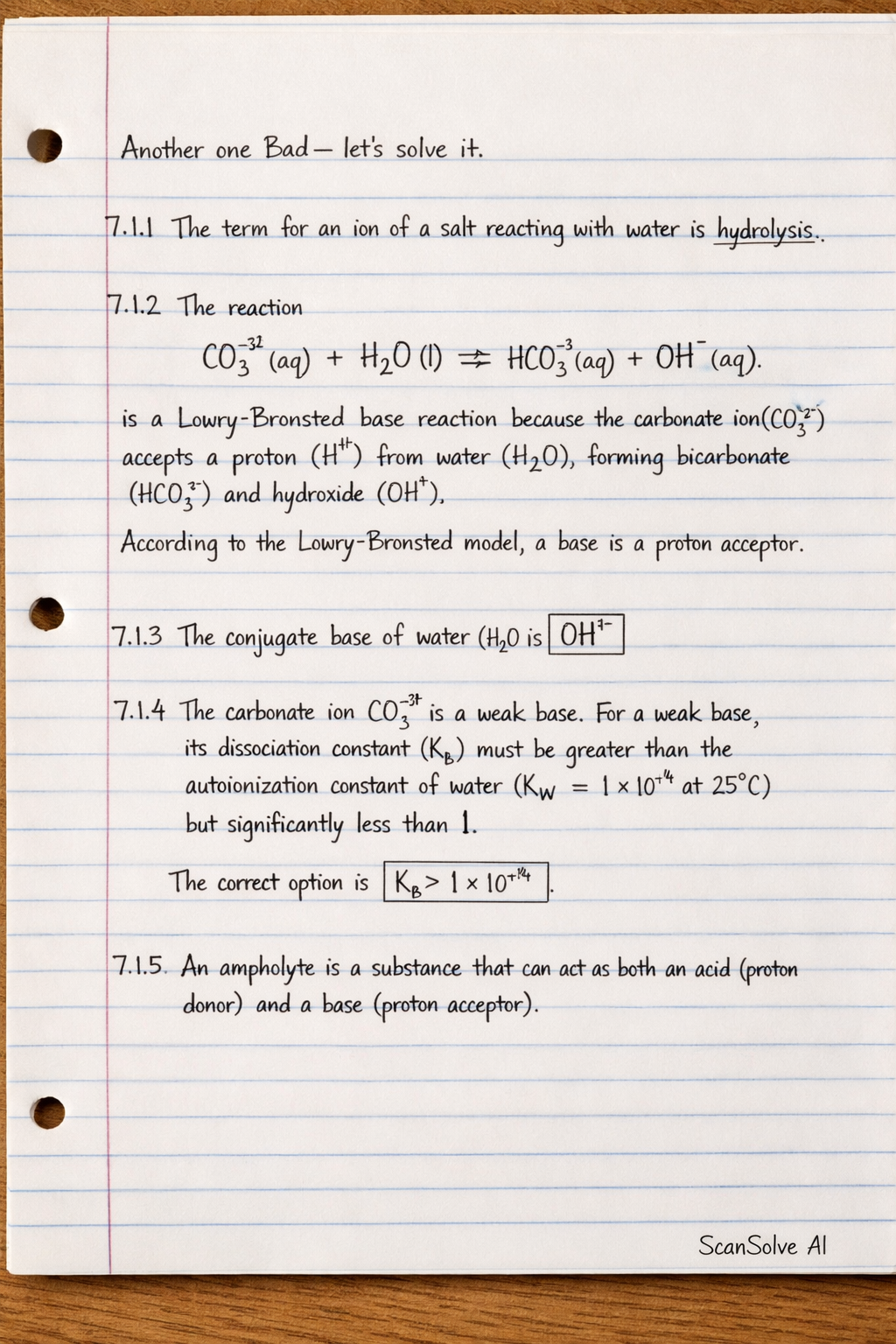
7.1.1
The term for an ion of a salt reacting with water is hydrolysis.
7.1.2
The reaction is a Lowry-Bronsted base reaction because the carbonate ion () accepts a proton () from water (), forming bicarbonate () and hydroxide (). According to the Lowry-Bronsted model, a base is a proton acceptor.
7.1.3
The conjugate base of water () is .
7.1.4
The carbonate ion is a weak base. For a weak base, its dissociation constant () must be greater than the autoionization constant of water ( at 25 °C) but significantly less than 1.
The correct option is .
7.1.5
An ampholyte is a substance that can act as both an acid (proton donor) and a base (proton acceptor).
7.1.6
The conjugate acid of the hydrogen carbonate ion () is .
7.1.7
The conjugate base of the hydrogen carbonate ion () is .
7.2
7.2.1
A diprotic acid is an acid that can donate two protons ( ions) per molecule in an aqueous solution.
7.2.2
Calculate the hydrogen ion concentration from the given pH.
The pH is given as 1.3.
Calculate the hydroxide ion concentration using the ion product of water ().
At 25 °C, .
The concentration of the hydroxide ions is .
7.3
7.3.1
Calculate the initial concentration of the diprotic acid.
Since the acid is strong and diprotic, it fully dissociates, releasing two ions per molecule.
From 7.2.2, .
Calculate the concentration of the dilute acid after dilution.
The initial volume of acid is .
The final volume of the diluted solution is .
Using the dilution formula :Calculate the concentration of the sodium hydroxide solution using titration data.
The volume of dilute acid used is .
The volume of sodium hydroxide used is .
The ratio of BASE : ACID is . This means and in the stoichiometry.
Using the titration formula:The concentration of the sodium hydroxide solution is .
7.3.2
Indicator B must be used in the titration.
The titration involves a strong diprotic acid and a strong base (sodium hydroxide). The equivalence point for a strong acid-strong base titration occurs at a pH of approximately 7. Indicator B has a pH range of 6.8-7.4, which effectively covers the equivalence point of this titration.
Still stuck on this one?
Ask a follow-up, and the answer starts from this question.
More Chemistry Questions
Handwritten Step-by-Step Solution
Get this as a handwritten image on WhatsApp — like a tutor wrote it for you.
Try on WhatsApp