
We read your photo as:
A) Isotopes are atoms of the same element that have the same number of protons (atomic number) but different numbers of neutrons (mass number). From the given data, the atomic number for element
Chemistry
ScanSolve AI Answer
Answer
63.54
Step-by-step solution
6 steps- a) Isotopes are atoms of the same element that have the same number of protons (atomic number) but different numbers of neutrons (mass number). From the given data, the atomic number for element K is 6. The isotopes of element K are:
b) To calculate the relative atomic mass of element A, we use the formula:
\text{Relative Atomic Mass} = \sum (\text{Isotope mass} \times \frac{\text{% abundance}}{100})Substitute the values for isotope A1.
Substitute the values for isotope A2.
Add the contributions to find the relative atomic mass.
Rounding to two decimal places:
- Step 1: Calculate the mass of carbon in 4.2 g of carbon (IV) oxide (). Molar mass of C = 12.0 g/mol Molar mass of
Calculate the mass of hydrogen in 1.71 g of water ().
Molar mass of H = 1.0 g/mol
Molar mass ofCalculate the moles of carbon and hydrogen.
Determine the simplest whole-number ratio of moles.
Divide by the smallest number of moles (0.09545 mol).
For C:
For H:
The ratio of C:H is approximately 1:2.
The empirical formula of the hydrocarbon is .- i) To obtain pure water from a mixture of water and common salt, the best method is distillation.
Was this helpful?
Try one yourself
A new problem that tests the same skill.
Still stuck on this one?
Ask a follow-up, and the answer starts from this question.
Got a different question?Ask your own question
More Chemistry Questions
QA) Isotopes are atoms of the same element that have the same number of protons (atomic number) but…QA) Define: i) Atomic number ii) Mass number. b) Calculate the relative atomic mass of element X. c)…QA) Define: i) Atomic number ii) Mass number b) Calculate the relative atomic mass of element X given…QA) Explain which of the above are isotopes of Neon. b) A student states "If two atoms have different…QDefine atomic number and isotopes. Determine if two given atomic notations represent isotopes…
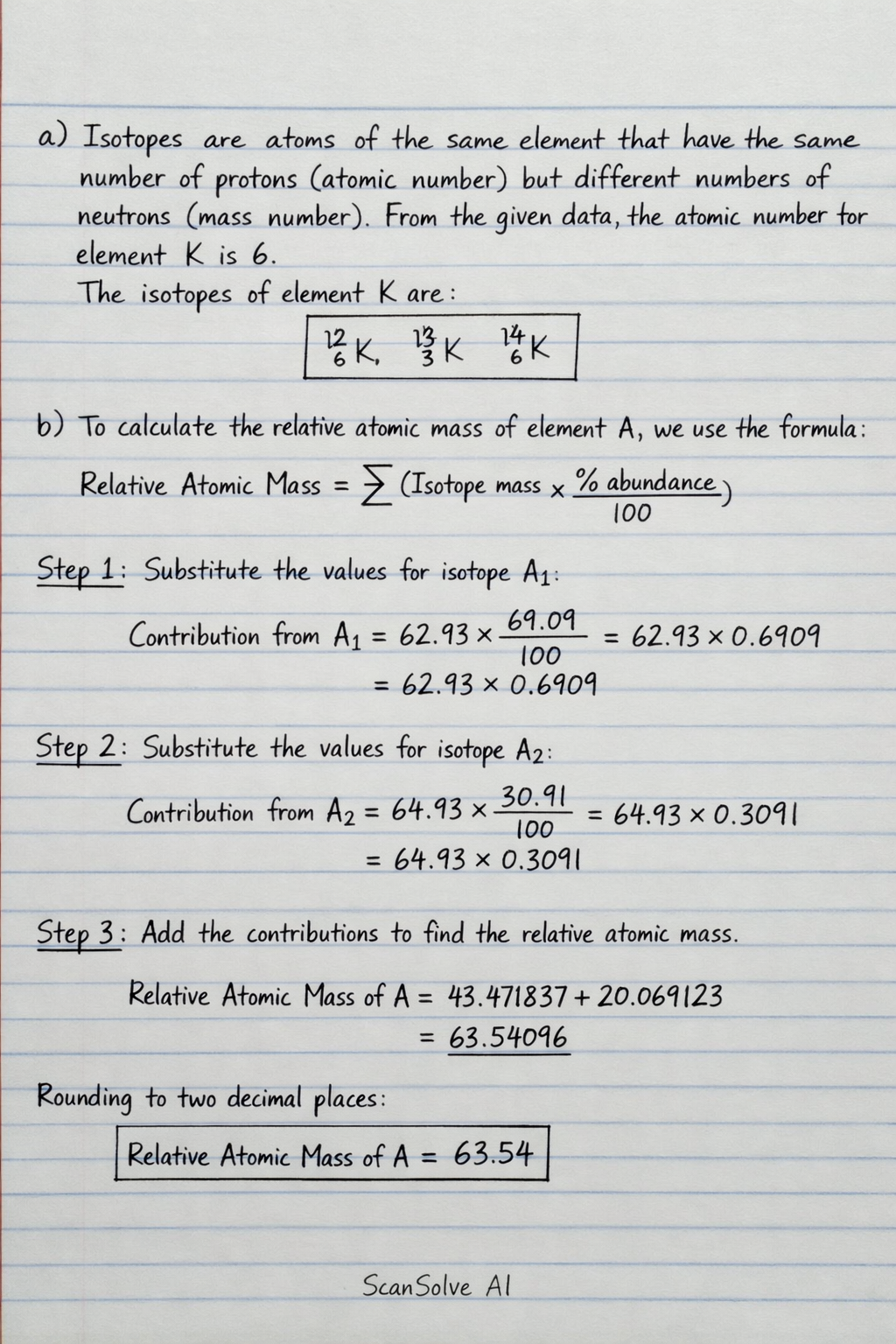
Handwritten Step-by-Step Solution
Get this as a handwritten image on WhatsApp — like a tutor wrote it for you.
Try on WhatsApp