
We read your photo as:
A 3.44 g sample of an oxide of nitrogen contains 30.45% nitrogen by mass. What is its empirical formula? If the molar mass of the oxide is 90 ± 5 g/mol, what is its molecular formula?
Chemistry
ScanSolve AI Answer
Answers
2 partsStep-by-step solution
6 stepsHere's how to solve .44:
Part a· 3 steps
Assume a 100 g sample of the oxide.
The mass of nitrogen (N) is 30.45 g.
The mass of oxygen (O) is .Convert the mass of each element to moles using their molar masses (N = 14.01 g/mol, O = 16.00 g/mol).
Divide each mole value by the smallest number of moles to find the simplest whole-number ratio.
The empirical formula is .
Part b
Calculate the empirical formula mass (EFM) for .
Determine the integer by dividing the given molar mass by the empirical formula mass.
We'll use 90 g/mol for the molar mass, noting the g/mol range.
This value is very close to 2. If we use a molar mass of 92 g/mol (which is within the g/mol range), . So, .
Multiply the subscripts in the empirical formula by to get the molecular formula.
Was this helpful?
Still stuck on this one?
Ask a follow-up, and the answer starts from this question.
Got a different question?Ask your own question
More Chemistry Questions
QThe mass of oxygen in a 20.0 g sample of sodium oxide is 8.2 g. Determine the empirical and…QUse the results to find the percentage mass of Magnesium & Oxygen in Magnesium oxide. Determine the…QGiven 30.45 mass % N, the remaining percentage is oxygen.QGiven molar mass (M) = 74 g⁻¹ and percentage of oxygen by mass = 43.24\%.QWhen 56.6 g of calcium and 30.5 g of nitrogen gas undergo a reaction that has a 93.0% yield, what…
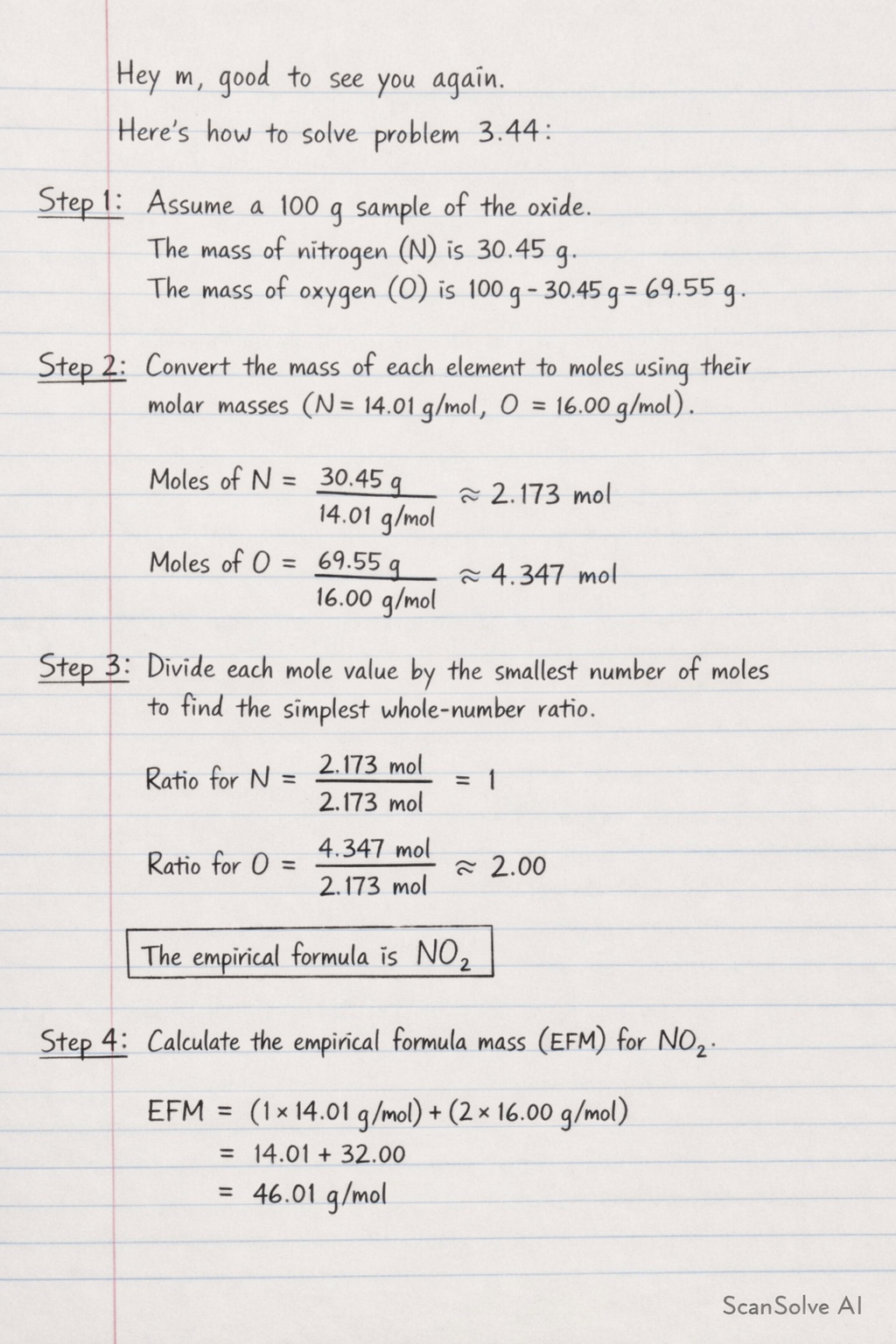
Handwritten Step-by-Step Solution
Get this as a handwritten image on WhatsApp — like a tutor wrote it for you.
Try on WhatsApp