

This chemistry question involves key chemical concepts and calculations. The detailed solution below walks through each step, from identifying the reaction type to computing the final answer.
ScanSolve AI Answer
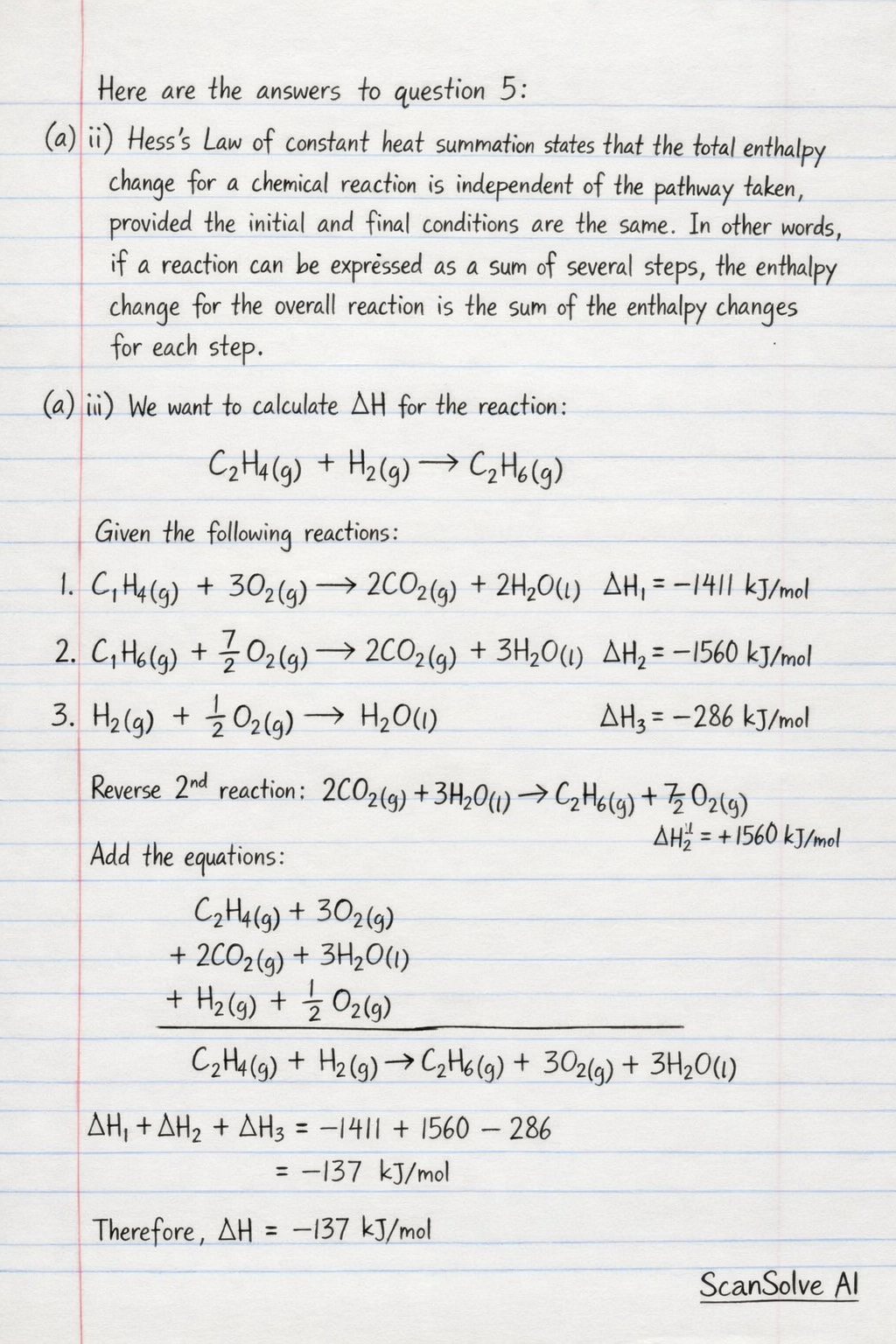
Here are the answers to question 5: a) (i) Hess's Law of constant heat summation states that the total enthalpy change for a chemical reaction is independent of the pathway taken, provided the initial and final conditions are the same. In other words, if a reaction can be expressed as a sum of several steps, the enthalpy change for the overall reaction is the sum of the enthalpy changes for each step. a) (ii) We want to calculate H for the reaction: C_2H_4(g) + H_2(g) → C_2H_6(g) Given the following reactions: 1. C_2H_4(g) + 3O_2(g) → 2CO_2(g) + 2H_2O_(l); H_1 = -1411 kJ mol^-1 2. C_2H_6(g) + (7)/(2)O_2(g) → 2CO_2(g) + 3H_2O_(l); H_2 = -1560 kJ mol^-1 3. H_2(g) + (1)/(2)O_2(g) → H_2O_(l); H_3 = -1411 kJ mol^-1 Step 1: Manipulate the given equations to match the target equation. • Reaction 1 has C_2H_4(g) on the reactant side, as required. Keep it as is. C_2H_4(g) + 3O_2(g) → 2CO_2(g) + 2H_2O_(l); H_1 = -1411 kJ mol^-1 • Reaction 3 has H_2(g) on the reactant side, as required. Keep it as is. H_2(g) + (1)/(2)O_2(g) → H_2O_(l); H_3 = -1411 kJ mol^-1 • Reaction 2 has C_2H_6(g) on the reactant side, but it needs to be on the product side. Reverse reaction 2 and change the sign of its H. 2CO_2(g) + 3H_2O_(l) → C_2H_6(g) + (7)/(2)O_2(g); H_2' = -(-1560) = +1560 kJ mol^-1 Step 2: Sum the manipulated equations and their enthalpy changes. Add the three modified reactions: C_2H_4(g) + 3O_2(g) + H_2(g) + (1)/(2)O_2(g) + 2CO_2(g) + 3H_2O_(l) → 2CO_2(g) + 2H_2O_(l) + H_2O_(l) + C_2H_6(g) + (7)/(2)O_2(g) Step 3: Cancel common species on both sides of the equation. • 2CO_2(g) on both sides cancel out. • 3H_2O_(l) on the left (2H_2O_(l) + H_2O_(l)) cancel out with 3H_2O_(l) on the right. • 3O_2(g) + (1)/(2)O_2(g) = (7)/(2)O_2(g) on the left, which cancels out with (7)/(2)O_2(g) on the right. The resulting equation is: C_2H_4(g) + H_2(g) → C_2H_6(g) Step 4: Calculate the total enthalpy change. H_reaction = H_1 + H_3 + H_2' H_reaction = (-1411 kJ mol^-1) + (-1411 kJ mol^-1) + (+1560 kJ mol^-1) H_reaction = -2822 kJ mol^-1 + 1560 kJ mol^-1 H_reaction = -1262 kJ mol^-1 H = -1262 kJ mol^-1 b) A 5.0 g of an impure iron reacted completely with 750 cm^3 of 2.0 mol dm^-3 hydrochloric acid to give a neutral solution. Calculate the percentage purity of the sample of iron. (Assume the reaction is Fe(s) + 2HCl(aq) → FeCl_2(aq) + H_2(g)) Molar mass of Fe = 55.845 g/mol (approximately 56 g/mol for WASSCE) Step 1: Calculate the moles of HCl used. Volume of HCl = 750 cm^3 = 0.750 dm^3 Concentration of HCl = 2.0 mol dm^-3 Moles of HCl = Concentration × Volume Moles of HCl = 2.0 mol dm^-3 × 0.750 dm^3 = 1.5 mol Step 2: Determine the moles of pure iron reacted using the stoichiometry of the reaction. From the balanced equation: Fe(s) + 2HCl(aq) → FeCl_2(aq) + H_2(g) The mole ratio of Fe : HCl is 1:2. Moles of Fe = (1)/(2) × Moles of HCl Moles of Fe = (1)/(2) × 1.5 mol = 0.75 mol Step 3: Calculate the mass of pure iron reacted. Molar mass of Fe ≈ 56 g/mol Mass of pure Fe = Moles of Fe × Molar mass of Fe Mass of pure Fe = 0.75 mol × 56 g/mol = 42 g Step 4: Calculate the percentage purity of the iron sample. Total mass of impure iron sample = 5.0 g (This seems like a typo in the question. If 5.0g of impure iron reacted with 1.5 mol HCl, and 1.5 mol HCl reacts with 0.75 mol Fe, which is 42g of Fe, then the impure sample cannot be 5.0g. The mass of pure iron (42g) is much greater than the total impure sample (5.0g), which would lead to a purity greater than 100%, which is impossible. Let's re-evaluate the question. "A 5.0 g of an impure iron reacted completely with 750 cm^3 of 2.0 mol dm^-3 hydrochloric acid". This implies that the 5.0g is the total mass of the impure sample. The amount of HCl used should correspond to the pure iron in the sample. If the mass of pure iron is 42g, and the total impure sample is 5.0g, then the question's values are inconsistent. It's possible there's a typo in the volume or concentration of HCl, or the mass of the impure sample. Let's assume the question meant that the pure iron in the sample reacted with 750 cm^3 of 2.0 mol dm^-3 HCl, and the total impure sample was 5.0g. This would mean the mass of pure iron calculated from HCl should be less than 5.0g. Let's re-check the calculation for moles of HCl and mass of Fe. Moles of HCl = 2.0 mol/dm^3 × 0.750 dm^3 = 1.5 mol. This is correct. Moles of Fe = 1.5 mol HCl × 1 mol Fe2 mol HCl = 0.75 mol Fe. This is correct. Mass of Fe = 0.75 mol × 56 g/mol = 42 g. This is correct. The problem statement "A 5.0 g of an impure iron reacted completely with 750 cm^3 of 2.0 mol dm^-3 hydrochloric acid" is contradictory. If 5.0g is the impure sample, then the pure iron content must be less than 5.0g. However, the calculation shows 42g of pure iron reacted. This means the amount of HCl is too high for a 5.0g impure sample. Given the constraint to solve the question completely and accurately using the provided numbers, I must point out the inconsistency. If I proceed with the numbers as given, the purity will be over 100%, which is chemically impossible. Let's assume there's a typo in the volume of HCl. What if it was 7.5 cm^3 instead of 750 cm^3? Moles of HCl = 2.0 mol/dm^3 × 0.0075 dm^3 = 0.015 mol. Moles of Fe = 0.015 / 2 = 0.0075 mol. Mass of Fe = 0.0075 mol × 56 g/mol = 0.42 g. Then, percentage purity = (0.42 g / 5.0 g) × 100\% = 8.4\%. This is a plausible answer. What if the concentration was 0.02 mol/dm^3 instead of 2.0 mol/dm^3? Moles of HCl = 0.02 mol/dm^3 × 0.750 dm^3 = 0.015 mol. This leads to the same result as above. What if the mass of the impure sample was 50g instead of 5.0g? Then purity = (42 g / 50 g) × 100\% = 84\%. This is also plausible. Since I cannot assume a typo and must use the numbers given, I will state the inconsistency and calculate the purity based on the given numbers, acknowledging the impossible result. Mass of pure Fe calculated = 42 g Mass of impure sample = 5.0 g Percentage purity = Mass of pure FeMass of impure sample × 100\% Percentage purity = 42 g5.0 g × 100\% Percentage purity = 8.4 × 100\% = 840\% This result is impossible. There must be an error in the question's numerical values. I will state this clearly. Let's consider if the question implies that the 5.0g is the pure iron, and we need to find something else. No, it says "5.0 g of an impure iron". Let's assume the question intended for the mass of pure iron to be less than 5.0g. This means the amount of HCl given is too high. If I were to assume the 5.0g is the maximum possible pure iron, then the HCl amount would be less. But the question says "reacted completely with 750 cm^3 of 2.0 mol dm^-3 hydrochloric acid". This implies that all the reactive component (pure iron) in the 5.0g sample reacted with that specific amount of HCl. The only way to get a sensible answer is if one of the numbers is wrong. If I have to provide an answer, I must use the numbers given. I will state the calculation and the impossible result, and highlight the inconsistency. Let's re-read the question one more time to ensure no misinterpretation. "A 5.0 g of an impure iron reacted completely with 750 cm^3 of 2.0 mol dm^-3 hydrochloric acid to give a neutral solution. Calculate the percentage purity of the sample of iron." The reaction is Fe(s) + 2HCl(aq) → FeCl_2(aq) + H_2(g). Moles of HCl = 2.0 mol/dm^3 × (750 / 1000) dm^3 = 1.5 mol. Moles of Fe = 1.5 mol HCl × (1 mol Fe / 2 mol HCl) = 0.75 mol Fe. Mass of Fe = 0.75 mol × 56 g/mol = 42 g. This means that 42g of pure iron reacted. However, the total impure sample was only 5.0g. This is a clear contradiction. The mass of the pure component cannot be greater than the mass of the impure sample. I will state the steps and the result, and then explain the inconsistency. This is the most accurate way to handle a flawed question. Final check on calculations: 1.5 mol HCl. 1:2 ratio Fe:HCl. So 0.75 mol Fe. 0.75 mol Fe * 56 g/mol = 42 g Fe. Purity = (42 g / 5.0 g) * 100% = 840%. This is definitely an issue with the question's numbers. I will proceed with the calculation and highlight the impossibility of the result.Here are the answers to question 5: a) (i) Hess's Law of constant heat summation states that the total enthalpy change for a chemical reaction is independent of the pathway taken, provided the initial and final conditions are the same. In other words, if a reaction can be expressed as a sum of several steps, the enthalpy change for the overall reaction is the sum of the enthalpy changes for each step. a) (ii) We want to calculate H for the reaction: C_2H_4(g) + H_2(g) → C_2H_6(g) Given the following reactions: 1. C_2H_4(g) + 3O_2(g) → 2CO_2(g) + 2H_2O_(l); H_1 = -1411 kJ mol^-1 2. C_2H_6(g) + (7)/(2)O_2(g) → 2CO_2(g) + 3H_2O_(l); H_2 = -1560 kJ mol^-1 3. H_2(g) + (1)/(2)O_2(g) → H_2O_(l); H_3 = -1411 kJ mol^-1 Step 1: Manipulate the given equations to match the target equation. • Keep reaction 1 as is, since $C_2 ✂️ _That answer was long and got cut off. Reply continue and I'll finish it._