

This chemistry question involves key chemical concepts and calculations. The detailed solution below walks through each step, from identifying the reaction type to computing the final answer.
ScanSolve AI Answer
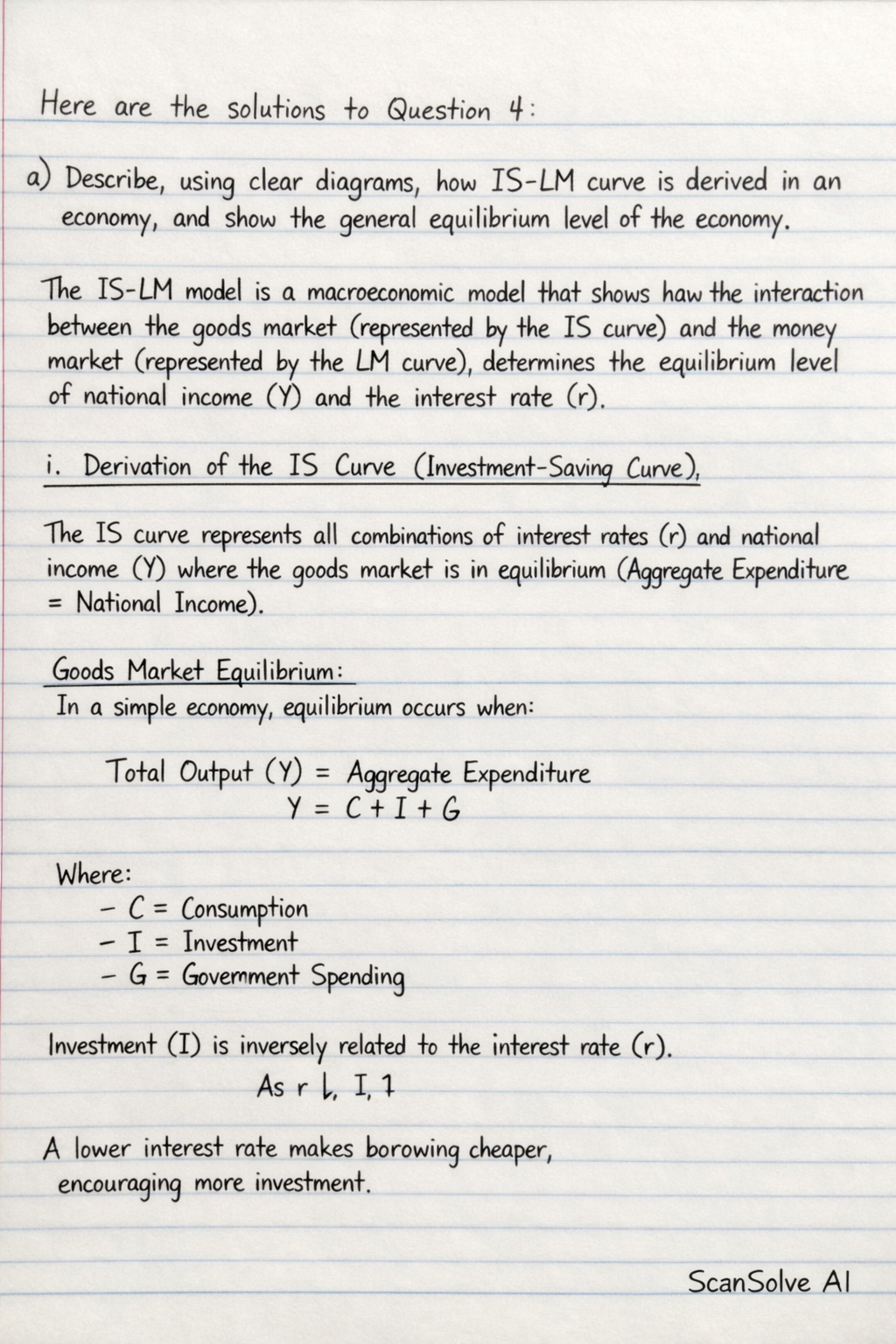
Here are the solutions to Question 4: a) Describe, using clear diagrams, how IS-LM curve is derived in an economy, and show the general equilibrium level of the economy The IS-LM model is a macroeconomic model that shows how the interaction between the goods market (represented by the IS curve) and the money market (represented by the LM curve) determines the equilibrium level of national income (Y) and the interest rate (r). i. Derivation of the IS Curve (Investment-Saving Curve) The IS curve represents all combinations of interest rates (r) and national income (Y) where the goods market is in equilibrium (Aggregate Expenditure = National Income). Goods Market Equilibrium: In a simple economy, equilibrium occurs when total output (Y) equals aggregate expenditure (AE = C + I + G). Investment (I) is inversely related to the interest rate (r). A lower interest rate makes borrowing cheaper, encouraging more investment. Diagram 1: Goods Market (Keynesian Cross) The vertical axis represents Aggregate Expenditure (AE). The horizontal axis represents National Income (Y). There is a 45-degree line where AE = Y. The AE curve (AE = C(Y) + I(r) + G) is upward-sloping. Scenario 1:* At a higher interest rate (r_1), investment is lower, leading to an AE_1 curve. The equilibrium income is Y_1. Scenario 2:* At a lower interest rate (r_2 < r_1), investment is higher, shifting the AE curve upwards to AE_2. The new equilibrium income is Y_2 > Y_1. Diagram 2: IS Curve The vertical axis represents the Interest Rate (r). The horizontal axis represents National Income (Y). Plot the points derived from Diagram 1: (Y_1, r_1) and (Y_2, r_2). Connecting these points yields the downward-sloping IS curve. This shows that a lower interest rate leads to higher investment, which in turn leads to a higher equilibrium income in the goods market. ii. Derivation of the LM Curve (Liquidity Preference-Money Supply Curve) The LM curve represents all combinations of interest rates (r) and national income (Y) where the money market is in equilibrium (Money Supply = Money Demand). Money Market Equilibrium: Equilibrium occurs when the supply of money (M_S) equals the demand for money (M_D). Money demand has two main components: transaction/precautionary demand (L_T), which is positively related to income (Y), and speculative demand (L_S), which is inversely related to the interest rate (r). Money supply is typically assumed to be exogenously determined by the central bank. Diagram 3: Money Market The vertical axis represents the Interest Rate (r). The horizontal axis represents the Quantity of Money (M). The Money Supply (M_S) is a vertical line (fixed by the central bank). The Money Demand (M_D = L_T(Y) + L_S(r)) curve is downward-sloping. Scenario 1:* At a lower income level (Y_1), transaction demand for money is lower, leading to an M_D1 curve. The equilibrium interest rate is r_1. Scenario 2:* At a higher income level (Y_2 > Y_1), transaction demand for money is higher, shifting the M_D curve to the right to M_D2. The new equilibrium interest rate is r_2 > r_1. Diagram 4: LM Curve The vertical axis represents the Interest Rate (r). The horizontal axis represents National Income (Y). Plot the points derived from Diagram 3: (Y_1, r_1) and (Y_2, r_2). Connecting these points yields the upward-sloping LM curve. This shows that a higher income level increases money demand, which, with a fixed money supply, leads to a higher equilibrium interest rate in the money market. iii. General Equilibrium of the Economy The general equilibrium of the economy occurs at the intersection of the IS and LM curves, where both the goods market and the money market are simultaneously in equilibrium. Diagram 5: IS-LM Model The vertical axis represents the Interest Rate (r). The horizontal axis represents National Income (Y). Draw the downward-sloping IS curve and the upward-sloping LM curve. The point where the IS and LM curves intersect is the general equilibrium point (E). At this point, the equilibrium interest rate is r^ and the equilibrium national income is Y^*. This represents the unique combination of income and interest rate where aggregate demand equals aggregate supply, and money demand equals money supply. --- b) Explain and illustrate the impact of fiscal and monetary policy on the general equilibrium of a developing economy Fiscal and monetary policies are used by governments and central banks to influence the economy. Their impact on a developing economy, while similar in direction to developed economies, can be influenced by specific structural characteristics. i. Fiscal Policy Fiscal policy involves the government's use of spending (G) and taxation (T) to influence the economy. Expansionary Fiscal Policy (e.g., increase in G or decrease in T): Explanation:* An increase in government spending or a decrease in taxes directly boosts aggregate demand. This leads to an increase in equilibrium income at any given interest rate. Impact on IS-LM:* The IS curve shifts to the right. Result: The new equilibrium will be at a higher national income (Y) and a higher interest rate* (r). The higher interest rate is due to increased money demand from higher income, which, with a fixed money supply, pushes rates up (crowding out effect). Developing Economy Context:* Can be effective in stimulating growth and infrastructure development. However, developing economies often face challenges like limited tax bases, high public debt, and potential for inflation if supply cannot keep up with demand. Crowding out of private investment can also be a significant concern if financial markets are shallow. Contractionary Fiscal Policy (e.g., decrease in G or increase in T): Explanation:* A decrease in government spending or an increase in taxes reduces aggregate demand, leading to a decrease in equilibrium income at any given interest rate. Impact on IS-LM:* The IS curve shifts to the left. Result: The new equilibrium will be at a lower national income (Y) and a lower interest rate* (r). Developing Economy Context:* Often used to control inflation or reduce budget deficits. Can slow down growth and development if not carefully managed. Diagram for Fiscal Policy: Start with an initial IS-LM equilibrium (E_1 at Y_1, r_1). For expansionary policy, shift the IS curve to the right (IS to IS'). The new equilibrium (E_2) will be at a higher Y_2 and r_2. For contractionary policy, shift the IS curve to the left (IS to IS''). The new equilibrium (E_3) will be at a lower Y_3 and r_3. ii. Monetary Policy Monetary policy involves the central bank's management of the money supply (M_S) and credit conditions. Expansionary Monetary Policy (e.g., increase in M_S): Explanation:* An increase in the money supply (e.g., through lowering policy rates, open market purchases) makes more funds available for lending, reducing interest rates. This stimulates investment and consumption. Impact on IS-LM:* The LM curve shifts to the right. Result: The new equilibrium will be at a higher national income (Y) and a lower interest rate* (r). Developing Economy Context:* Can encourage investment and growth. However, its effectiveness can be limited by underdeveloped financial markets, a large informal sector, and potential for capital flight if domestic interest rates fall too much relative to international rates. Exchange rate stability can also be a concern. Contractionary Monetary Policy (e.g., decrease in M_S): Explanation:* A decrease in the money supply (e.g., through raising policy rates, open market sales) makes funds scarcer, increasing interest rates. This dampens investment and consumption. Impact on IS-LM:* The LM curve shifts to the left. Result: The new equilibrium will be at a lower national income (Y) and a higher interest rate* (r). Developing Economy Context:* Often used to combat inflation. Can slow down economic activity and make borrowing more expensive for businesses and consumers, potentially hindering development. Diagram for Monetary Policy: Start with an initial IS-LM equilibrium (E_1 at Y_1, r_1). For expansionary policy, shift the LM curve to the right (LM to LM'). The new equilibrium (E_2) will be at a higher Y_2 and lower r_2. For contractionary policy, shift the LM curve to the left (LM to LM''). The new equilibrium (E_3) will be at a lower Y_3 and higher r_3.