
We read your photo as:
A) Distinguish between a strong acid and a weak acid.
ScanSolve AI Answer
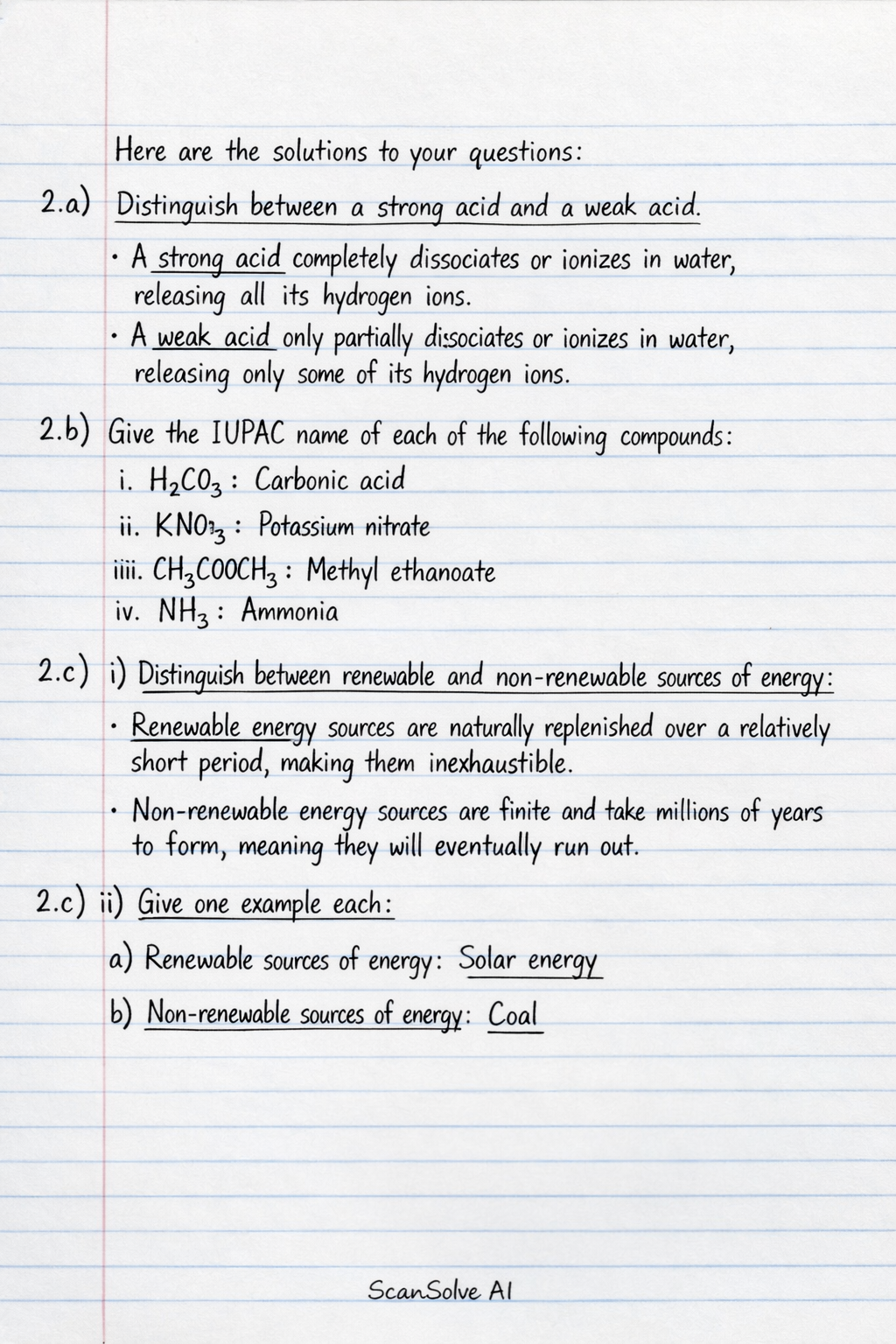
Here are the solutions to your questions:
2.a) Distinguish between a strong acid and a weak acid.
- A strong acid completely dissociates or ionizes in water, releasing all its hydrogen ions.
- A weak acid only partially dissociates or ionizes in water, releasing only some of its hydrogen ions.
2.b) Give the IUPAC name of each of the following compounds.
i. : Carbonic acid
ii. : Potassium nitrate
iii. : Methyl ethanoate
iv. : Ammonia
2.c) i) Distinguish between renewable and non-renewable sources of energy.
- Renewable energy sources are naturally replenished over a relatively short period, making them inexhaustible.
- Non-renewable energy sources are finite and take millions of years to form, meaning they will eventually run out.
2.c) ii) Give one example each.
a) Renewable sources of energy: Solar energy
b) Non-renewable sources of energy: Coal
3.a) Explain why:
i) The tip of needles are made pointed.
A pointed tip has a very small surface area. When a force is applied, this small area results in a high pressure, allowing the needle to easily penetrate materials.
ii) Wheels of earth moving machines are broad.
Broad wheels have a large surface area. This large area distributes the machine's heavy weight over a wider region, reducing the pressure exerted on the ground and preventing the machine from sinking.
3.b) i) Distinguish between a base and an alkali.
- A base is a substance that can accept protons (hydrogen ions) or donate a pair of electrons.
- An alkali is a base that is soluble in water and produces hydroxide ions () when dissolved.
3.b) ii) Name one natural source of each bases:
a) Ammonia (): Decomposition of organic matter (e.g., from bacterial action on nitrogenous waste).
b) Potassium hydroxide (): Potassium is found in minerals such as sylvite () and carnallite (). Pure is primarily an industrial product.
c) Calcium oxide (): Produced by heating calcium carbonate (limestone).
Still stuck on this one?
Ask a follow-up, and the answer starts from this question.
More Chemistry Questions
Handwritten Step-by-Step Solution
Get this as a handwritten image on WhatsApp — like a tutor wrote it for you.
Try on WhatsApp