
We read your photo as:
A) Hess's Law of Constant Heat Summation states that the total enthalpy change for a chemical reaction is the same, regardless of the pathway or number of steps taken to convert reactants to pro
ScanSolve AI Answer
a) Hess's Law of Constant Heat Summation states that the total enthalpy change for a chemical reaction is the same, regardless of the pathway or number of steps taken to convert reactants to products, as long as the initial and final conditions are the same.
b) Gay-Lussac's Law (Pressure-Temperature Law) states that for a fixed mass of gas at constant volume, the pressure of the gas is directly proportional to its absolute temperature.
-
A basic gas is ammonia (). Reagents used to prepare it in the laboratory are an ammonium salt (e.g., ammonium chloride, ) and a strong base (e.g., calcium hydroxide, ).
-
The reagent used to prepare ethyne gas () in the laboratory is calcium carbide () reacting with water ().
The balanced chemical equation is:
Still stuck on this one?
Ask a follow-up, and the answer starts from this question.
More Chemistry Questions
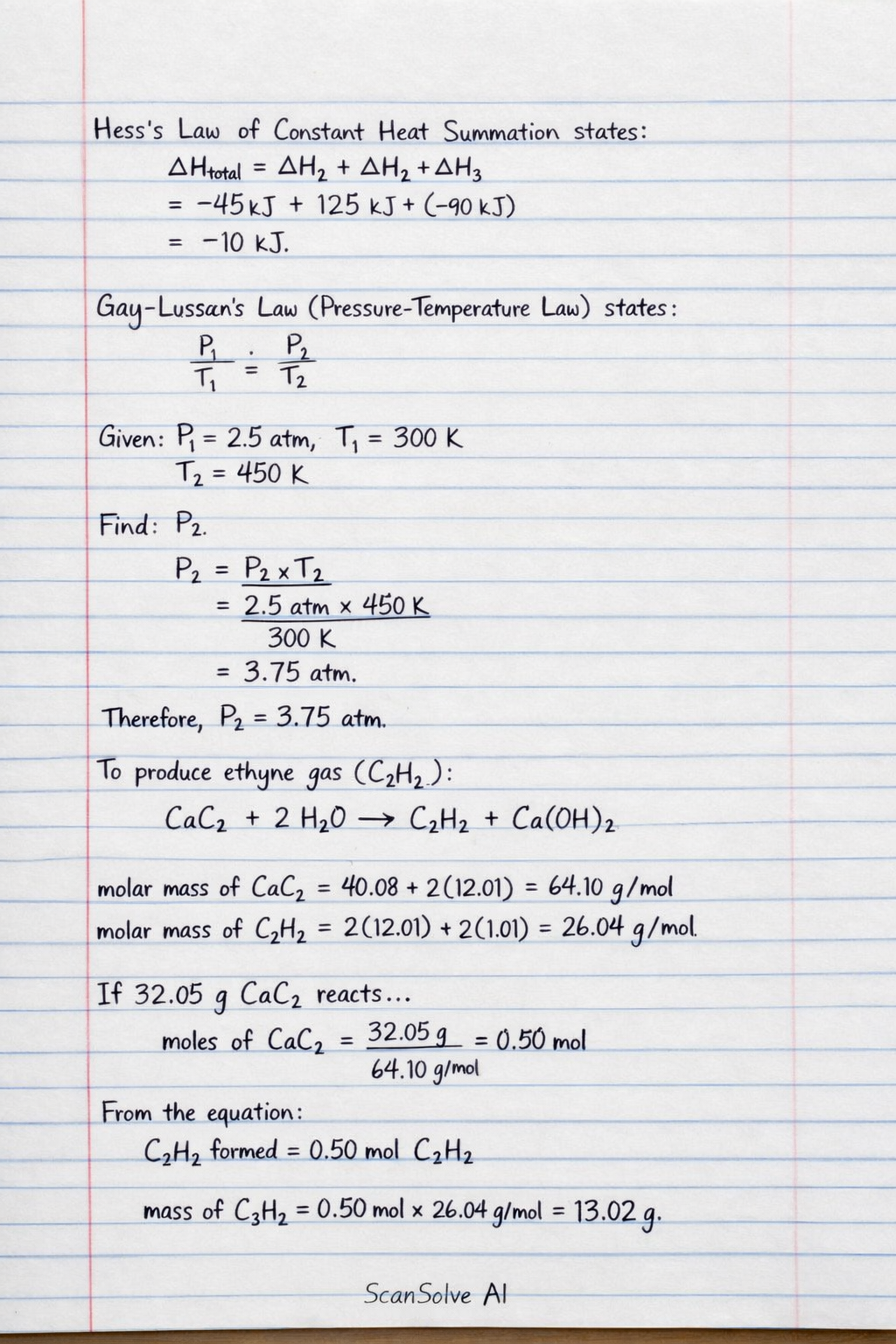
Handwritten Step-by-Step Solution
Get this as a handwritten image on WhatsApp — like a tutor wrote it for you.
Try on WhatsApp