
We read your photo as:
A) i) State three (3) differences between macro nutrients and micro nutrients as used in crop production. ii) Give one (1) example each of macro nutrient and micro nutrient. b) i) State three (3) reas
ScanSolve AI Answer
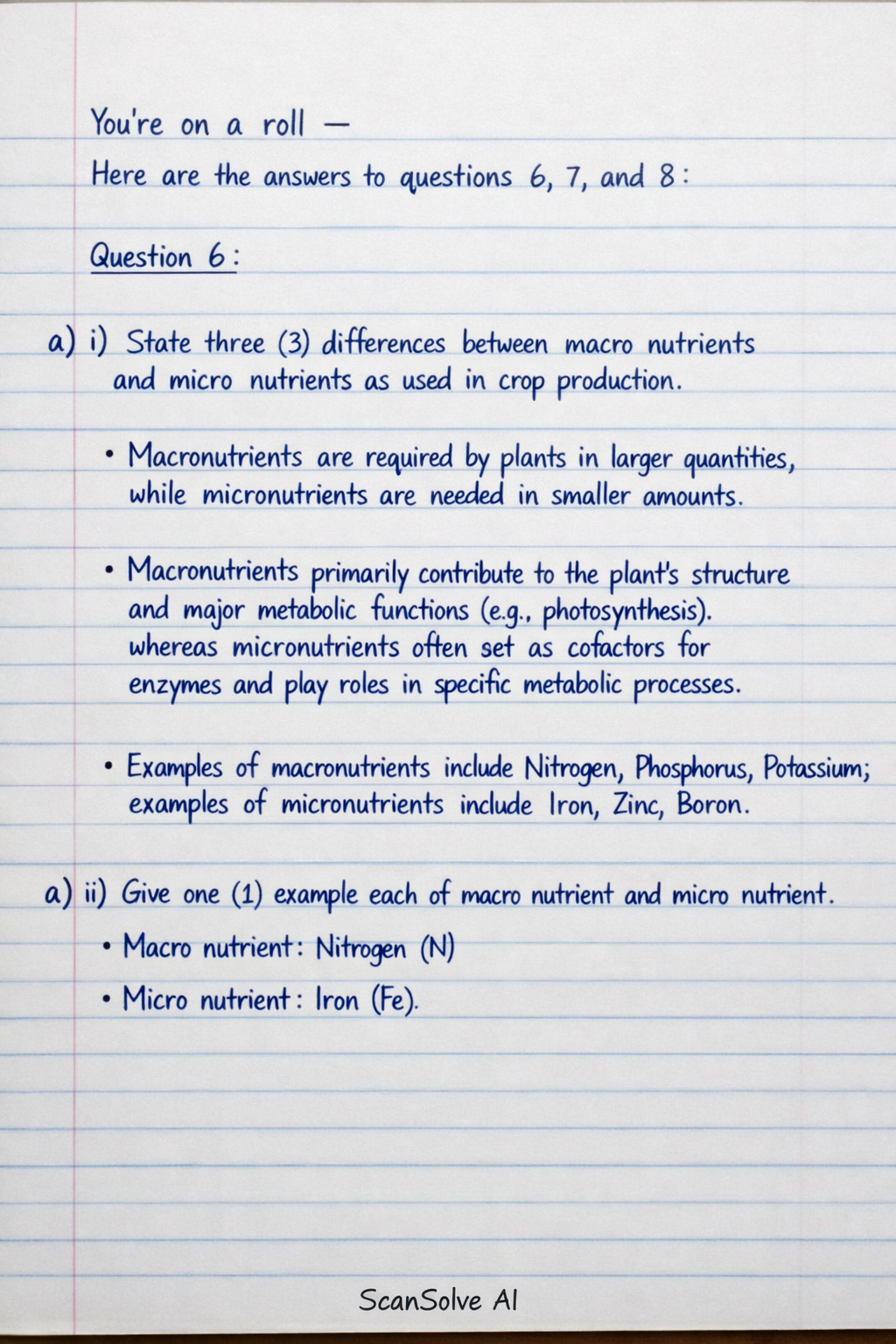
Here are the answers to questions 6, 7, and 8:
Question 6:
a) i) State three (3) differences between macro nutrients and micro nutrients as used in crop production.
- Macronutrients are required by plants in larger quantities, while micronutrients are needed in smaller amounts.
- Macronutrients primarily contribute to the plant's structure and major metabolic functions (e.g., photosynthesis), whereas micronutrients often act as cofactors for enzymes and play roles in specific metabolic processes.
- Examples of macronutrients include Nitrogen, Phosphorus, Potassium; examples of micronutrients include Iron, Zinc, Boron.
a) ii) Give one (1) example each of macro nutrient and micro nutrient.
- Macro nutrient: Nitrogen (N)
- Micro nutrient: Iron (Fe)
b) i) State three (3) reasons why alloys are preferred to pure metals.
- Alloys often have increased strength and hardness compared to pure metals.
- Alloys can have improved corrosion resistance.
- Alloys can have better electrical or thermal properties (e.g., higher resistivity or lower melting point).
b) ii) Differentiate rusting from corrosion.
- Corrosion is the general process of deterioration of a material, usually a metal, due to a chemical reaction with its environment.
- Rusting is a specific type of corrosion that applies only to iron and its alloys (like steel), where iron reacts with oxygen and water to form iron oxides (rust).
c) Explain the following terms as used in seed germination:
i) Hypogeal germination: A type of seed germination where the cotyledons remain below the soil surface, and the epicotyl elongates, pushing the plumule above ground.
ii) Epigeal germination: A type of seed germination where the hypocotyl elongates, carrying the cotyledons above the soil surface, where they may become photosynthetic.
d) Write the ionic forms of the following elements:
i) Sodium (Na): Na
ii) Calcium (Ca): Ca
iii) Aluminium (Al): Al
iv) Oxygen (O): O
v) Magnesium (Mg): Mg
Question 7:
a) State two (2) uses of each of the following:
i) Metals:
- Used in construction (e.g., steel in buildings, aluminum in aircraft).
- Used in electrical wiring (e.g., copper).
ii) Non-metals:
- Used in fertilizers (e.g., nitrogen, phosphorus).
- Used as fuels (e.g., carbon in coal, hydrogen).
b) State four (4) ways of controlling mosquitoes in the community.
- Eliminating breeding sites by draining stagnant water.
- Using insecticides or larvicides in water bodies.
- Employing biological control methods (e.g., introducing fish that eat mosquito larvae).
- Using mosquito nets and repellents.
c) Give four (4) measures that can be taken to minimize the negative impact of gold extraction on the Ghanaian environment.
- Implementing strict environmental regulations and monitoring for mining operations.
- Promoting and enforcing the use of environmentally friendly mining technologies (e.g., mercury-free gold extraction).
- Ensuring reclamation and rehabilitation of mined-out areas.
- Establishing protected areas and buffer zones around sensitive ecosystems.
d) State four (4) importance of cover cropping in crop production.
- Prevents soil erosion by protecting the soil surface from wind and rain.
- Improves soil fertility by adding organic matter and fixing nitrogen (leguminous cover crops).
- Suppresses weeds by competing for light, water, and nutrients.
- Enhances soil structure and water infiltration.
Question 8:
a) State two (2) methods of soil conservation.
- Contour plowing: Plowing across the slope of a hill to create furrows that slow down water runoff.
- Terracing: Creating level platforms on slopes to reduce erosion and retain water.
b) i) Define light energy.
- Light energy is a form of electromagnetic radiation that is visible to the human eye, consisting of photons and traveling in waves.
b) ii) Explain two (2) ways in which light energy is useful to living organisms.
- Photosynthesis: Plants and other photosynthetic organisms use light energy to convert carbon dioxide and water into glucose (food) and oxygen.
- Vision: Animals use light energy to perceive their surroundings, allowing them to navigate, find food, and avoid predators.
c) i) Define an atom.
- An atom is the smallest unit of an element that retains the chemical identity of that element, consisting of a nucleus (protons and neutrons) and electrons orbiting the nucleus.
c) ii) An atom has 11 electrons.
) Draw the electronic configuration of the atom.
The electronic configuration is 2, 8, 1.
$\beta$) Type of bond the element will form with chlorine.
The element (Sodium, Na) will form an **ionic bond** with chlorine.

$\gamma$) Give two (2) reasons for the type of chemical bond stated in ($\beta$) above.
*   The atom with 11 electrons (Sodium) has **one valence electron** which it readily loses to achieve a stable octet.
*   Chlorine has **seven valence electrons** and readily gains one electron to achieve a stable octet. The transfer of an electron creates oppositely charged ions that are attracted to each other.
d) i) Define food poisoning.
- Food poisoning is an illness caused by consuming food or drink contaminated with harmful bacteria, viruses, parasites, toxins, or chemicals.
d) ii) Explain two (2) causes of food poisoning.
- Bacterial contamination: Eating food contaminated with bacteria such as Salmonella, E. coli, or Listeria, often due to improper handling, cooking, or storage.
- Viral contamination: Consuming food contaminated with viruses like Norovirus or Hepatitis A, typically spread through infected food handlers or contaminated water.
Still stuck on this one?
Ask a follow-up, and the answer starts from this question.
More Chemistry Questions
Handwritten Step-by-Step Solution
Get this as a handwritten image on WhatsApp — like a tutor wrote it for you.
Try on WhatsApp