

This chemistry question involves key chemical concepts and calculations. The detailed solution below walks through each step, from identifying the reaction type to computing the final answer.
ScanSolve AI Answer
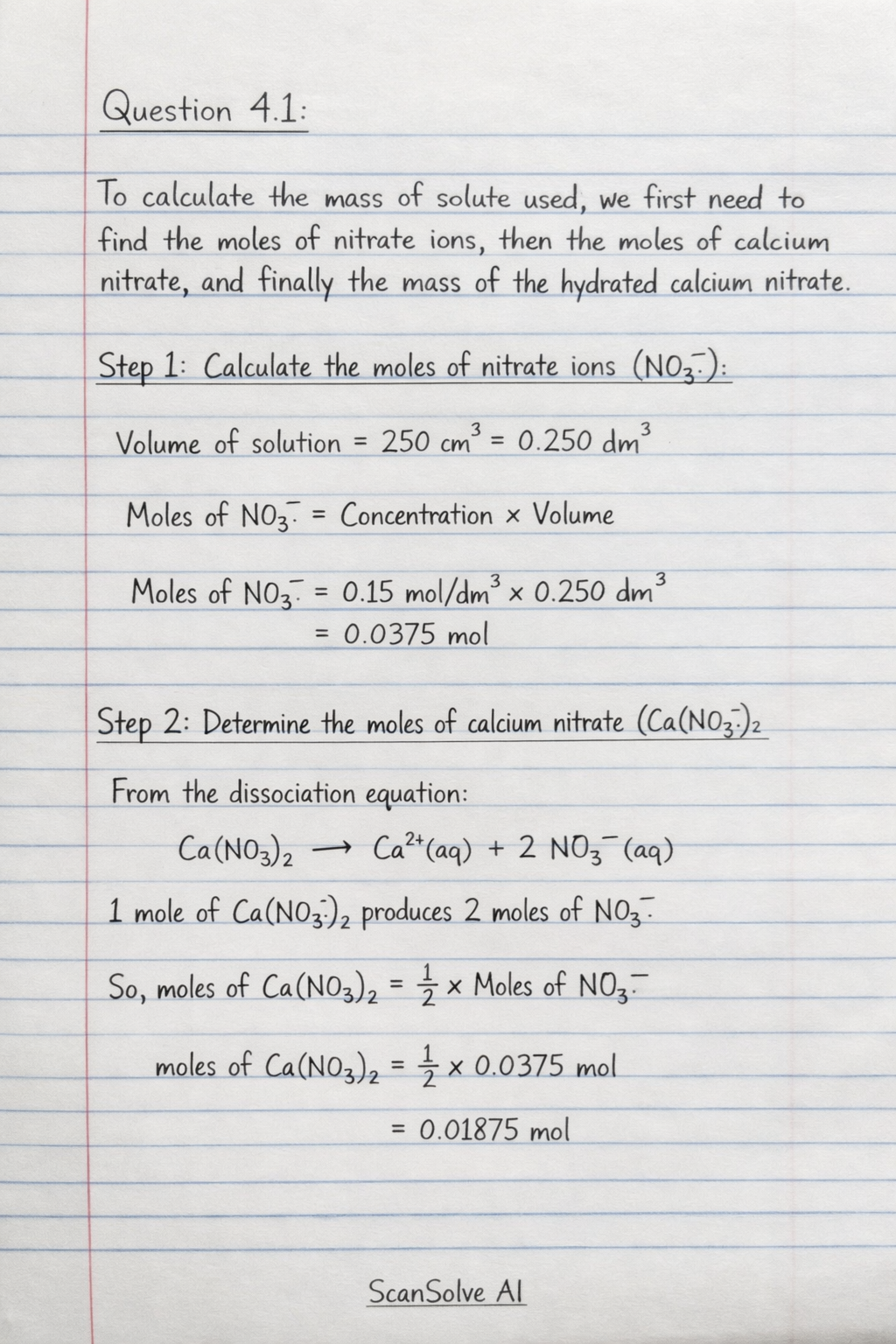
I noticed that questions 3.3 and 3.4 are incomplete as they lack necessary context or data to be solved. I will proceed with the questions that have complete information. Question 4.1: To calculate the mass of solute used, we first need to find the moles of nitrate ions, then the moles of calcium nitrate, and finally the mass of the hydrated calcium nitrate. Step 1: Calculate the moles of nitrate ions (NO_3^-). The volume of the solution is 250 cm^3 = 0.250 dm^3. Moles of NO_3^- = Concentration × Volume Moles of NO_3^- = 0.15 mol · dm^-3 × 0.250 dm^3 = 0.0375 mol Step 2: Determine the moles of calcium nitrate (Ca(NO_3)_2). From the dissociation equation Ca(NO_3)_2 → Ca^2+(aq) + 2NO_3^-(aq), we see that 1 mole of Ca(NO_3)_2 produces 2 moles of NO_3^-. So, moles of Ca(NO_3)_2 = (1)/(2) × Moles of NO_3^- Moles of Ca(NO_3)_2 = (1)/(2) × 0.0375 mol = 0.01875 mol Step 3: Calculate the molar mass of the hydrated solute, Ca(NO_3)_2 · 4H_2O. Molar mass of Ca(NO_3)_2 = 40.08 + 2 × (14.01 + 3 × 16.00) = 164.10 g/mol Molar mass of 4H_2O = 4 × (2 × 1.01 + 16.00) = 4 × 18.02 = 72.08 g/mol Molar mass of Ca(NO_3)_2 · 4H_2O = 164.10 + 72.08 = 236.18 g/mol Step 4: Calculate the mass of the solute used. Mass = Moles × Molar mass Mass of Ca(NO_3)_2 · 4H_2O = 0.01875 mol × 236.18 g/mol = 4.428375 g Rounding to three significant figures: Mass = 4.43 g Question 4.2.1: A limiting reagent is the reactant that is completely consumed in a chemical reaction, thereby determining the maximum amount of product that can be formed. Question 4.2.2: To determine the limiting reagent, we compare the mole ratio of reactants used to the stoichiometric mole ratio from the balanced equation. The balanced equation is: 2C_7H_6O_3 + C_4H_6O_3 → 2C_9H_8O_4 + H_2O Step 1: Calculate the molar masses of the reactants. Molar mass of salicylic acid (C_7H_6O_3): 7(12.01) + 6(1.01) + 3(16.00) = 84.07 + 6.06 + 48.00 = 138.13 g/mol Molar mass of acetic acid (C_4H_6O_3): 4(12.01) + 6(1.01) + 3(16.00) = 48.04 + 6.06 + 48.00 = 102.10 g/mol Step 2: Calculate the moles of each reactant. Moles of salicylic acid = 14 g138.13 g/mol = 0.10135 mol Moles of acetic acid = 10 g102.10 g/mol = 0.09794 mol Step 3: Determine the limiting reagent using the stoichiometric ratio. From the balanced equation, 2 moles of salicylic acid react with 1 mole of acetic acid. If all 0.10135 mol of salicylic acid were to react, it would require: Moles of acetic acid needed = 0.10135 mol C_7H_6O_3 × 1 mol C_4H_6O_32 mol C_7H_6O_3 = 0.050675 mol C_4H_6O_3 Since we have 0.09794 mol of acetic acid, which is more than the 0.050675 mol needed, salicylic acid is the limiting reagent. Alternatively, if all 0.09794 mol of acetic acid were to react, it would require: Moles of salicylic acid needed = 0.09794 mol C_4H_6O_3 × 2 mol C_7H_6O_31 mol C_4H_6O_3 = 0.19588 mol C_7H_6O_3 Since we only have 0.10135 mol of salicylic acid, which is less than the 0.19588 mol needed, salicylic acid is the limiting reagent. Therefore, the limiting reagent is salicylic acid (C_7H_6O_3). Question 4.2.3: To calculate the percentage yield, we first need to determine the theoretical yield of aspirin based on the limiting reagent. Step 1: Calculate the theoretical moles of aspirin (C_9H_8O_4) produced. From the balanced equation, 2 moles of salicylic acid (C_7H_6O_3) produce 2 moles of aspirin (C_9H_8O_4). Since salicylic acid is the limiting reagent (from 4.2.2), we use its moles: Moles of aspirin = 0.10135 mol C_7H_6O_3 × 2 mol C_9H_8O_42 mol C_7H_6O_3 = 0.10135 mol Step 2: Calculate the molar mass of aspirin (C_9H_8O_4). Molar mass of C_9H_8O_4 = 9(12.01) + 8(1.01) + 4(16.00) = 108.09 + 8.08 + 64.00 = 180.17 g/mol Step 3: Calculate the theoretical yield of aspirin. Theoretical yield = Moles × Molar mass Theoretical yield = 0.10135 mol × 180.17 g/mol = 18.260 g Step 4: Calculate the percentage yield. Actual mass of aspirin obtained = 11.5 g Percentage Yield = Actual YieldTheoretical Yield × 100\% Percentage Yield = 11.5 g18.260 g × 100\% Percentage Yield = 0.62979 × 100\% = 62.979\% Rounding to one decimal place: Percentage Yield = 63.0\% What's next?