
We read your photo as:
The amount of silver deposited by passing 241.25 coulombs of electricity through silver nitrate is (Molar mass of Ag=108g/mol, F=96500C/mol. For 2nd order if the concentration twice the rate. what will be the ans)?
ScanSolve AI Answer
Step-by-step solution
7 stepsHere are the solutions to your questions:
1) The amount of silver deposited by passing 241.25 coulombs of electricity through silver nitrate is
Write the half-reaction for the deposition of silver.
From the reaction, 1 mole of electrons is required to deposit 1 mole of silver.
Calculate the moles of electrons passed using Faraday's constant ().
Calculate the moles of silver deposited.
Since 1 mole of electrons deposits 1 mole of silver:
Calculate the mass of silver deposited using its molar mass ().
The amount of silver deposited is .
2) For 2nd Order if the Con, twice the rxn rate. what will be the ans:
Write the general rate law for a second-order reaction.
For a reaction that is second order with respect to a reactant A, the rate law is:
where is the rate constant and is the concentration of reactant A.
Determine the new rate when the concentration is doubled.
If the concentration of A is doubled, the new concentration is .
Compare the new rate to the original rate.
When the concentration of a reactant in a second-order reaction is doubled, the reaction rate will increase by a factor of .
The reaction rate will be four times the original rate.
Still stuck on this one?
Ask a follow-up, and the answer starts from this question.
More Chemistry Questions
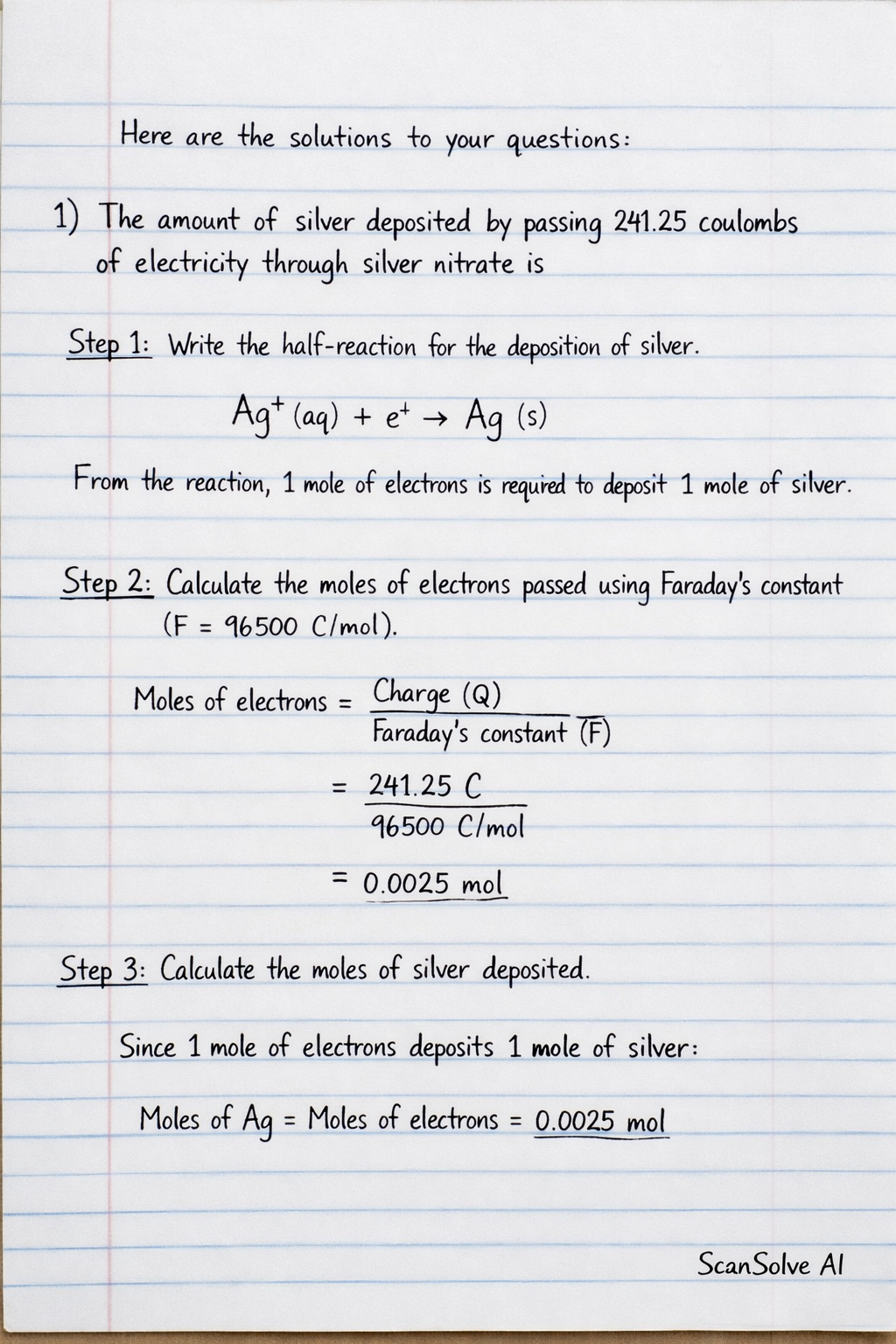
Handwritten Step-by-Step Solution
Get this as a handwritten image on WhatsApp — like a tutor wrote it for you.
Try on WhatsApp