

This chemistry question involves key chemical concepts and calculations. The detailed solution below walks through each step, from identifying the reaction type to computing the final answer.
ScanSolve AI Answer
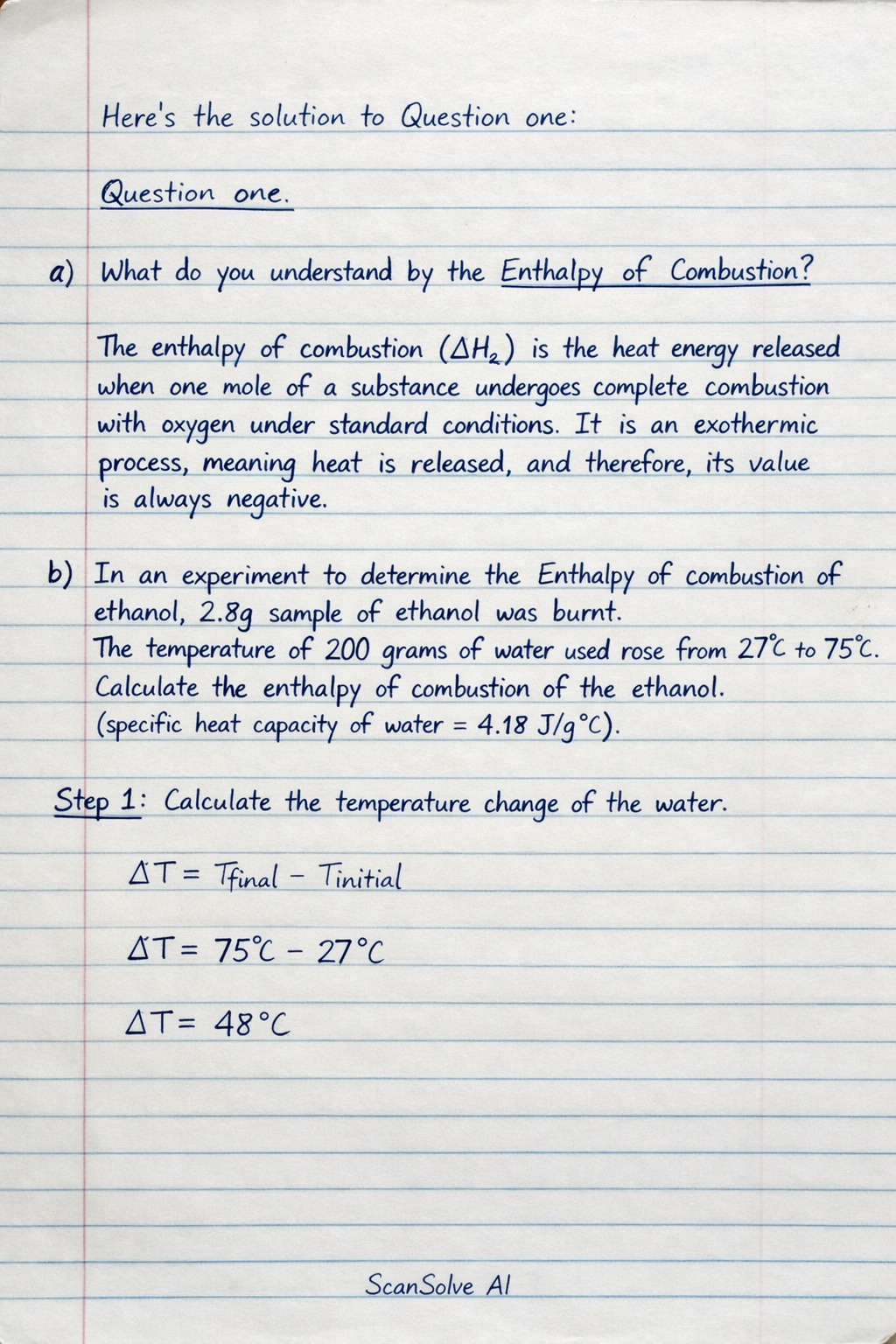
Here's the solution to Question one: Question one a) What do you understand by the Enthalpy of Combustion? The enthalpy of combustion ( H_c) is the heat energy released when one mole of a substance undergoes complete combustion with oxygen under standard conditions. It is an exothermic process, meaning heat is released, and therefore, its value is always negative. b) In an an experiment to determine the Enthalpy of combustion of ethanol, 2.8g sample of ethanol was burnt. The temperature of 200 gram: of water used rose from 27^ to 75^. Calculate the enthalpy of combustion of the ethanol. (specific heat capacity of water = 4.18 \, J/g^) Step 1: Calculate the temperature change of the water. T = T_final - T_initial T = 75^ - 27^ T = 48^ Step 2: Calculate the heat absorbed by the water. The heat absorbed by the water (q) is calculated using the formula q = mc T. q = (200 \, g) × (4.18 \, J/g^) × (48^) q = 40128 \, J Convert Joules to Kilojoules: q = 40128 \, J1000 \, J/kJ = 40.128 \, kJ Step 3: Calculate the molar mass of ethanol (C_2H_5OH). (Atomic masses: C = 12.01 g/mol, H = 1.008 g/mol, O = 16.00 g/mol) Molar mass of C_2H_5OH = (2 × 12.01) + (6 × 1.008) + (1 × 16.00) Molar mass of C_2H_5OH = 24.02 + 6.048 + 16.00 Molar mass of C_2H_5OH = 46.068 \, g/mol Step 4: Calculate the number of moles of ethanol burnt. Moles of ethanol = Mass of ethanolMolar mass of ethanol Moles of ethanol = 2.8 \, g46.068 \, g/mol Moles of ethanol ≈ 0.060777 \, mol Step 5: Calculate the enthalpy of combustion per mole of ethanol. The heat released by the combustion of ethanol is equal to the heat absorbed by the water. Since combustion is an exothermic process, the enthalpy change is negative. H_c = -(q)/(Moles of ethanol) H_c = -40.128 \, kJ0.060777 \, mol H_c ≈ -660.20 \, kJ/mol Rounding to two significant figures (due to the mass of ethanol and temperature change): H_c ≈ -660 \, kJ/mol