

This chemistry question involves key chemical concepts and calculations. The detailed solution below walks through each step, from identifying the reaction type to computing the final answer.
ScanSolve AI Answer
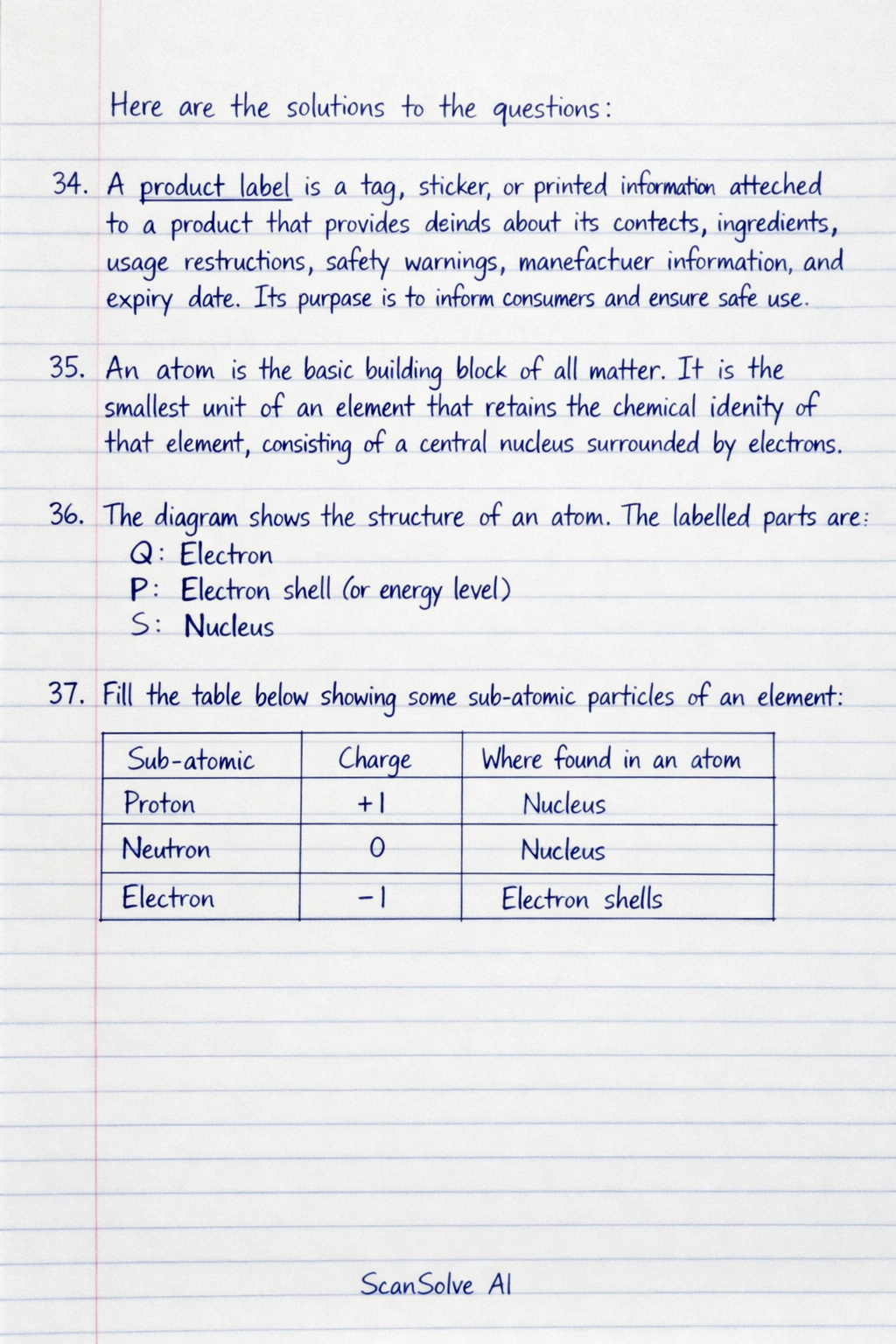
Here are the solutions to the questions: 34. A product label is a tag, sticker, or printed information attached to a product that provides details about its contents, ingredients, usage instructions, safety warnings, manufacturer information, and expiry date. Its purpose is to inform consumers and ensure safe use. 35. An atom is the basic building block of all matter. It is the smallest unit of an element that retains the chemical identity of that element, consisting of a central nucleus surrounded by electrons. 36. The diagram shows the structure of an atom. The labelled parts are: Q: Electron* P: Electron shell* (or energy level) S: Nucleus* 37. Fill the table below showing some sub-atomic particles of an element: | Sub-atomic | Charge | Where found in an atom | | :--------- | :----- | :--------------------- | | Proton | +1 | Nucleus | | Neutron | 0 | Nucleus | | Electron | -1 | Electron shells | 38. Electron arrangement (or electron configuration) refers to the distribution of electrons of an atom or molecule in atomic or molecular orbitals. It describes how electrons are organized in different energy levels or shells around the nucleus. 39. We say that an element is stable when its outermost electron shell is completely filled with electrons. For most elements, this means having eight electrons in the valence shell (the octet rule), or two electrons for the first shell (like helium). 40. An atom of an element has an electron arrangement of 2.8.2 a) To identify the element, we sum the number of electrons: 2 + 8 + 2 = 12 electrons. In a neutral atom, the number of electrons is equal to the number of protons (atomic number). The element with atomic number 12 is Magnesium (Mg). 41. The electron arrangement of calcium (Ca) is determined by its atomic number, which is 20. The electron arrangement is 2.8.8.2. 42. Grade 8 learners discussing the differences between atomic number and mass number are likely to have come up with the following: • Atomic number (Z) is the number of protons in an atom's nucleus. It uniquely identifies an element. • Mass number (A) is the total number of protons and neutrons in an atom's nucleus. It represents the approximate mass of the atom. • While the atomic number is constant for all atoms of a given element, the mass number can vary for different isotopes of the same element (due to different numbers of neutrons). 43. Fluorine has 10 neutrons and electron arrangement of 2.7 a) The electron arrangement 2.7 indicates that Fluorine has 2 + 7 = 9 electrons. In a neutral atom, the number of protons is equal to the number of electrons. Therefore, Fluorine has 9 protons.