
We read your photo as:
Describe how a pure sample of iron (III) oxide can be obtained from a mixture contaminated with copper (II) sulphate. Also, describe how each of the substances can be obtained from a mixture of ammoni
ScanSolve AI Answer
Step-by-step solution
8 stepsHere are the answers to your chemistry questions.
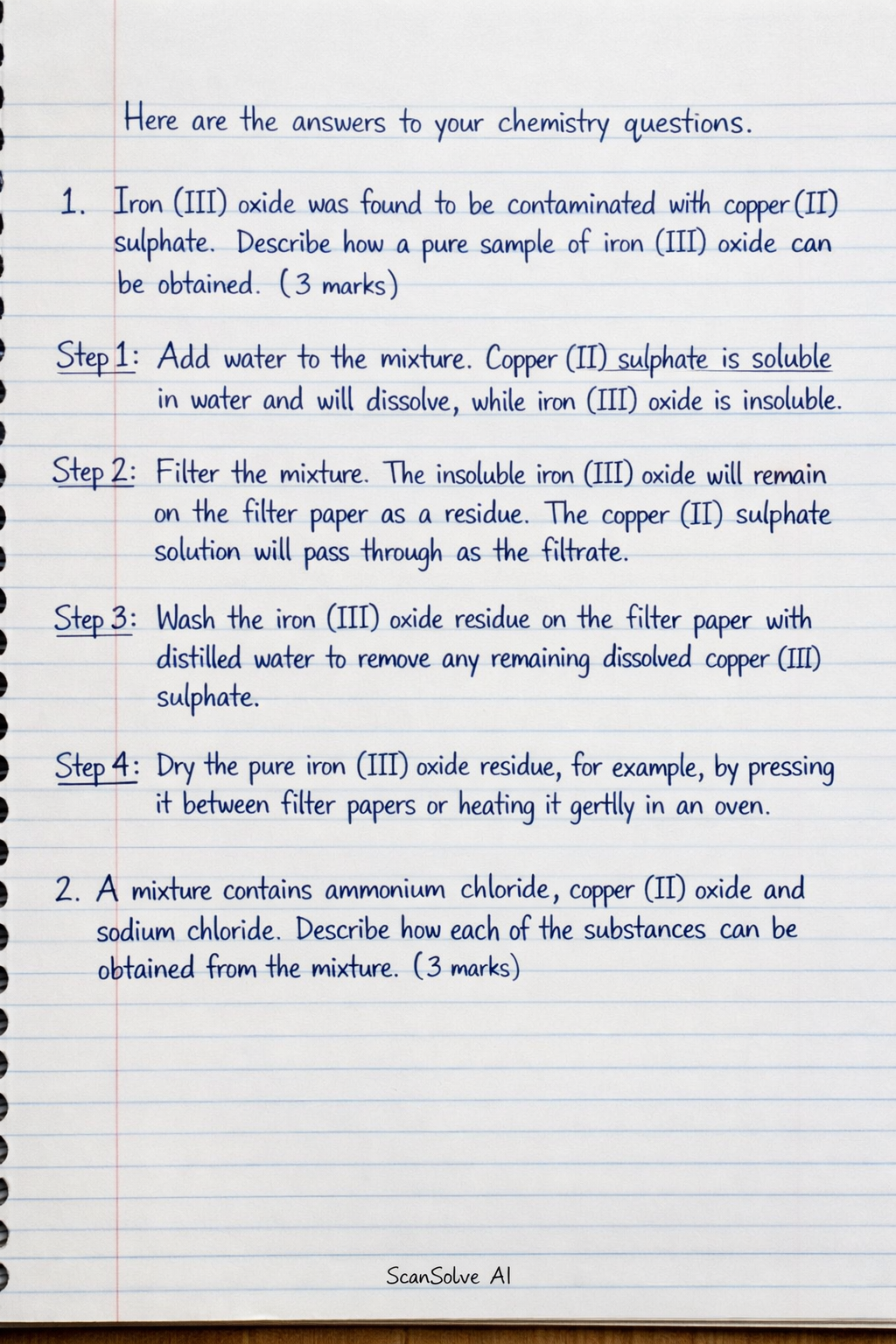
- Iron (III) oxide was found to be contaminated with copper (II) sulphate. Describe how a pure sample of iron (III) oxide can be obtained. (3 marks)
Add water to the mixture.
Copper (II) sulphate is soluble in water and will dissolve, while iron (III) oxide is insoluble.
Filter the mixture.
The insoluble iron (III) oxide will remain on the filter paper as a residue. The copper (II) sulphate solution will pass through as the filtrate.
Wash the iron (III) oxide residue on the filter paper with distilled water to remove any remaining dissolved copper (II) sulphate.
Dry the pure iron (III) oxide residue, for example, by pressing it between filter papers or heating it gently in an oven.
- A mixture contains ammonium chloride, copper (II) oxide and sodium chloride. Describe how each of the substances can be obtained from the mixture. (3 marks)
Separate ammonium chloride.
Gently heat the mixture. Ammonium chloride will sublime (change directly from solid to gas) and can be collected by deposition on a cool surface.
Separate copper (II) oxide and sodium chloride.
Add water to the remaining mixture. Sodium chloride is soluble in water and will dissolve, while copper (II) oxide is insoluble.
Filter the mixture.
The insoluble copper (II) oxide will be left as a residue on the filter paper. Wash and dry it.
Obtain sodium chloride.
The filtrate contains dissolved sodium chloride. Heat the filtrate to evaporate the water, leaving behind solid sodium chloride.
-
Explain why it is important to put off a non-luminous flame immediately after use. (2 marks)
It is important to put off a non-luminous flame immediately after use for two main reasons:
- To prevent accidents such as burns or fires, as an unattended flame is a safety hazard.
- To prevent wastage of laboratory gas, conserving resources.
-
Name a suitable solvent for extracting flower extracts from flowers. Give a reason for your answer. (2 marks)
A suitable solvent is propanone (also known as acetone) or ethanol.
Reason: Propanone is an organic solvent that effectively dissolves the organic compounds (like pigments and essential oils) present in flower extracts. -
Explain why commercial indicators are preferred over flower extracts as acid-base indicators. (2 marks)
Commercial indicators are preferred over flower extracts as acid-base indicators because:
- Commercial indicators are pure substances with consistent chemical compositions, providing more reliable and reproducible color changes over specific pH ranges. Flower extracts can vary in composition, leading to inconsistent results.
- Commercial indicators are generally more stable and have a longer shelf life, allowing them to be stored and used repeatedly without degradation, unlike natural extracts which can degrade quickly.
-
Still stuck on this one?
Ask a follow-up, and the answer starts from this question.
More Chemistry Questions
Handwritten Step-by-Step Solution
Get this as a handwritten image on WhatsApp — like a tutor wrote it for you.
Try on WhatsApp