
We read your photo as:
A) State Faraday's first law of electrolysis. b) Calculate the volume of chlorine gas liberated at s.t.p. when a current of 100 A is passed for 2 hours through molten sodium chloride.
ScanSolve AI Answer
Step-by-step solution
4 steps-
a) Faraday's first law of electrolysis states that the mass of a substance deposited or liberated at an electrode is directly proportional to the quantity of electricity passed through the electrolyte.
-
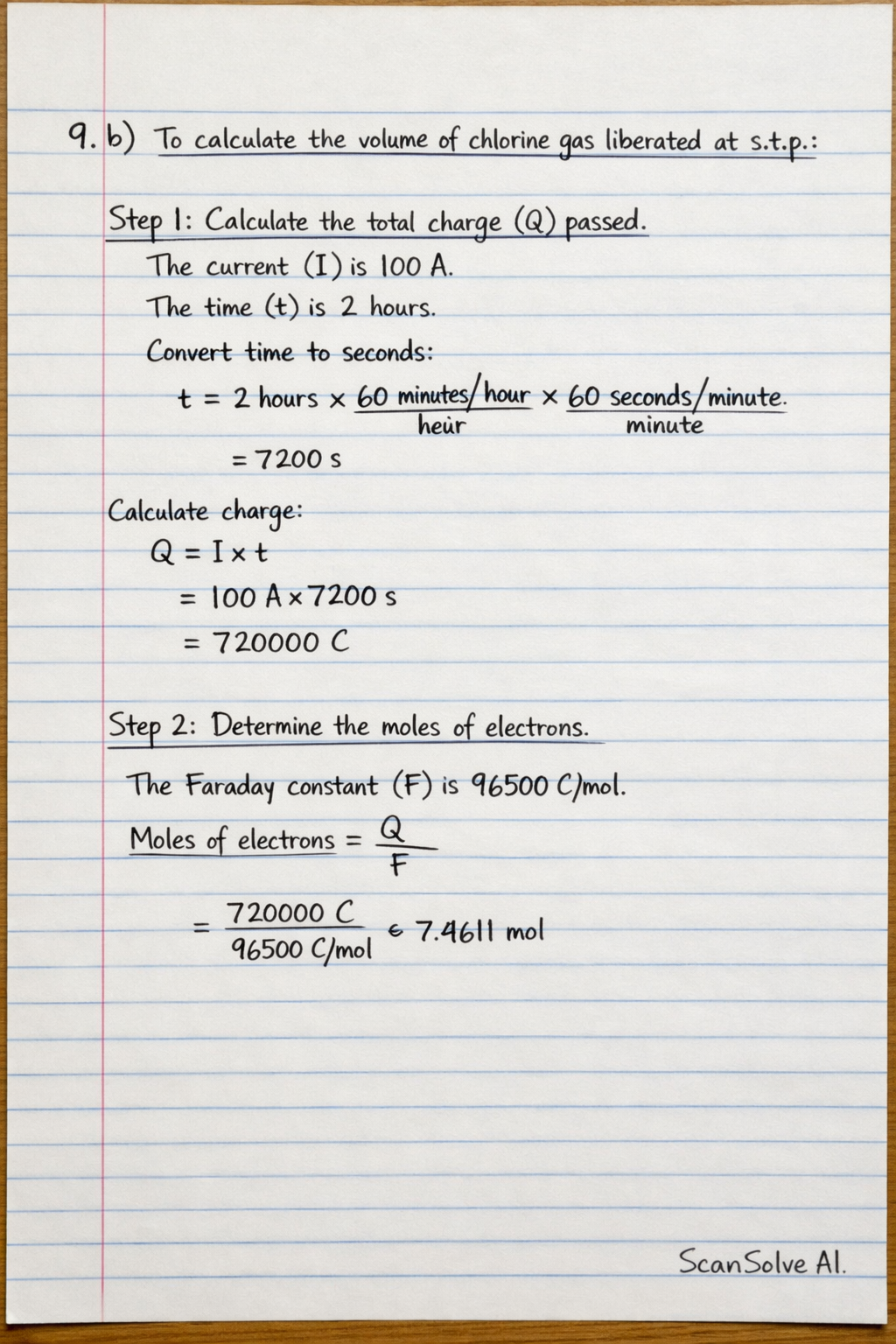
b) To calculate the volume of chlorine gas liberated at s.t.p.:
Calculate the total charge () passed.
The current () is .
The time () is .
Convert time to seconds:Calculate charge:
Determine the moles of electrons.
The Faraday constant () is .
Write the half-reaction for chlorine gas liberation and find moles of .
In molten sodium chloride, chlorine gas is liberated at the anode:
From the reaction, 2 moles of electrons produce 1 mole of .
Calculate the volume of at s.t.p.
The molar gas volume () at s.t.p. is .
The volume of chlorine gas liberated at s.t.p. is .
- c) Three applications of electrolysis are:
- Electroplating, such as coating a metal object with a layer of another metal (e.g., silver plating).
- Extraction of reactive metals from their ores, such as aluminium from bauxite.
- Purification of metals, such as refining crude copper.
-
a) Solubility in Chemistry is defined as the maximum mass of a solute that can dissolve in a given mass of solvent (usually ) at a specific temperature to form a saturated solution.
-
b) The table shows the solubility of potassium chlorate (V) at different temperatures: | Mass of in grams per of water | 40.0 | 20.0 | 13.3 | 10.0 | 8.0 | |---|---|---|---|---|---| | Temperature () | 88.0 | 52.0 | 38.0 | 31.0 | 25.0 |
Still stuck on this one?
Ask a follow-up, and the answer starts from this question.
More Chemistry Questions
Handwritten Step-by-Step Solution
Get this as a handwritten image on WhatsApp — like a tutor wrote it for you.
Try on WhatsApp