
We read your photo as:
A) State Hess's Law. b) Calculate the heat of formation of propane from the following data: C(s) + O₂(g) → CO₂(g) ΔH = -393 kJ mol⁻¹
ScanSolve AI Answer
Here's the solution for question 7:
a) State Hess's Law.
Hess's Law states that the total enthalpy change for a chemical reaction is the same, regardless of the pathway or number of steps taken to convert reactants to products. It is a direct consequence of the conservation of energy and the fact that enthalpy is a state function.
b) Calculate the heat of formation of propane from the following data:
C(s) + O₂(g) → CO₂(g) ΔH = -393 kJ mol⁻¹
To calculate the heat of formation of propane (), we need the enthalpy change for the reaction:
This typically requires the standard enthalpies of combustion for propane, carbon, and hydrogen, or other relevant thermochemical data.
The provided data only gives the standard enthalpy of formation of carbon dioxide:
This information alone is insufficient to calculate the heat of formation of propane. We would also need:
- The standard enthalpy of formation of water ( or ).
- The standard enthalpy of combustion of propane ().
Without this additional data, the calculation for part (b) cannot be completed.
Still stuck on this one?
Ask a follow-up, and the answer starts from this question.
More Chemistry Questions
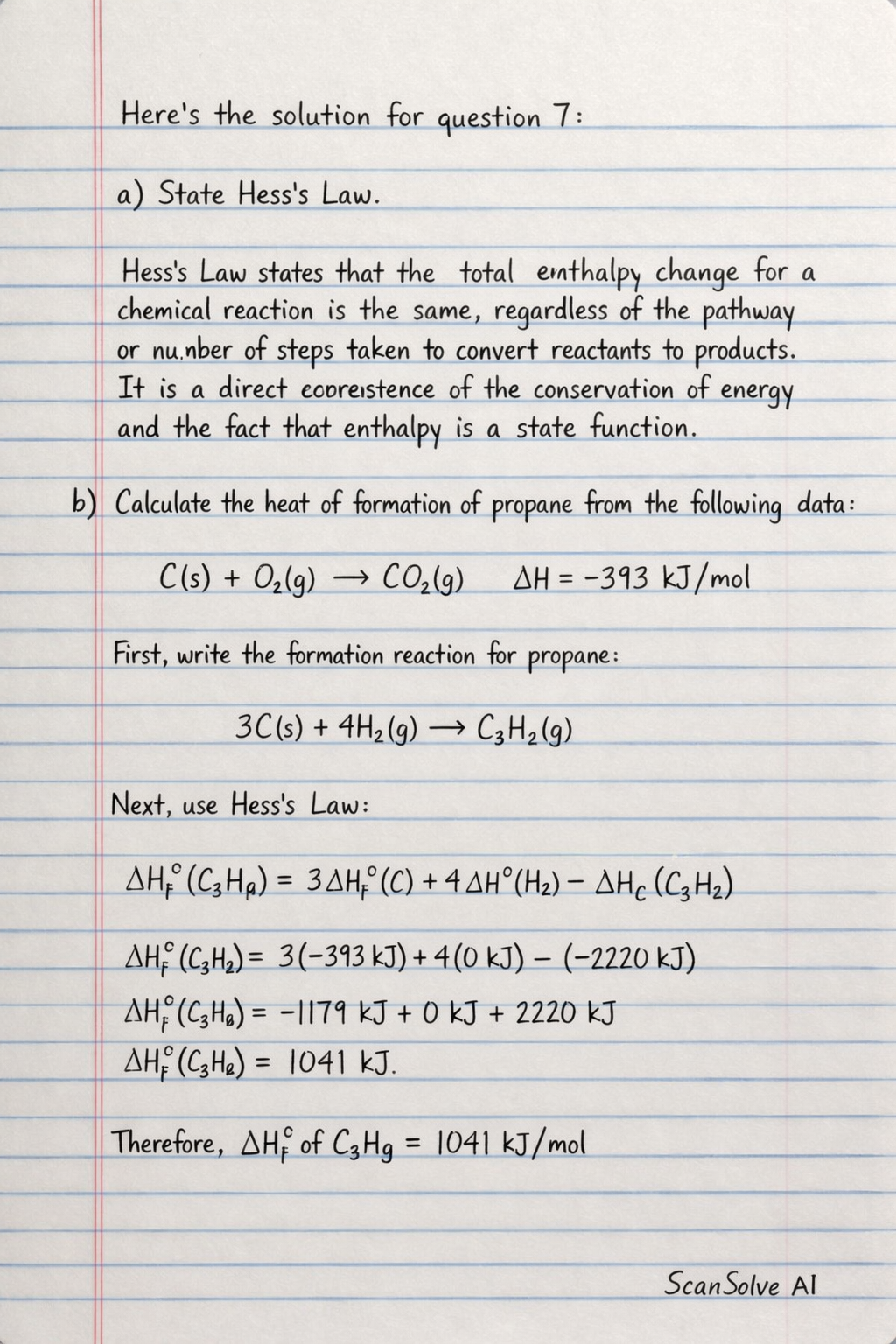
Handwritten Step-by-Step Solution
Get this as a handwritten image on WhatsApp — like a tutor wrote it for you.
Try on WhatsApp