
We read your photo as:
A) Suggest one evidence that shows that the chemistry of benzene cannot be explained on the basis of the Kekulé structures. b) Benzene undergoes electrophilic substitution to produce nitrobenzene. b)(
ScanSolve AI Answer
Answer
Step-by-step solution
11 stepsPart a· 2 steps
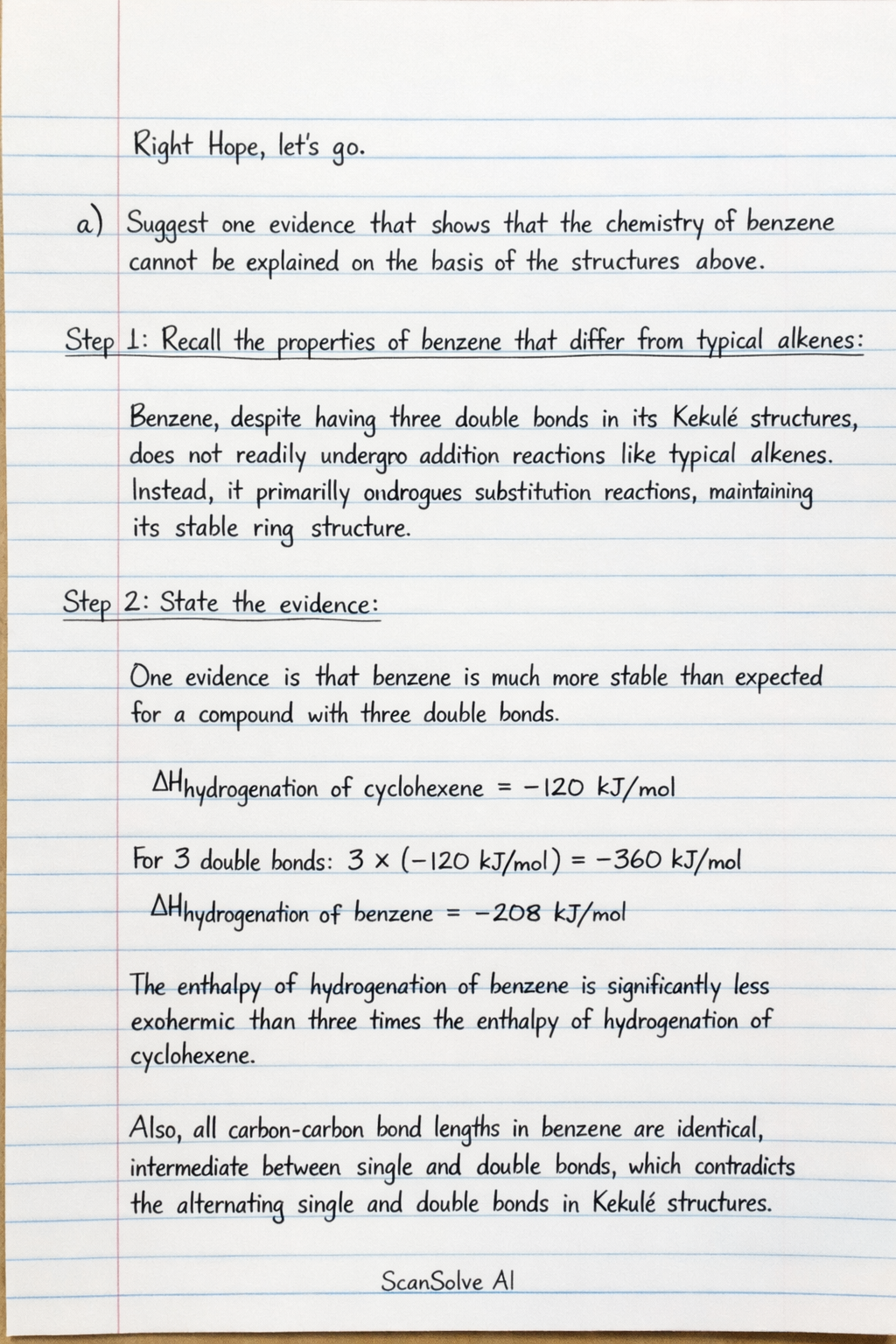
Suggest one evidence that shows that the chemistry of benzene cannot be explained on the basis of the structures above.
Recall the properties of benzene that differ from typical alkenes.
Benzene, despite having three double bonds in its Kekulé structures, does not readily undergo addition reactions like typical alkenes. Instead, it primarily undergoes substitution reactions, maintaining its stable ring structure.
State the evidence.
One evidence is that benzene is much more stable than expected for a compound with three double bonds. Its enthalpy of hydrogenation is significantly less exothermic than three times the enthalpy of hydrogenation of cyclohexene. Also, all carbon-carbon bond lengths in benzene are identical, intermediate between single and double bonds, which contradicts the alternating single and double bonds in Kekulé structures.
- Evidence: Benzene undergoes substitution reactions rather than addition reactions with reagents like bromine, unlike typical alkenes. Additionally, all carbon-carbon bond lengths in benzene are equal, which is not consistent with alternating single and double bonds.
Part b
Benzene undergoes electrophilic substitution to produce nitrobenzene.
b)(i) Identify the electrophile.
Identify the electrophile for nitration.
The electrophile in the nitration of benzene is the nitronium ion.
- Electrophile:
b)(ii) Give the reagents and reaction conditions for the nitration of benzene.
List the necessary reagents.
The reagents required are concentrated nitric acid and concentrated sulfuric acid.
State the reaction conditions.
The reaction is typically carried out at a controlled temperature, usually between and , to prevent further nitration or oxidation.
- Reagents: Concentrated and concentrated .
- Conditions: Temperature between and (or reflux below ).
b)(iii) Outline the mechanism for the nitration reaction.
Generation of the electrophile.
Concentrated sulfuric acid protonates nitric acid, which then loses a water molecule to form the nitronium ion ().
Electrophilic attack on the benzene ring.
The nitronium ion acts as an electrophile and attacks the electron-rich benzene ring, forming a sigma complex (carbocation intermediate) where the aromaticity is temporarily disrupted.
(This is represented by the student's drawing of the benzene ring with attached and a positive charge delocalized over the ring, with a hydrogen atom also attached to the carbon bearing the group).
Loss of a proton and restoration of aromaticity.
A proton is removed from the sigma complex by a base (e.g., or ), restoring the aromaticity of the ring and forming nitrobenzene.
(This is represented by the student's drawing showing the loss of and the formation of nitrobenzene).
b)(vi) Further nitration to the dinitro-product is difficult. Give the structure of the possible product on further nitration and explain why this is difficult.
Determine the directing effect of the nitro group.
The nitro () group is a meta-director and a strong deactivating group. This means it directs incoming electrophiles to the meta position and makes the benzene ring less reactive towards electrophilic substitution.
Draw the structure of the possible product.
When nitrobenzene undergoes further nitration, the second nitro group will attach at the meta position relative to the first nitro group, forming 1,3-dinitrobenzene.
(This is represented by the student's drawing of a benzene ring with two groups in meta positions).
Explain why further nitration is difficult.
The nitro group is a strong electron-withdrawing group. It withdraws electron density from the benzene ring, making the ring less nucleophilic (less electron-rich). This deactivates the ring, making it much less susceptible to attack by the electrophile (). Therefore, harsher conditions (higher temperature, more concentrated acids) are required for further nitration.
- Structure of possible product:
- Explanation: The existing nitro () group is a strong electron-withdrawing group. It deactivates the benzene ring by reducing its electron density, making it less attractive to the electrophilic nitronium ion (). This makes further electrophilic substitution significantly more difficult, requiring more vigorous reaction conditions.
Try one yourself
A new problem that tests the same skill.
Still stuck on this one?
Ask a follow-up, and the answer starts from this question.
More Chemistry Questions
Handwritten Step-by-Step Solution
Get this as a handwritten image on WhatsApp — like a tutor wrote it for you.
Try on WhatsApp