
We read your photo as:
A volume of 0.25dm³ of 0.1mol/dm³ sodium hydroxide (NaOH) was put into a flask and few drops of phenolphthalein indicator were added. A volume of 0.20 dm³ of dilute hydrochloric acid (HCl) was used to completely neutralize sodium hydroxide.
ScanSolve AI Answer
Step-by-step solution
3 stepshere are the solutions to your questions:
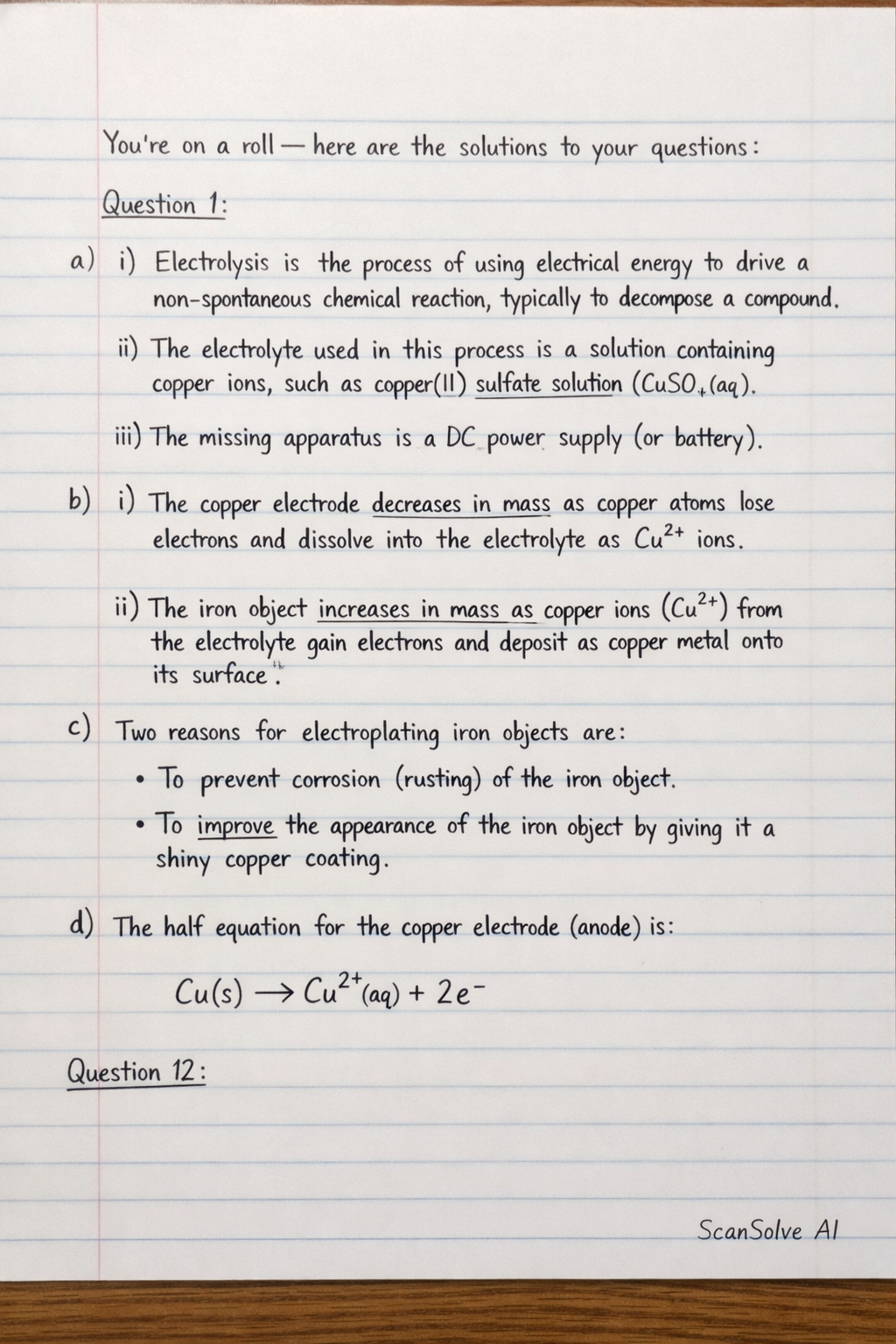
Question 1:
a)
i) Electrolysis is the process of using electrical energy to drive a non-spontaneous chemical reaction, typically to decompose a compound.
ii) The electrolyte used in this process is a solution containing copper ions, such as copper(II) sulfate solution ().
iii) The missing apparatus is a DC power supply (or battery).
b)
i) The copper electrode decreases in mass as copper atoms lose electrons and dissolve into the electrolyte as ions.
ii) The iron object increases in mass as copper ions () from the electrolyte gain electrons and deposit as copper metal onto its surface.
c) Two reasons for electroplating iron objects are:
- To prevent corrosion (rusting) of the iron object.
- To improve the appearance of the iron object by giving it a shiny copper coating.
d) The half equation for the copper electrode (anode) is:
Question 12:
a) The method of neutralization used is titration.
b) Phenolphthalein indicator is added to signal the endpoint of the titration. It changes color (from pink in basic solution to colorless in acidic solution) when the neutralization reaction is complete, indicating that the equivalence point has been reached.
c) The chemical equation for the reaction between sodium hydroxide and hydrochloric acid is:
d) Hydrochloric acid should be handled with care because it is a corrosive acid that can cause severe chemical burns to skin and damage to eyes.
e) Calculate the concentration of dilute hydrochloric acid:
Calculate the moles of sodium hydroxide ().
Determine the moles of hydrochloric acid () required for neutralization.
From the balanced chemical equation , the mole ratio of to is .
Calculate the concentration of dilute hydrochloric acid.
The concentration of dilute hydrochloric acid is .
Still stuck on this one?
Ask a follow-up, and the answer starts from this question.
More Chemistry Questions
Handwritten Step-by-Step Solution
Get this as a handwritten image on WhatsApp — like a tutor wrote it for you.
Try on WhatsApp