
Give me All notes for capacitors connecting in series, parallel and compound then factors affecting capacitance
ScanSolve AI Answer
Answer
Step-by-step solution
7 stepsCapacitors in Series
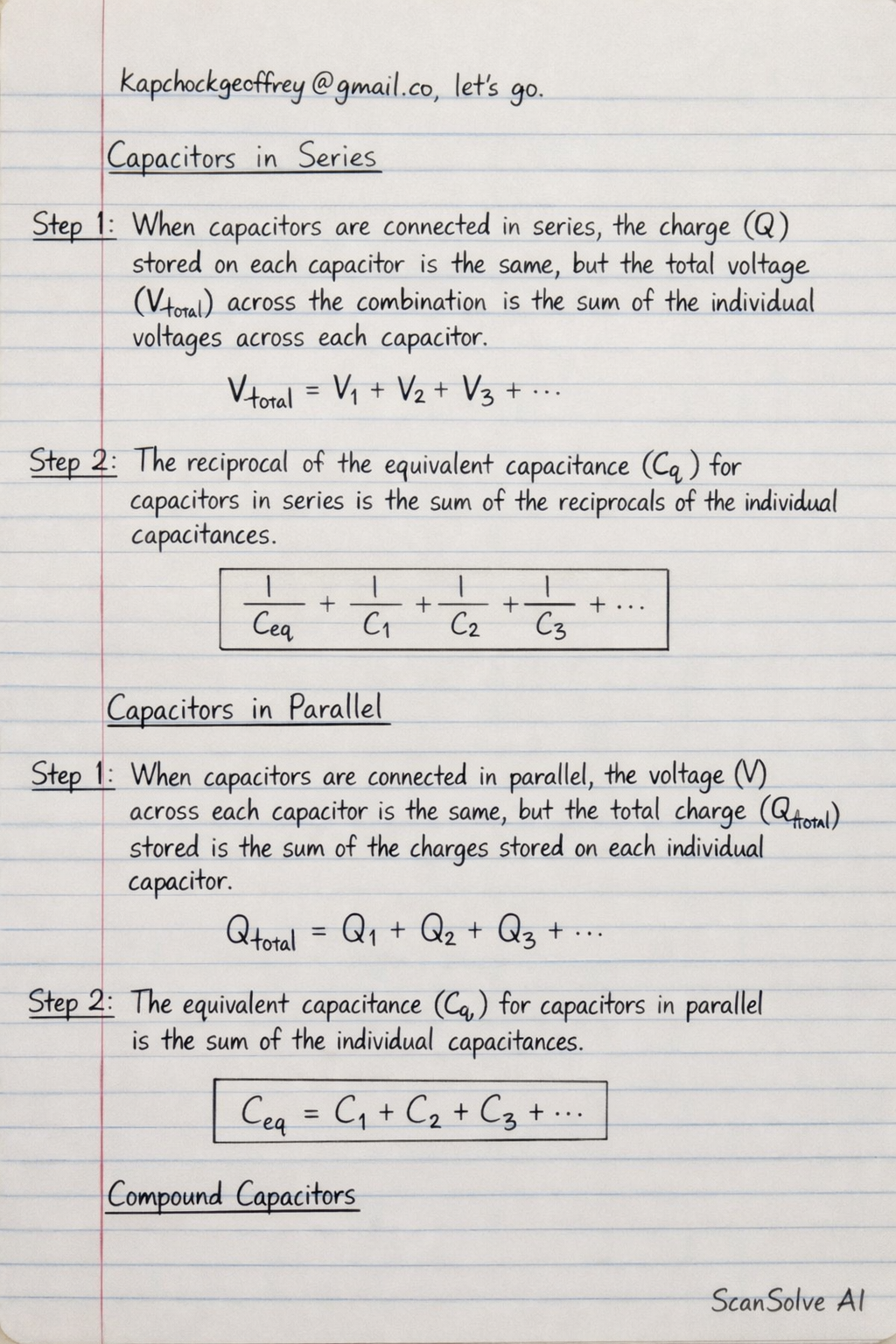
When capacitors are connected in series, the charge () stored on each capacitor is the same, but the total voltage () across the combination is the sum of the individual voltages across each capacitor.
The reciprocal of the equivalent capacitance () for capacitors in series is the sum of the reciprocals of the individual capacitances.
Capacitors in Parallel
When capacitors are connected in parallel, the voltage () across each capacitor is the same, but the total charge () stored is the sum of the charges stored on each individual capacitor.
The equivalent capacitance () for capacitors in parallel is the sum of the individual capacitances.
Compound Capacitors
A compound capacitor circuit is a combination of both series and parallel connections.
To find the equivalent capacitance of such a circuit, simplify the series and parallel sections step-by-step until the entire circuit is reduced to a single equivalent capacitance.
- First, identify and simplify any purely series or purely parallel sections.
- Then, treat the simplified sections as new individual capacitors and continue simplifying until a single equivalent capacitance is found.
Factors Affecting Capacitance
The capacitance () of a parallel-plate capacitor is determined by three main factors
- Area of the plates (): Capacitance is directly proportional to the area of the plates. A larger plate area allows more charge to be stored for a given voltage.
- Distance between the plates (): Capacitance is inversely proportional to the distance between the plates. A smaller distance results in a stronger electric field for a given voltage, allowing more charge to be stored.
- Dielectric material ( or ): Capacitance is directly proportional to the dielectric constant (relative permittivity) of the material between the plates. A dielectric material increases the capacitance by reducing the electric field strength for a given charge, thus allowing more charge to be stored at the same voltage.
The relationship between these factors and capacitance is given by the formula
Where:
- is the capacitance in Farads (F).
- is the permittivity of free space ().
- (or ) is the relative permittivity (dielectric constant) of the material between the plates (dimensionless).
- is the area of one of the plates in square meters ().
- is the distance between the plates in meters (m).
Try one yourself
A new problem that tests the same skill.
Still stuck on this one?
Ask a follow-up, and the answer starts from this question.
More Chemistry Questions
Handwritten Step-by-Step Solution
Get this as a handwritten image on WhatsApp — like a tutor wrote it for you.
Try on WhatsApp