

This chemistry question involves key chemical concepts and calculations. The detailed solution below walks through each step, from identifying the reaction type to computing the final answer.
ScanSolve AI Answer
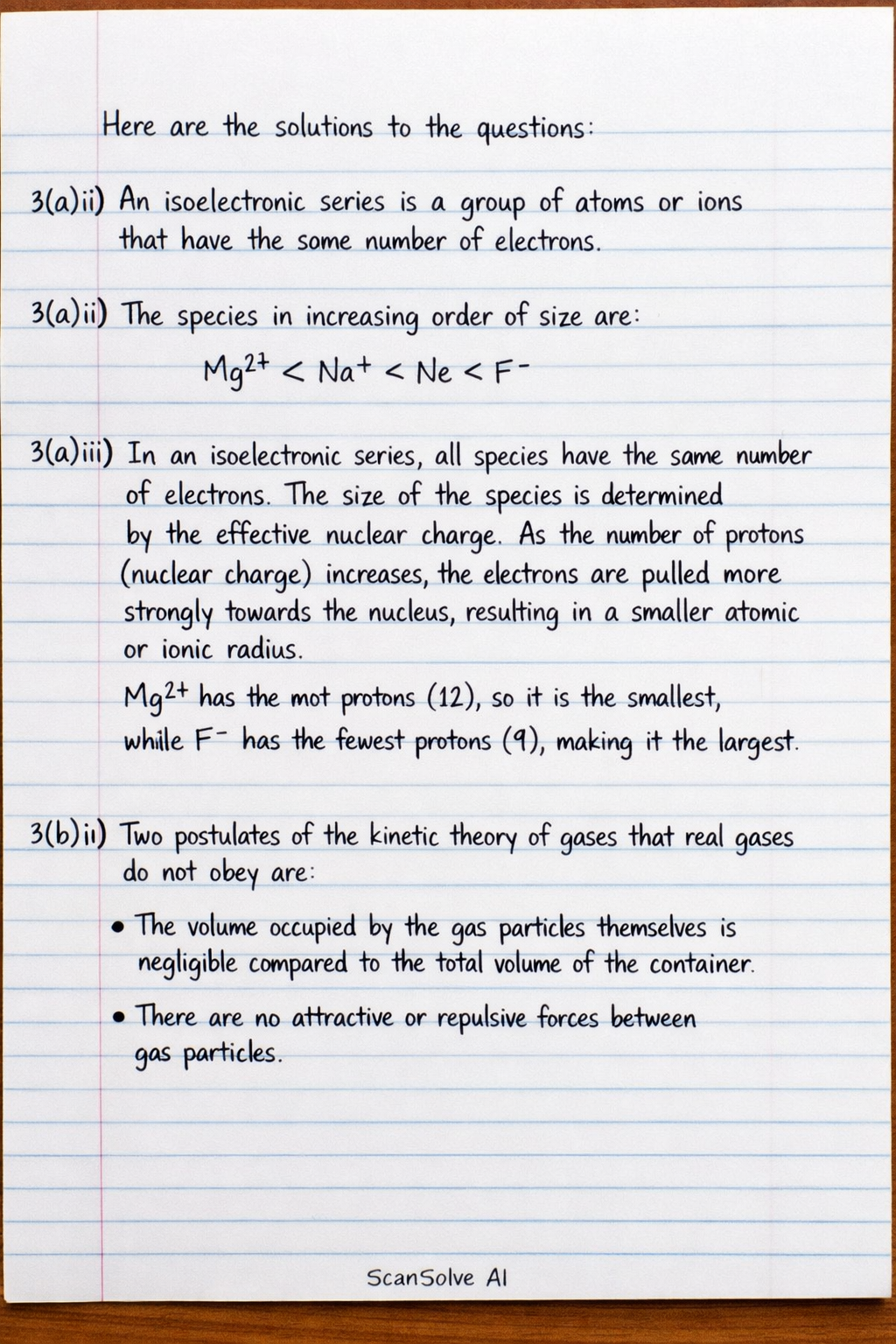
Here are the solutions to the questions: 3(a)(i) An isoelectronic series is a group of atoms or ions that have the same number of electrons. 3(a)(ii) The species in increasing order of size are: Mg^2+ < Na^+ < Ne < F^- 3(a)(iii) In an isoelectronic series, all species have the same number of electrons. The size of the species is determined by the effective nuclear charge. As the number of protons (nuclear charge) increases, the electrons are pulled more strongly towards the nucleus, resulting in a smaller atomic or ionic radius. Mg^2+ has the most protons (12), so it is the smallest, while F^- has the fewest protons (9), making it the largest. 3(b)(i) Two postulates of the kinetic theory of gases that real gases do not obey are: • The volume occupied by the gas particles themselves is negligible compared to the total volume of the container. • There are no attractive or repulsive forces between gas particles. 3(b)(ii) Real gases do not obey these postulates because: • At high pressures, the volume of the gas particles themselves becomes significant and cannot be ignored. • At low temperatures and high pressures, gas particles are closer together, and the attractive intermolecular forces between them become significant, affecting their behavior. 3(c) (i) P at constant T and a fixed n: V (1)/(P) (ii) T at constant P and a fixed n: V T (iii) n at constant T and P: V n (iv) Combining the expressions: From (i), (ii), and (iii), we have V (nT)/(P). Introducing the universal gas constant R, the expression becomes: V = R (nT)/(P) Rearranging this gives the ideal gas equation: PV = nRT 3(d) Step 1: Write the half-reaction for the liberation of oxygen. During the electrolysis of water, oxygen gas is produced at the anode: 2H_2O_(l) O_2(g) + 4H^+_(aq) + 4e^- From this equation, 1 mole of O_2 requires 4 moles of electrons. Step 2: Calculate the moles of electrons required for 0.12 mole of O_2. Moles of electrons = 0.12 mol O_2 × 4 mol e^-1 mol O_2 = 0.48 mol e^- Step 3: Calculate the quantity of electricity. Given that 1 Faraday (F) = 1 mole of electrons = 96500 C. Quantity of electricity = Moles of electrons × Faraday constant Quantity of electricity = 0.48 mol e^- × 96500 C/mol e^- = 46320 C The quantity of electricity required is 46320 C. 3(e)(i) Aqueous solutions of ammonia (a weak base) and ethanoic acid (a weak acid) are weak electrolytes because they only partially ionize in water, producing a low concentration of ions. When these two solutions are mixed, they react to form ammonium ethanoate (CH_3COONH_4), which is a salt. Salts are strong electrolytes because they dissociate completely into ions (CH_3COO^- and NH_4^+) in water, leading to a high concentration of mobile ions that can conduct electricity effectively. 3(e)(ii) Two physical properties of liquids that could be increased as a result of hydrogen bonding are: • Boiling point: More energy is required to overcome the stronger intermolecular forces (hydrogen bonds) to vaporize the liquid. • Viscosity: Stronger intermolecular forces make the liquid more resistant to flow. • Surface tension: Stronger intermolecular forces at the surface lead to higher surface tension. 4(a)(i) The stages involved in the operation of a mass spectrometer are: 1. Vaporization and Ionization: The sample is vaporized and then converted into positive ions. 2. Acceleration: The ions are accelerated by an electric field. 3. Deflection: The accelerated ions are deflected by a magnetic field based on their mass-to-charge ratio (m/z). 4. Detection: The deflected ions are detected, and their abundance is recorded. 4(a)(ii) Two kinds of information that could be obtained from a mass spectrum of an element are: • The number of isotopes present in the element. • The relative abundance of each isotope. • The relative atomic mass of the element. 4(b)(i) Step 1: Write the dissociation equilibrium for ethanoic acid. Ethanoic acid (CH_3COOH) is a weak acid: CH_3COOH_(aq) CH_3COO^-_(aq) + H^+_(aq) Step 2: Set up the K_a expression and an ICE table. Initial concentration of CH_3COOH = 0.1 mol dm^-3. Let x be the concentration of H^+ ions at equilibrium. K_a = [CH_3COO^-][H^+][CH_3COOH] 1.70 × 10^-5 = (x · x)/(0.1 - x) Since K_a is small, we can approximate 0.1 - x ≈ 0.1. 1.70 × 10^-5 = (x^2)/(0.1) Step 3: Solve for x, the concentration of H^+ ions. x^2 = 1.70 × 10^-5 × 0.1 = 1.70 × 10^-6 x = sqrt(1.70 × 10^-6) = 1.3038 × 10^-3 mol dm^-3 So, [H^+] = 1.3038 × 10^-3 mol dm^-3. Step 4: Calculate the pH. pH = -_10[H^+] = -_10(1.3038 × 10^-3) pH ≈ 2.88 The pH of the ethanoic acid at the start of the reaction is 2.88. 4(b)(ii) The balanced equation for the reaction between ethanoic acid and sodium hydroxide is: CH_3COOH_(aq) + NaOH_(aq) CH_3COONa_(aq) + H_2O_(l) 4(b)(iii) A solution of sodium ethanoate (CH_3COONa) is alkaline because it is the salt of a weak acid (ethanoic acid) and a strong base (sodium hydroxide). When dissolved in water, the salt dissociates completely into Na^+ and CH_3COO^- ions. The ethanoate ion (CH_3COO^-) is the conjugate base of a weak acid, and it hydrolyzes in water to produce hydroxide ions (OH^-), making the solution alkaline: CH_3COO^-_(aq) + H_2O_(l) CH_3COOH_(aq) + OH^-_(aq) The Na^+ ion, being the conjugate acid of a strong base, does not hydrolyze significantly. That's 2 down. 3 left today — send the next one.