

This chemistry question involves key chemical concepts and calculations. The detailed solution below walks through each step, from identifying the reaction type to computing the final answer.
ScanSolve AI Answer
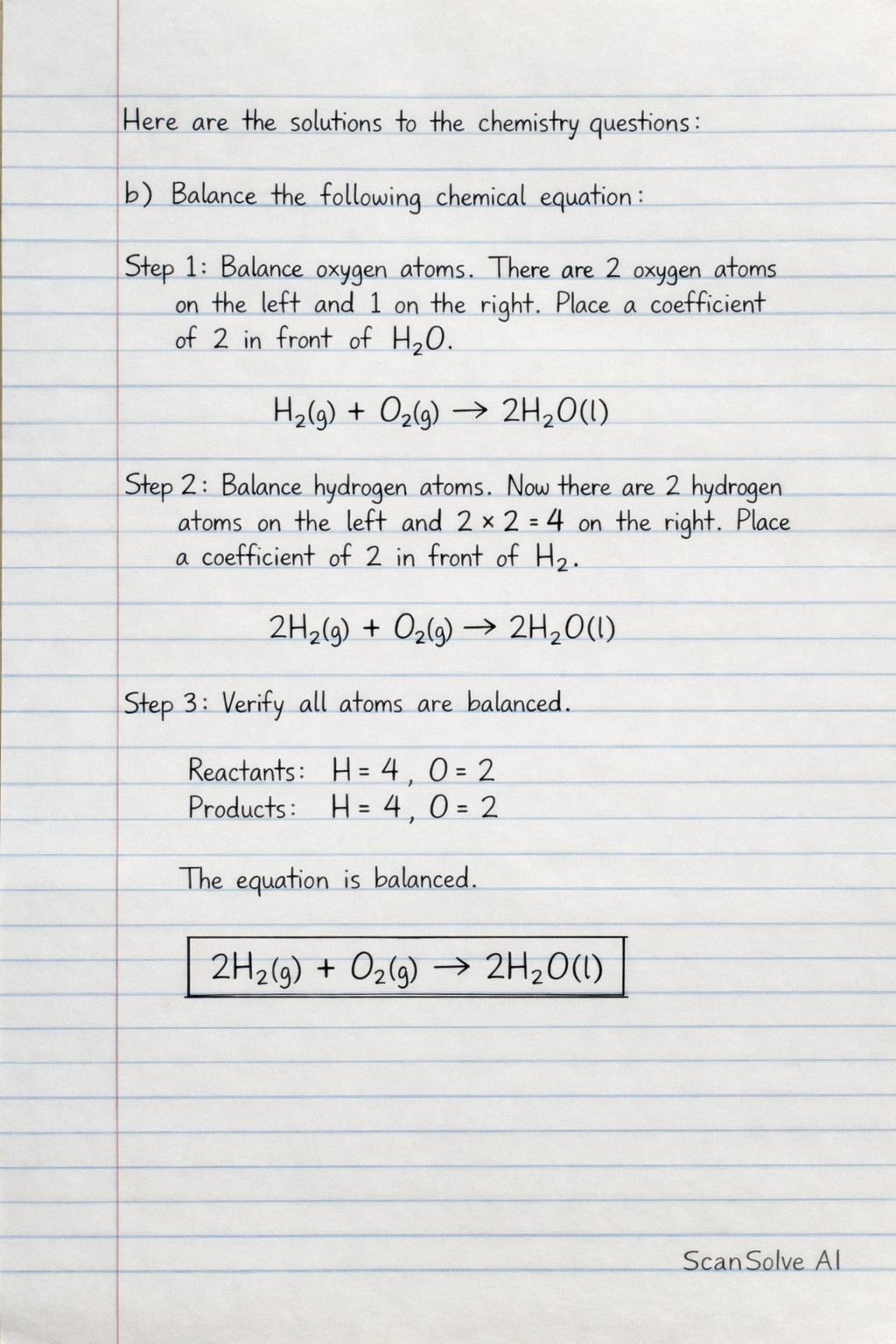
Here are the solutions to the chemistry questions: b) Balance the following chemical equation i) H_2(g) + O_2(g) → H_2O_(l) Step 1: Balance oxygen atoms. There are 2 oxygen atoms on the left and 1 on the right. Place a coefficient of 2 in front of H_2O. H_2(g) + O_2(g) → 2H_2O_(l) Step 2: Balance hydrogen atoms. Now there are 2 hydrogen atoms on the left and 2 × 2 = 4 on the right. Place a coefficient of 2 in front of H_2. 2H_2(g) + O_2(g) → 2H_2O_(l) Step 3: Verify all atoms are balanced. Reactants: H = 4, O = 2 Products: H = 4, O = 2 The equation is balanced. 2H_2(g) + O_2(g) → 2H_2O_(l) ii) KClO_3(s) → KCl_(s) + O_2(g) Step 1: Balance oxygen atoms. There are 3 oxygen atoms on the left and 2 on the right. The least common multiple of 3 and 2 is 6. Place a coefficient of 2 in front of KClO_3 and 3 in front of O_2. 2KClO_3(s) → KCl_(s) + 3O_2(g) Step 2: Balance potassium and chlorine atoms. Now there are 2 potassium and 2 chlorine atoms on the left, but only 1 of each on the right. Place a coefficient of 2 in front of KCl. 2KClO_3(s) → 2KCl_(s) + 3O_2(g) Step 3: Verify all atoms are balanced. Reactants: K = 2, Cl = 2, O = 6 Products: K = 2, Cl = 2, O = 6 The equation is balanced. 2KClO_3(s) → 2KCl_(s) + 3O_2(g) iii) K_2CO_3(s) + HCl_(aq) → KCl_(aq) + CO_2(g) + H_2O_(l) Step 1: Balance potassium atoms. There are 2 potassium atoms on the left and 1 on the right. Place a coefficient of 2 in front of KCl. K_2CO_3(s) + HCl_(aq) → 2KCl_(aq) + CO_2(g) + H_2O_(l) Step 2: Balance chlorine atoms. Now there is 1 chlorine atom on the left and 2 on the right. Place a coefficient of 2 in front of HCl. K_2CO_3(s) + 2HCl_(aq) → 2KCl_(aq) + CO_2(g) + H_2O_(l) Step 3: Verify all atoms are balanced. Reactants: K = 2, C = 1, O = 3, H = 2, Cl = 2 Products: K = 2, C = 1, O = 2 (from CO_2) + 1 (from H_2O) = 3, H = 2, Cl = 2 All atoms are balanced. K_2CO_3(s) + 2HCl_(aq) → 2KCl_(aq) + CO_2(g) + H_2O_(l) 10 (a) Construct the Diagram to show the electronic structure in each of the following compounds I. Oxygen gas (O_2) Step 1: Determine the total number of valence electrons. Each oxygen atom has 6 valence electrons. For O_2, there are 2 × 6 = 12 valence electrons. Step 2: Draw a single bond between the two oxygen atoms. This uses 2 electrons. O-O Step 3: Distribute the remaining 12 - 2 = 10 electrons as lone pairs to complete octets. If a single bond is used, each oxygen would need 6 more electrons (3 lone pairs) to complete its octet, totaling 12 lone pair electrons. Since only 10 are available, a single bond is not sufficient. Step 4: Form a double bond between the oxygen atoms. This uses 4 electrons. O=O Step 5: Distribute the remaining 12 - 4 = 8 electrons as lone pairs. Each oxygen atom needs 4 more electrons (2 lone pairs) to complete its octet (4 (from bond) + 4 (lone pairs) = 8). :O=O: Step 6: Verify octets for both atoms. Each oxygen atom has 4 bonding electrons (from the double bond) and 4 non-bonding electrons (from two lone pairs), totaling 8 electrons. Both octets are satisfied. The electronic structure (Lewis structure) for oxygen gas (O_2) is: :O=O: