
We read your photo as:
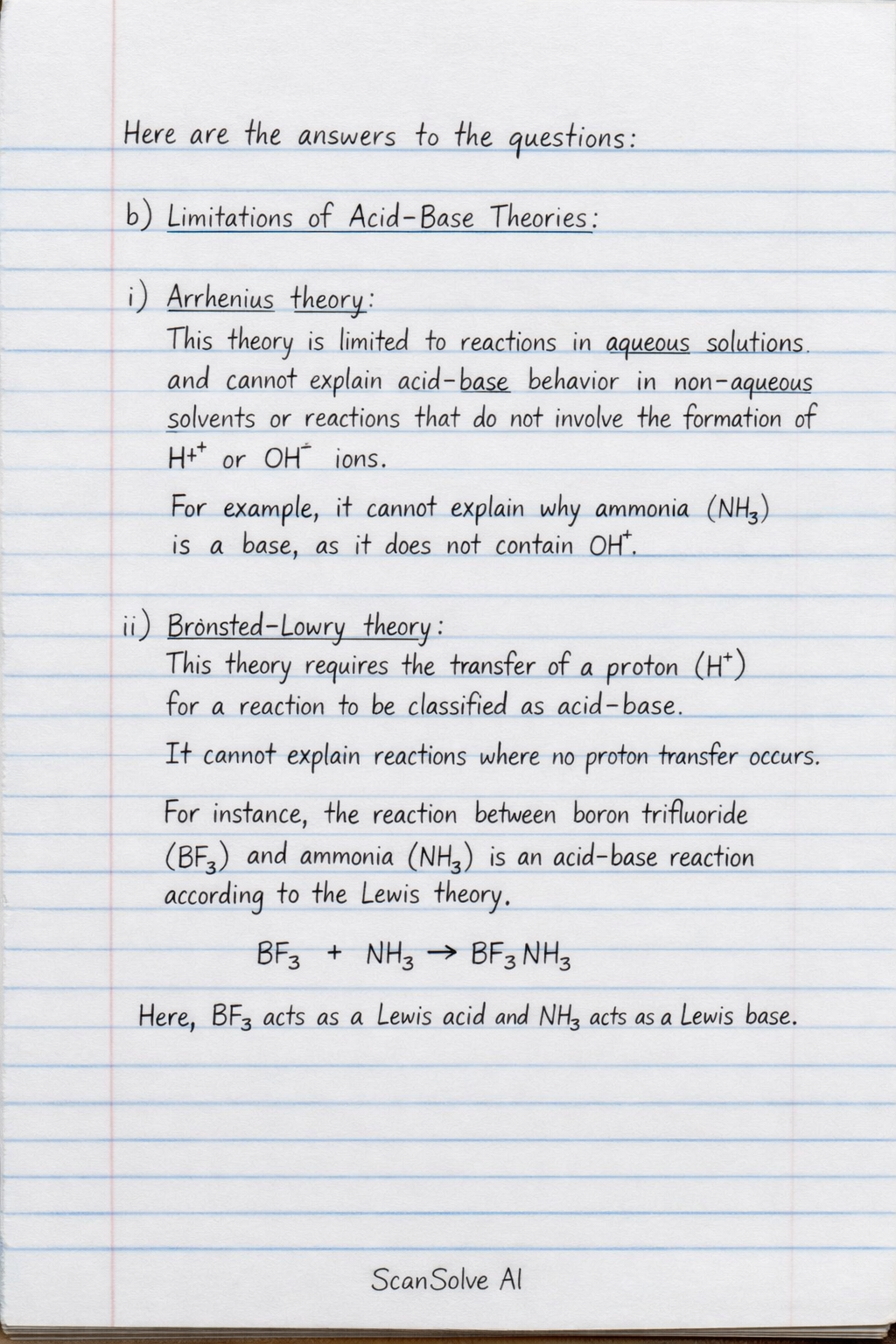
b) Limitations of Acid-Base Theories:
ScanSolve AI Answer
Here are the answers to the questions:
b) Limitations of Acid-Base Theories:
-
i) Arrhenius theory: This theory is limited to reactions occurring in aqueous solutions and cannot explain acid-base behavior in non-aqueous solvents or reactions that do not involve the formation of or ions. For example, it cannot explain why ammonia () is a base, as it does not contain .
-
ii) Brønsted-Lowry theory: This theory requires the transfer of a proton () for a reaction to be classified as acid-base. It cannot explain reactions where no proton transfer occurs, such as the reaction between boron trifluoride () and ammonia (), which is an acid-base reaction according to the Lewis theory.
-
iii) Lewis theory: While the broadest theory, it can be more complex to apply and does not easily predict the relative strengths of acids and bases quantitatively. The concept of electron pair donation/acceptance can also be less intuitive for some reactions compared to proton transfer.
2. Amphiprotic Species:
An amphiprotic species is a molecule or ion that can act as both a Brønsted-Lowry acid (by donating a proton) and a Brønsted-Lowry base (by accepting a proton).
-
Illustration with equations: Water () is a common example of an amphiprotic species.
-
When acting as an acid (donating a proton to a base like ammonia):
-
When acting as a base (accepting a proton from an acid like hydrochloric acid):
-
3. Neutralization Reaction and Conjugate Acid-Base Pairs:
The neutralization reaction between hydrochloric acid () and magnesium hydroxide () is:
The conjugate acid-base pairs are:
- (acid) and (conjugate base)
- (acid, formed from ) and (base, from )
Still stuck on this one?
Ask a follow-up, and the answer starts from this question.
More Chemistry Questions
Handwritten Step-by-Step Solution
Get this as a handwritten image on WhatsApp — like a tutor wrote it for you.
Try on WhatsApp