
We read your photo as:
Write the balanced chemical equation for the reaction of ethene with hypobromous acid and its oxidation with potassium tetraoxomanganate(VII).
ScanSolve AI Answer
Step-by-step solution
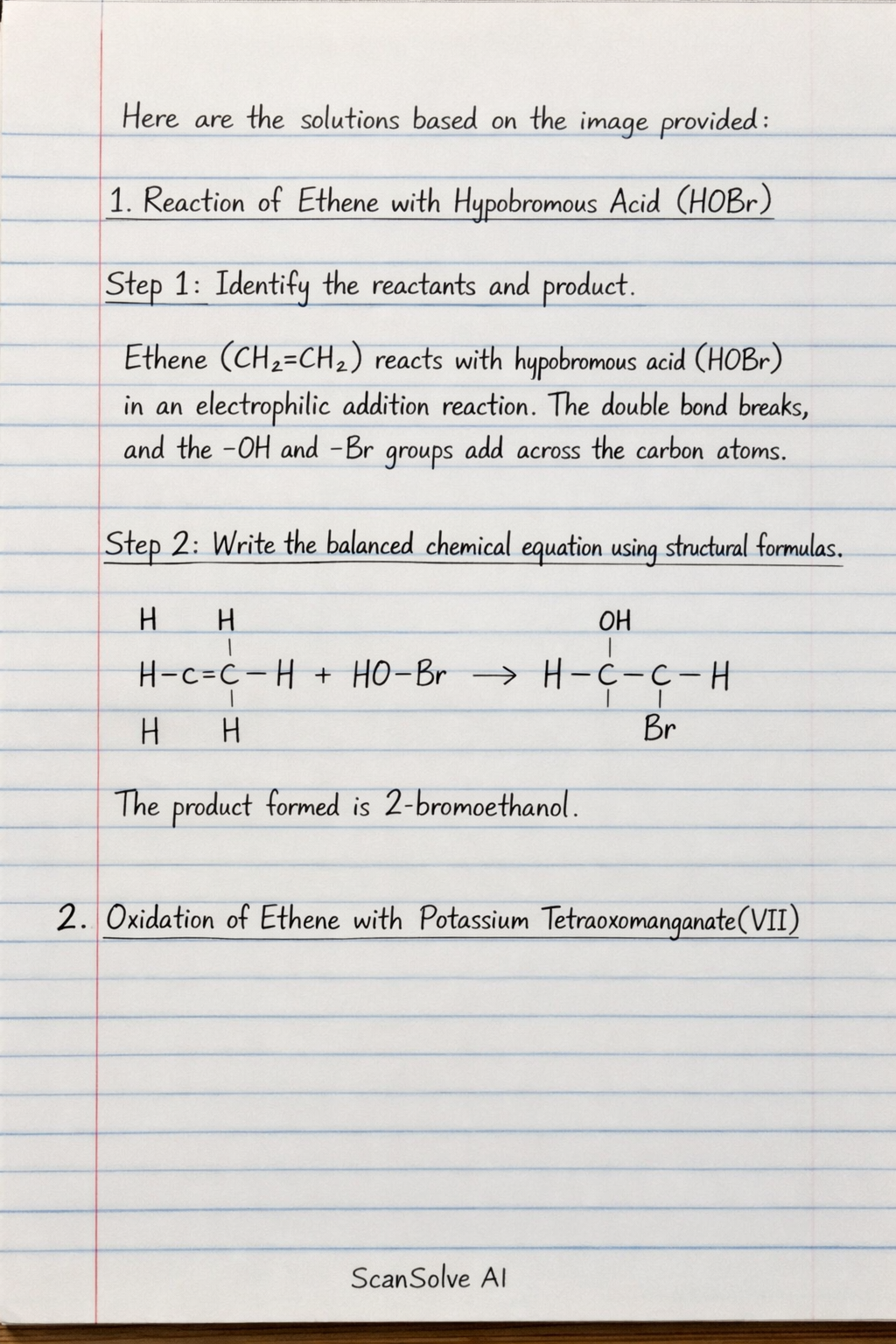
6 stepsHere are the solutions based on the image provided:
1. Reaction of Ethene with Hypobromous Acid (HOBr)
Identify the reactants and product.
Ethene () reacts with hypobromous acid () in an electrophilic addition reaction. The double bond breaks, and the -OH and -Br groups add across the carbon atoms.
Write the balanced chemical equation using structural formulas.
The product formed is 2-bromoethanol.
2. Oxidation of Ethene with Potassium Tetraoxomanganate(VII)
Identify the reactants and product.
Ethene () is oxidized by nascent oxygen () from dilute, cold potassium tetraoxomanganate(VII) () in the presence of water (). This reaction is known as Baeyer's test and results in the formation of a diol.
Write the chemical equation for the reaction.
The product is ethane-1,2-diol (also known as ethylene glycol).
3. Definition of Polymerisation Reaction
Define polymerisation.
Polymerisation is a chemical process in which many small, repeating molecules, called monomers, react together to form a very large chain-like molecule, known as a polymer.
Explain the nature of the process.
During polymerisation, the monomers link together through covalent bonds, forming a macromolecule with repeating structural units.
The definition is:
A polymerisation reaction is a chemical process where numerous small molecules, called monomers, combine to form a large, chain-like molecule known as a polymer. The monomers link together through covalent bonds to create a repeating structural unit within the polymer.
Still stuck on this one?
Ask a follow-up, and the answer starts from this question.
More Chemistry Questions
Handwritten Step-by-Step Solution
Get this as a handwritten image on WhatsApp — like a tutor wrote it for you.
Try on WhatsApp