
We read your photo as:
Write the balanced chemical equation for the reaction of sodium chloride with concentrated sulfuric acid. Explain why hydrogen iodide cannot be prepared using sodium iodide and concentrated sulfuric a
ScanSolve AI Answer
Step-by-step solution
2 stepsc) (i)
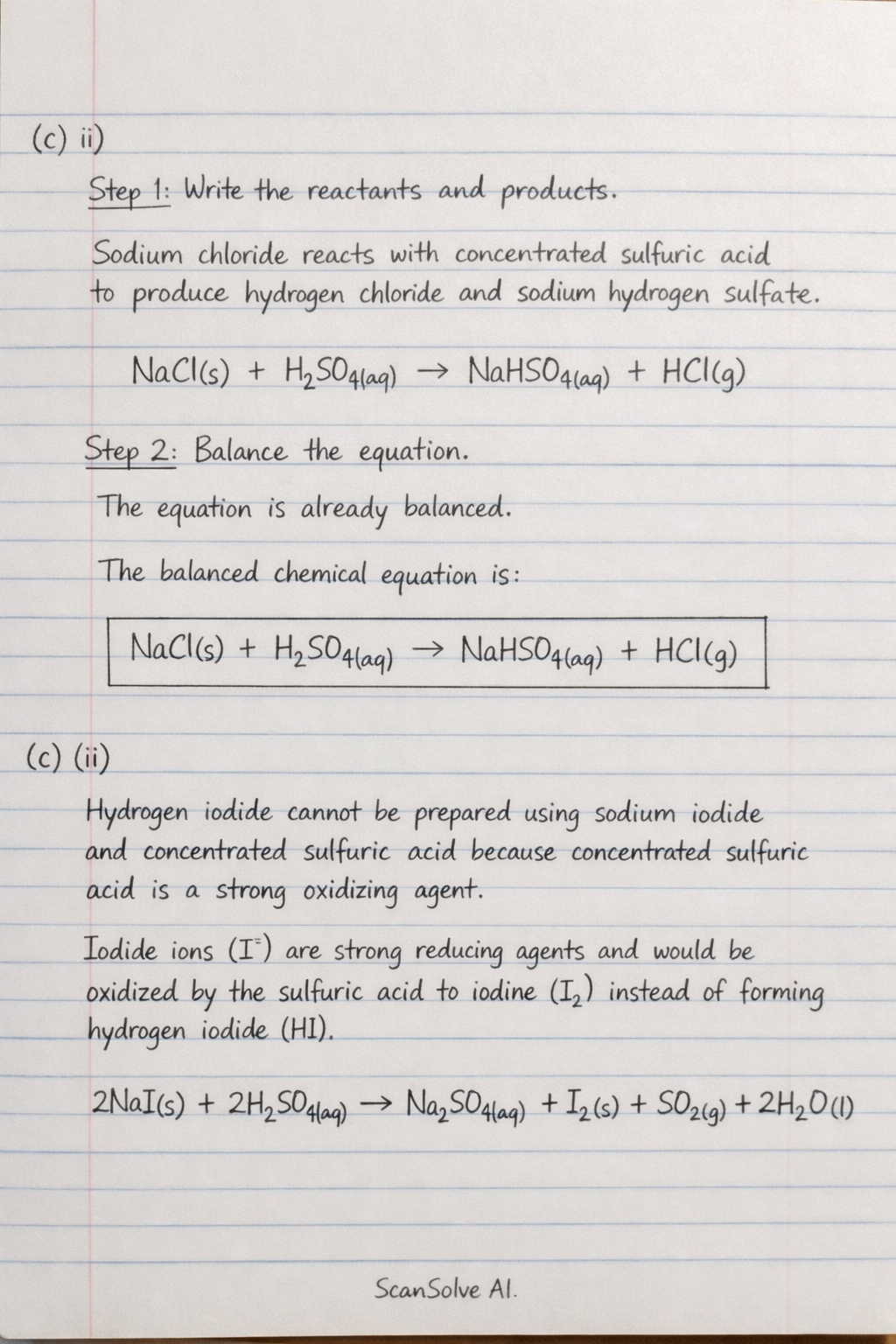
Write the reactants and products.
Sodium chloride reacts with concentrated sulfuric acid to produce hydrogen chloride and sodium hydrogen sulfate.
Balance the equation.
The equation is already balanced.
- The balanced chemical equation is:
c) (ii)
Hydrogen iodide cannot be prepared using sodium iodide and concentrated sulfuric acid because concentrated sulfuric acid is a strong oxidizing agent. Iodide ions () are strong reducing agents and would be oxidized by the sulfuric acid to iodine () instead of forming hydrogen iodide ().d)
The acid strength of oxo-acids with the general formula HOX (where X is a halogen) depends on the electronegativity of the halogen atom. As the electronegativity of X increases, it pulls electron density away from the O-H bond, making the hydrogen more acidic.
Electronegativity order: .
Therefore, the increasing order of acid strength is:e) (i)
Groups I and II elements are called s-block elements because their outermost valence electrons occupy the s-orbital.e) (ii)
Diagonal relationship is a phenomenon where certain elements of the second period exhibit similarities in properties with elements diagonally placed in the third period of the next group. This similarity arises due to comparable charge/radius ratios of the ions.e) (iii)
Two s-block elements that show diagonal relationship are:- Lithium (Li) and Magnesium (Mg)
- Beryllium (Be) and Aluminum (Al)
e) (iv)
Effect of heat on s-block nitrates:
For : Lithium nitrate decomposes to lithium oxide, nitrogen dioxide, and oxygen.For : Sodium nitrate decomposes to sodium nitrite and oxygen.
e) (v) A:
Group I carbonates are more stable to heat than Group II carbonates because the cations of Group I elements are larger and have a lower charge (+1) compared to Group II cations (+2). This results in lower polarizing power for Group I cations, meaning they distort the carbonate ion () less effectively. Less distortion leads to stronger C-O bonds within the carbonate ion, making it more difficult to decompose by heat.e) (v) B:
The solubility of Group II sulfates decreases down the group. This is because as you move down Group II, the size of the cation increases. Both the lattice energy (energy released when ions form a crystal lattice) and the hydration energy (energy released when ions are hydrated by water molecules) decrease with increasing ionic size. However, for Group II sulfates, the decrease in hydration energy is more significant than the decrease in lattice energy. This makes it energetically less favorable for the larger sulfates to dissolve, leading to a decrease in solubility.
Still stuck on this one?
Ask a follow-up, and the answer starts from this question.
More Chemistry Questions
Handwritten Step-by-Step Solution
Get this as a handwritten image on WhatsApp — like a tutor wrote it for you.
Try on WhatsApp