
We read your photo as:
Explain Boyle's Law and calculate the final volume of a gas given initial conditions and a final pressure. Differentiate between simple molecular and giant covalent structures.
ScanSolve AI Answer
Step-by-step solution
4 stepshere are the answers to your questions:
- To calculate the volume of the gas at , we use Boyle's Law, which states that for a fixed mass of gas at constant temperature, the pressure is inversely proportional to its volume ().
Identify the given values.
Initial volume ($V_1$) = $400 \text{ cm}^3$ Initial pressure ($P_1$) = $1 \text{ atm}$ Final pressure ($P_2$) = $4 \text{ atm}$ Final volume ($V_2$) = ?Apply Boyle's Law formula.
$$ P_1V_1 = P_2V_2 $$Rearrange the formula to solve for .
$$ V_2 = \frac{P_1V_1}{P_2} $$Substitute the values and calculate.
$$ V_2 = \frac{1 \text{ atm} \times 400 \text{ cm}^3}{4 \text{ atm}} $$ $$ V_2 = \frac{400 \text{ atm} \cdot \text{cm}^3}{4 \text{ atm}} $$ $$ V_2 = 100 \text{ cm}^3 $$ The volume of the gas at $4 \text{ atm}$ is $\boxed{\text{100 cm}^3}$.16. a) The difference between Simple Molecular and Giant Covalent Structures lies in their bonding and overall arrangement: * Simple Molecular Structures consist of discrete molecules where atoms within each molecule are held together by strong covalent bonds, but the forces between molecules (intermolecular forces) are weak. This results in low melting and boiling points because little energy is needed to overcome these weak intermolecular forces. They do not conduct electricity as they have no free moving ions or delocalized electrons. * Giant Covalent Structures consist of a vast, continuous network of atoms, all held together by strong covalent bonds throughout the entire structure. There are no discrete molecules. This extensive network of strong bonds requires a large amount of energy to break, leading to very high melting and boiling points. Most giant covalent structures do not conduct electricity (except for graphite, which has delocalized electrons).
b) Two properties of Covalent Compounds are: * They generally have **low melting and boiling points** because the intermolecular forces between molecules are weak and require little energy to overcome. * They are typically **poor conductors of electricity** in both solid and liquid states because they do not contain free-moving ions or delocalized electrons to carry charge.17. a) Electronegativity is defined as the measure of the tendency of an atom to attract a bonding pair of electrons towards itself in a covalent bond.
b) Electronegativity influences bond formation by determining the **type** of bond formed between two atoms and its **polarity**:
*   If two atoms have a **small or zero difference** in electronegativity, they will share electrons relatively equally, forming a **non-polar covalent bond**.
*   If there is a **moderate difference** in electronegativity, the electrons will be shared unequally, being pulled closer to the more electronegative atom. This creates partial positive and negative charges on the atoms, resulting in a **polar covalent bond**.
*   If there is a **large difference** in electronegativity, the more electronegative atom will essentially pull the electron(s) completely away from the less electronegative atom, leading to the formation of ions and an **ionic bond**.
Still stuck on this one?
Ask a follow-up, and the answer starts from this question.
More Chemistry Questions
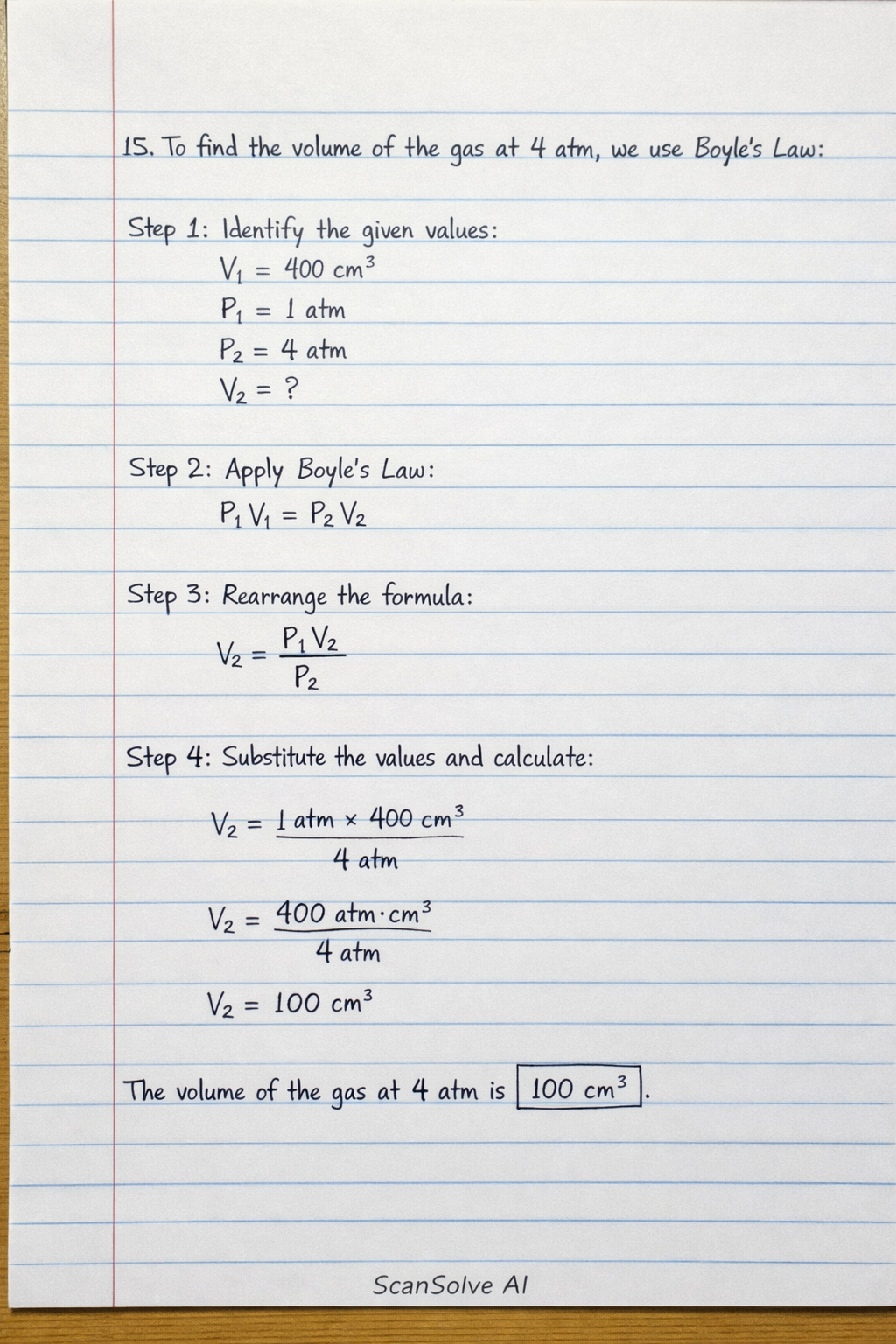
Handwritten Step-by-Step Solution
Get this as a handwritten image on WhatsApp — like a tutor wrote it for you.
Try on WhatsApp