
We read your photo as:
Explain the Brønsted-Lowry concept of acids, calculate the pH of a 0.001 M H2SO4 solution, define heterogeneous catalysts, and identify the strongest oxidizing and reducing agents based on standard el
ScanSolve AI Answer
Answers
2 partsStep-by-step solution
4 stepsPart d(i)
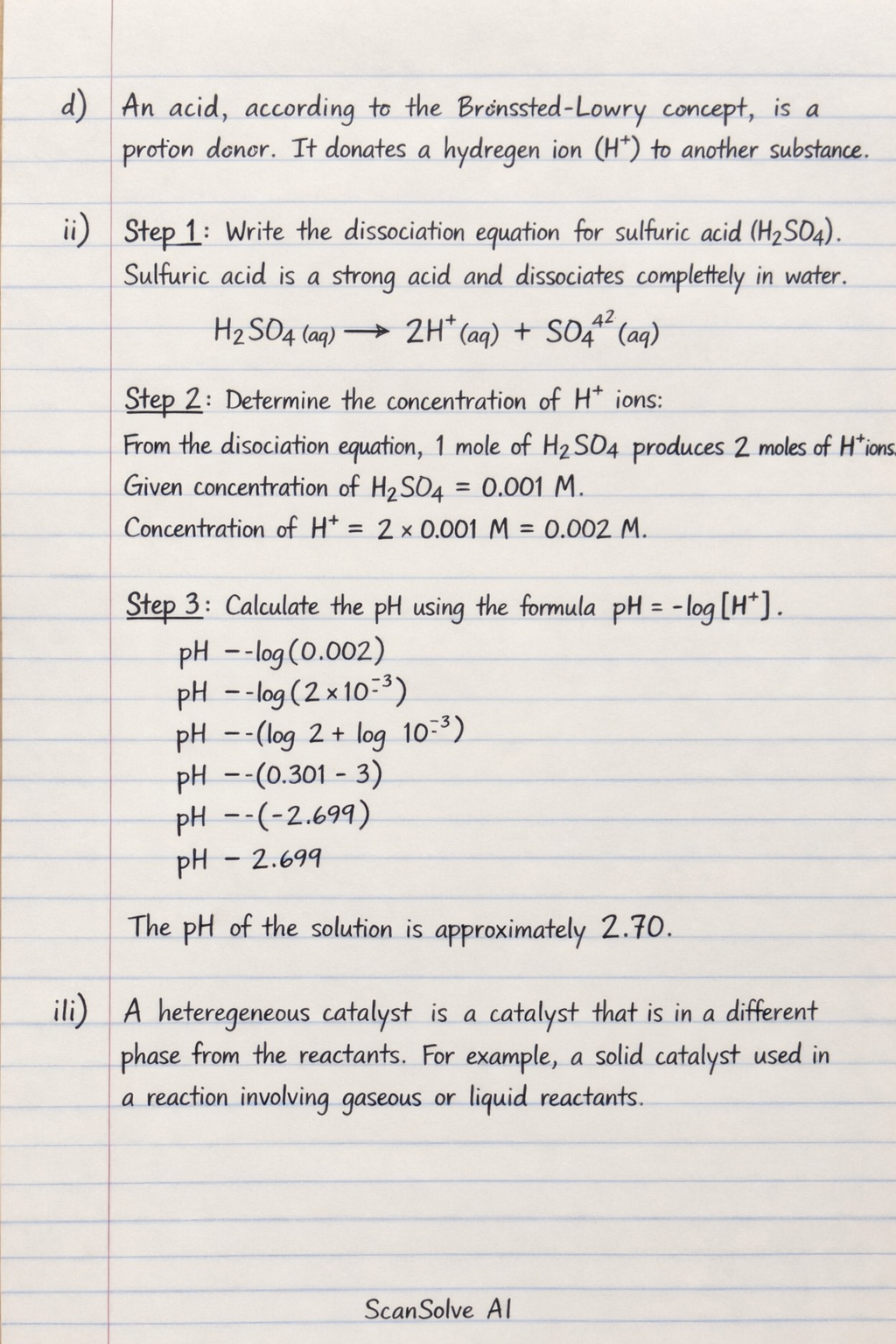
An acid, according to the Brønsted-Lowry concept, is a proton donor. It donates a hydrogen ion () to another substance.
Part d(ii)· 2 steps
Step 1: Write the dissociation equation for sulfuric acid ().
Sulfuric acid is a strong acid and dissociates completely in water.
Determine the concentration of ions.
From the dissociation equation, 1 mole of produces 2 moles of ions.
Given concentration of .
Concentration of .Calculate the pH using the formula .
The pH of the solution is approximately 2.70.
Part d(iii)
A heterogeneous catalyst is a catalyst that is in a different phase from the reactants. For example, a solid catalyst used in a reaction involving gaseous or liquid reactants.
Part e(i)
To identify the strongest oxidizing and reducing agents, we look at the standard electrode potentials ().
- The strongest oxidizing agent is the species on the left side of the half-reaction with the most positive (or least negative) value. This species is most easily reduced.
- The strongest reducing agent is the species on the right side of the half-reaction with the most negative (or least positive) value. This species is most easily oxidized.
Given electrode potentials:
A: ,
B: ,
C: ,
Comparing the values: is the most positive.
The strongest oxidizing agent is .
Comparing the values: is the most negative.
The strongest reducing agent is .
Strongest oxidizing agent:
Strongest reducing agent:
Part e(ii)
Step 1: Determine the anode and cathode when cells A and B are coupled.
For a spontaneous reaction, the species with the more positive will be reduced (cathode), and the species with the more negative will be oxidized (anode).
Cell A: ,
Cell B: ,
Since is more positive than , reaction B will occur at the cathode (reduction) and reaction A will occur at the anode (oxidation, reversed).
Anode (oxidation):
Cathode (reduction):
Write the cell diagram.
The cell diagram notation is: Anode | Anode ion || Cathode ion | Cathode.
Calculate the electromotive force (emf) of the cell.
The emf of the cell is .
Part e(iii)
Electrons flow from the anode to the cathode in the external circuit.
In this cell, is oxidized at the anode, and is reduced at the cathode.
Therefore, electrons will flow from the lead electrode (Pb) to the iodine electrode (I).
Try one yourself
A new problem that tests the same skill.
Still stuck on this one?
Ask a follow-up, and the answer starts from this question.
More Chemistry Questions
Handwritten Step-by-Step Solution
Get this as a handwritten image on WhatsApp — like a tutor wrote it for you.
Try on WhatsApp