
We read your photo as:
Explain briefly the statement: Ionic compounds conduct electricity when molten or in aqueous solution but not in the solid state. Write electron configuration for each of the following species: (i) 19K (ii) 17Cl- (iii) 20Ca2+. What is an alkali?
ScanSolve AI Answer
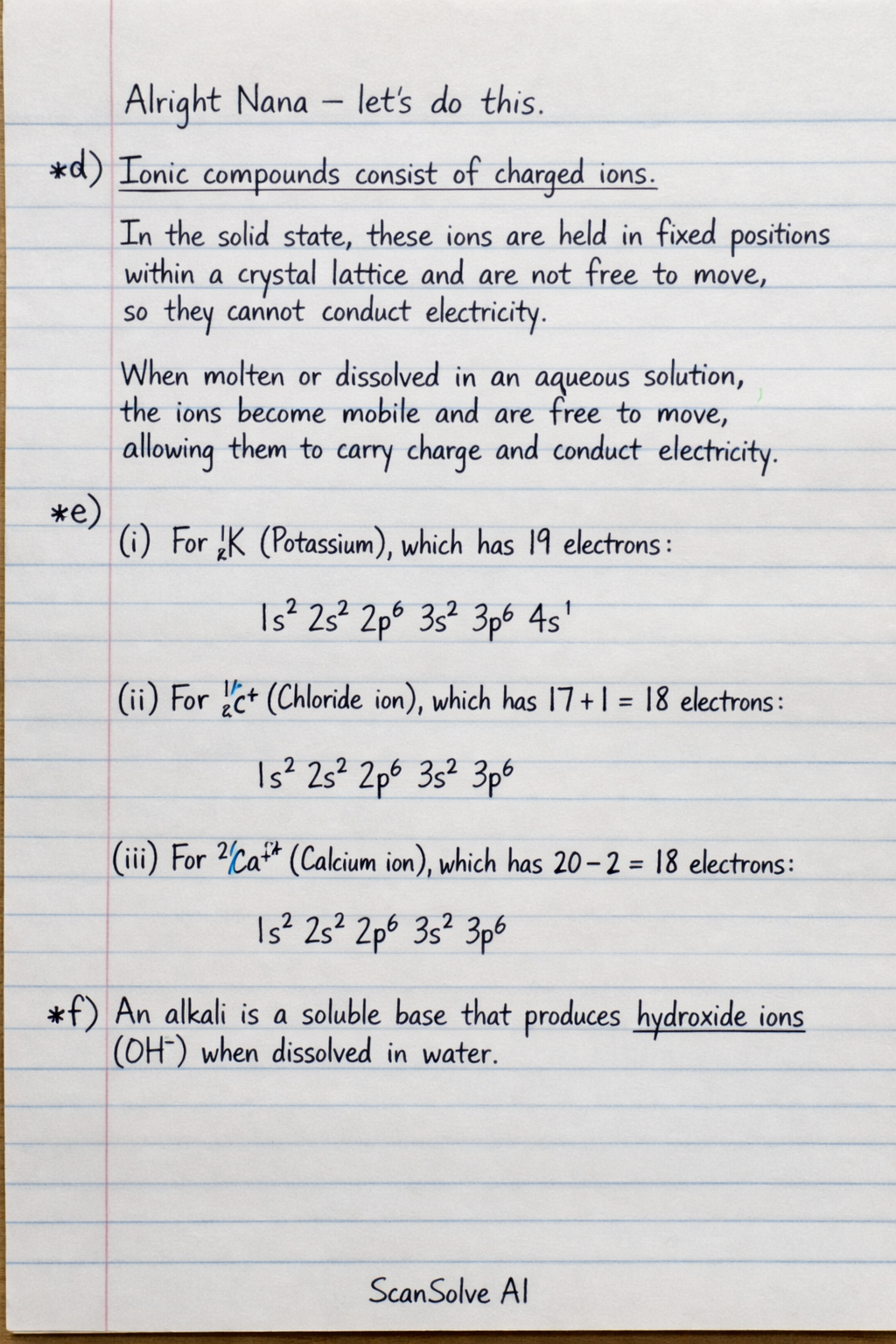
d) Ionic compounds consist of charged ions.
In the solid state, these ions are held in fixed positions within a crystal lattice and are not free to move, so they cannot conduct electricity.
When molten or dissolved in an aqueous solution, the ions become mobile and are free to move, allowing them to carry charge and conduct electricity.
e)
(i) For K (Potassium), which has 19 electrons:
(ii) For Cl (Chloride ion), which has 17 + 1 = 18 electrons:
(iii) For Ca (Calcium ion), which has 20 - 2 = 18 electrons:
f) An alkali is a soluble base that produces hydroxide ions () when dissolved in water.
Still stuck on this one?
Ask a follow-up, and the answer starts from this question.
More Chemistry Questions
Handwritten Step-by-Step Solution
Get this as a handwritten image on WhatsApp — like a tutor wrote it for you.
Try on WhatsApp