
We read your photo as:
Comment on the coordination number of lanthanides and provide evidence for the existent of the coordination number of 9. Illustrate with examples why some lanthanide ions are coloured and others are n
ScanSolve AI Answer
Step-by-step solution
9 stepsHere are the solutions to questions 5a, 5b, and 5c.
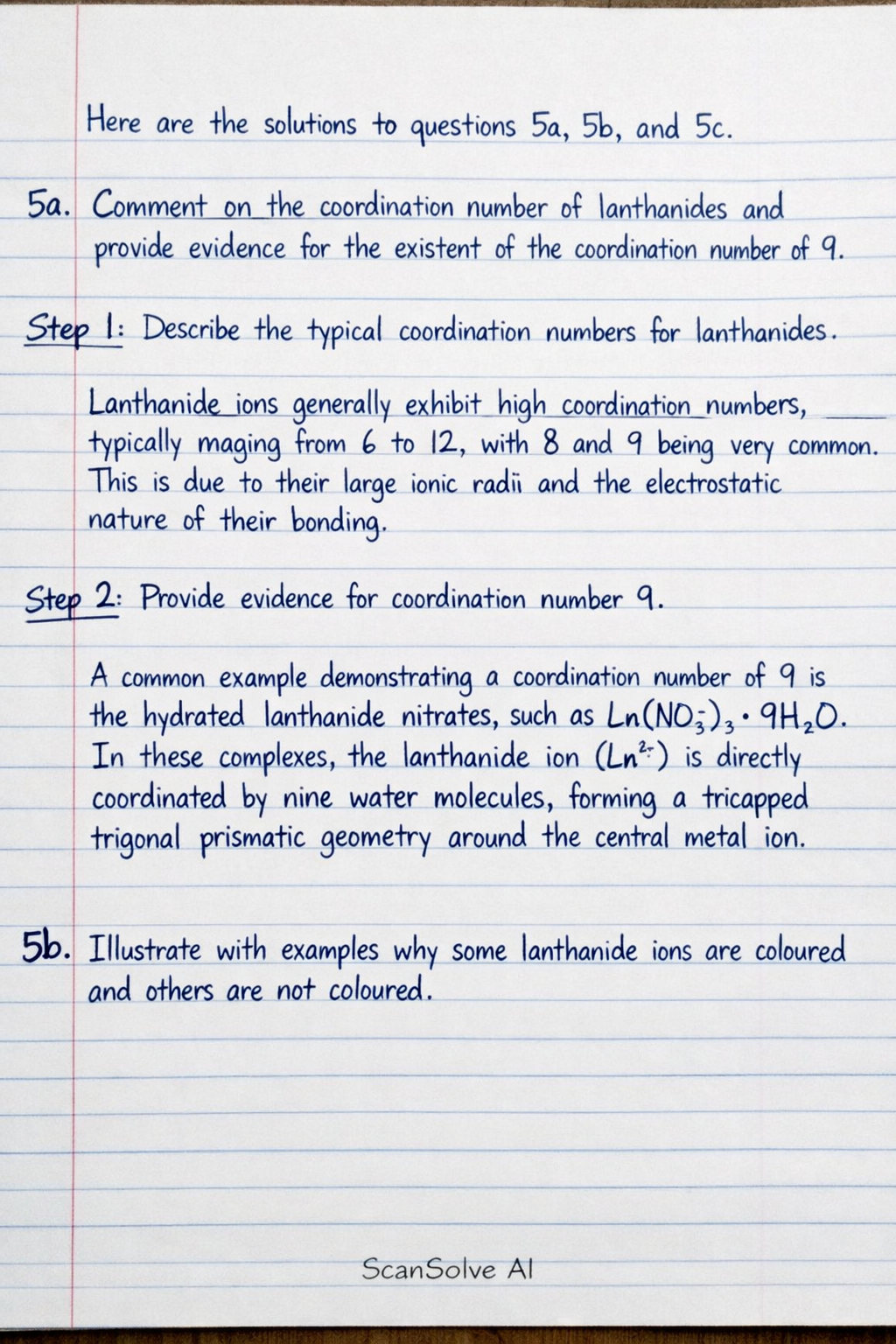
5a. Comment on the coordination number of lanthanides and provide evidence for the existent of the coordination number of 9.
Describe the typical coordination numbers for lanthanides.
Lanthanide ions generally exhibit high coordination numbers, typically ranging from 6 to 12, with 8 and 9 being very common. This is due to their large ionic radii and the electrostatic nature of their bonding.
Provide evidence for coordination number 9.
A common example demonstrating a coordination number of 9 is the hydrated lanthanide nitrates, such as . In these complexes, the lanthanide ion () is directly coordinated by nine water molecules, forming a tricapped trigonal prismatic geometry around the central metal ion.
5b. Illustrate with examples why some lanthanides ions are coloured and others are not coloured.
Explain the origin of colour in lanthanide ions.
Colour in lanthanide ions arises from f-f electronic transitions. These transitions occur when an electron in a lower energy f-orbital absorbs light and moves to a higher energy f-orbital within the same 4f subshell. The specific wavelength of light absorbed determines the observed colour.
Explain why some lanthanide ions are colourless.
Lanthanide ions are colourless if they have either empty f-orbitals () or completely filled f-orbitals (). In these cases, there are no available f-electrons to undergo f-f transitions () or no empty f-orbitals for electrons to transition into ().
Provide examples of colourless and coloured lanthanide ions.
- Colourless Lanthanide Ions:
- : Electron configuration is . It has no f-electrons for transitions.
- : Electron configuration is . It has completely filled f-orbitals, so no empty f-orbitals for transitions.
- : Electron configuration is . Although it has partially filled f-orbitals, its f-f transitions are very weak and occur in the UV region, making it appear colourless.
- Coloured Lanthanide Ions:
- : Electron configuration is . It is typically green.
- : Electron configuration is . It is typically lilac/pink.
- : Electron configuration is . It is typically pink.
5c. Why are transition metal ions with zero, partially and completely filled orbital colourless.
- Colourless Lanthanide Ions:
State the general principle for colour in transition metal ions.
Colour in most transition metal ions is due to d-d electronic transitions. These occur when electrons in partially filled d-orbitals absorb energy from visible light and jump to higher energy d-orbitals that have been split by the ligand field.
Explain why transition metal ions with zero d-electrons are colourless.
Transition metal ions with zero d-electrons ( configuration) are colourless because there are no d-electrons available to undergo d-d transitions.
- Example: () and () are both colourless.
Explain why transition metal ions with completely filled d-orbitals are colourless.
Transition metal ions with completely filled d-orbitals ( configuration) are colourless because all d-orbitals are occupied. There are no empty d-orbitals at higher energy for electrons to transition into.
- Example: () and () are both colourless.
Address why transition metal ions with partially filled d-orbitals might appear colourless.
Transition metal ions with partially filled d-orbitals are typically coloured due to d-d transitions. However, if they appear colourless, it is usually because:
- The energy difference between the split d-orbitals is such that the absorption of light occurs outside the visible region (e.g., in the ultraviolet or infrared range).
- The d-d transitions are extremely weak (e.g., due to symmetry restrictions), resulting in very little light being absorbed in the visible spectrum, making the compound appear very pale or effectively colourless.
Still stuck on this one?
Ask a follow-up, and the answer starts from this question.
More Chemistry Questions
Handwritten Step-by-Step Solution
Get this as a handwritten image on WhatsApp — like a tutor wrote it for you.
Try on WhatsApp