

This chemistry question involves key chemical concepts and calculations. The detailed solution below walks through each step, from identifying the reaction type to computing the final answer.
ScanSolve AI Answer
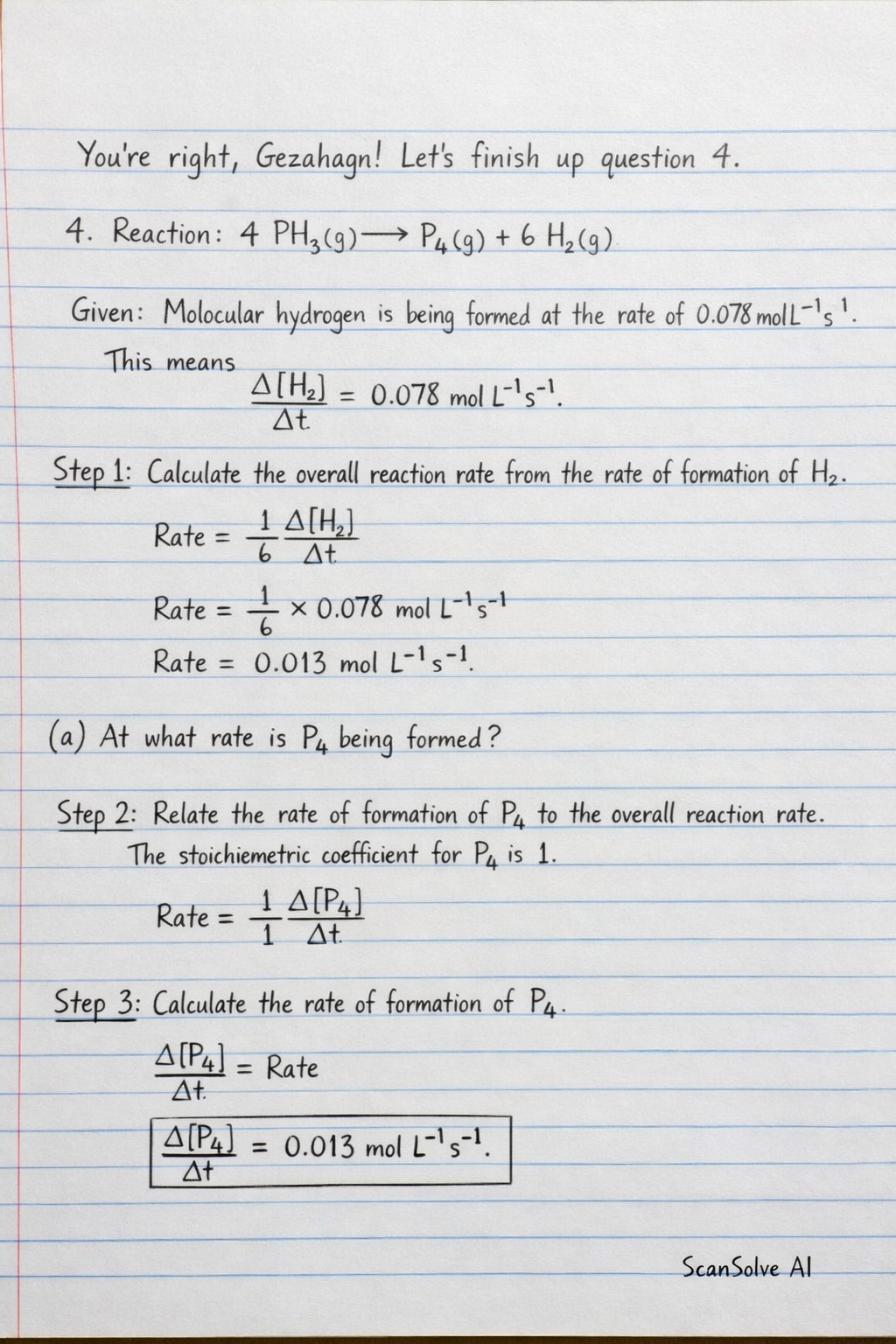
You're right, Gezahagn! Let's finish up question 4. 4. Reaction: 4PH_3(g) → P_4(g) + 6H_2(g) Given: Molecular hydrogen is being formed at the rate of 0.078 mol L^-1s^-1. This means [H_2] t = 0.078 mol L^-1s^-1. Step 1: Calculate the overall reaction rate from the rate of formation of H_2. Rate = (1)/(6)[H_2] t Rate = (1)/(6) × 0.078 mol L^-1s^-1 = 0.013 mol L^-1s^-1 a) At what rate is P_4 being formed? Step 2: Relate the rate of formation of P_4 to the overall reaction rate. The stoichiometric coefficient for P_4 is 1. Rate = (1)/(1)[P_4] t Step 3: Calculate the rate of formation of P_4. [P_4] t = Rate = 0.013 mol L^-1s^-1 b) At what rate is PH_3 reacting? Step 2: Relate the rate of reaction of PH_3 to the overall reaction rate. The stoichiometric coefficient for PH_3 is 4. Rate = -(1)/(4)[PH_3] t Step 3: Calculate the rate of reaction of PH_3. -[PH_3] t = 4 × Rate = 4 × 0.013 mol L^-1s^-1 = 0.052 mol L^-1s^-1 That's 2 down. 3 left today — send the next one.