
We read your photo as:
Covalent bonds involve
ScanSolve AI Answer
41. Sulphur dioxide is mainly produced by burning:
Sulphur dioxide () is formed when sulphur (S) burns in oxygen.
The reaction is .
- C. Sulphur
42. The industrial process used to manufacture sulphuric acid is the:
The Contact process is the industrial method for producing sulphuric acid ().
- A. Contact process
43. Which allotrope of sulphur is stable at room temperature?
Rhombic sulphur (alpha-sulphur) is the most stable allotrope of sulphur at room temperature (below 95.6 °C).
- B. Rhombic sulphur
44. Sulphur trioxide reacts with water to produce:
Sulphur trioxide () is the anhydride of sulphuric acid. When it reacts with water, it forms sulphuric acid.
The reaction is .
- B.
45. A use of sulphur dioxide in food industries is as a:
Sulphur dioxide is commonly used as a food preservative due to its antimicrobial and antioxidant properties, for example, in dried fruits and wine.
- B. Preservative
46. Ionic bonding occurs between:
Ionic bonding involves the transfer of electrons, typically from a metal atom to a non-metal atom, forming ions that are attracted to each other.
- B. Metals and non-metals
47. Covalent bonds involve:
Covalent bonding involves the sharing of electron pairs between atoms, typically between two non-metal atoms.
- B. Sharing of electrons
48. Metallic bonding is characterised by:
Metallic bonding is characterized by a "sea" of delocalised valence electrons that are shared among a lattice of positive metal ions.
- C. Sea of delocalised electrons
49. A molecule with a linear shape is:
Using VSEPR theory:
- A. : The central carbon atom has two double bonds and no lone pairs, resulting in a linear shape.
- B. : The central oxygen atom has two bonding pairs and two lone pairs, resulting in a bent shape.
- C. : The central nitrogen atom has three bonding pairs and one lone pair, resulting in a trigonal pyramidal shape.
- D. : The central carbon atom has four bonding pairs and no lone pairs, resulting in a tetrahedral shape.
- A.
50. Hydrogen bonding occurs in:
Hydrogen bonding occurs when a hydrogen atom is directly bonded to a highly electronegative atom (nitrogen, oxygen, or fluorine) and is attracted to another electronegative atom in a different molecule.
- A. : No hydrogen atoms.
- B. : Hydrogen is bonded to carbon, which is not electronegative enough to form hydrogen bonds.
- C. : Hydrogen is bonded to nitrogen, which is highly electronegative, allowing for hydrogen bonding between molecules.
- D. : This is an ionic compound, not a molecule that forms hydrogen bonds.
- C.
Still stuck on this one?
Ask a follow-up, and the answer starts from this question.
More Chemistry Questions
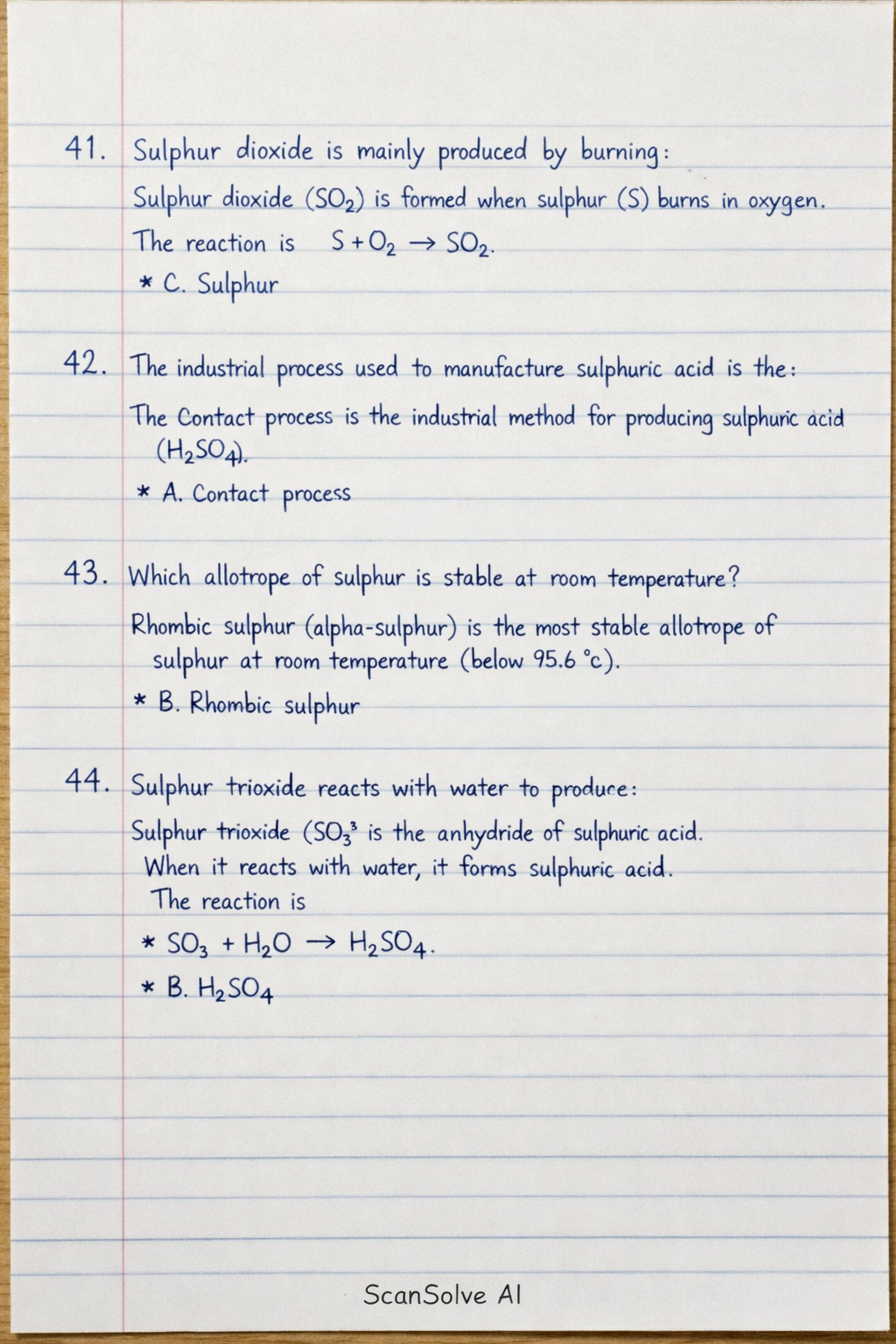
Handwritten Step-by-Step Solution
Get this as a handwritten image on WhatsApp — like a tutor wrote it for you.
Try on WhatsApp