We read your photo as:

Calculate the density of KF given it has an NaCl structure and the distance between K+ and F- ions is 269 pm.

Chemistry

ScanSolve AI Answer

Answer

d) 2.48 g/cm3\text{d) } 2.48 \, \text{g/cm}^3

Step-by-step solution

9 steps
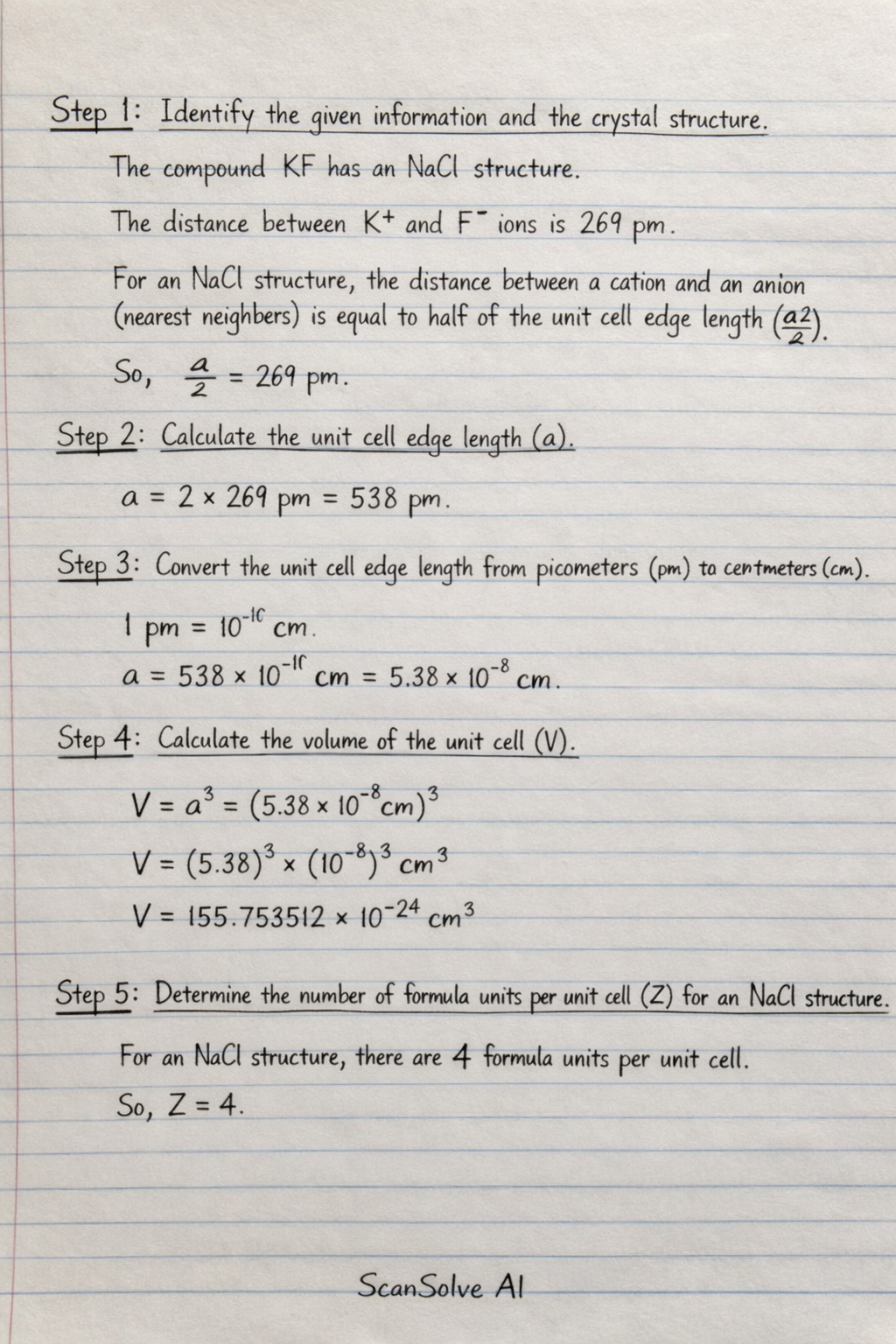
  1. Identify the given information and the crystal structure.

    The compound KF has an NaCl structure.
    The distance between K+^+ and F−^- ions is 269 pm269 \, \text{pm}.
    For an NaCl structure, the distance between a cation and an anion (nearest neighbors) is equal to half of the unit cell edge length (a/2a/2).
    So, a2=269 pm\frac{a}{2} = 269 \, \text{pm}.

  2. Calculate the unit cell edge length (aa).

    a=2×269 pm=538 pma = 2 \times 269 \, \text{pm} = 538 \, \text{pm}
  3. Convert the unit cell edge length from picometers (pm) to centimeters (cm).

    1 pm=10−10 cm1 \, \text{pm} = 10^{-10} \, \text{cm}

    a=538×10−10 cm=5.38×10⁻⁸ cma = 538 \times 10^{-10} \, \text{cm} = 5.38 \times 10^{-8} \, \text{cm}
  4. Calculate the volume of the unit cell (VV).

    V=a3=(5.38×10⁻⁸ cm)3V = a^3 = (5.38 \times 10^{-8} \, \text{cm})^3 V=(5.38)3×(10−8)3 cm3V = (5.38)^3 \times (10^{-8})^3 \, \text{cm}^3 V=155.753512×10⁻²⁴ cm3V = 155.753512 \times 10^{-24} \, \text{cm}^3
  5. Determine the number of formula units per unit cell (ZZ) for an NaCl structure.

    For an NaCl structure, there are 4 formula units per unit cell. So, Z=4Z = 4.

  6. Calculate the molar mass (MM) of KF.

    Atomic mass of K ≈39.098 g/mol\approx 39.098 \, \text{g/mol}
    Atomic mass of F ≈18.998 g/mol\approx 18.998 \, \text{g/mol}

    M=39.098+18.998=58.096 g/molM = 39.098 + 18.998 = 58.096 \, \text{g/mol}
  7. Use Avogadro's number (NAN_A).

    NA=6.022×10²³ mol−1N_A = 6.022 \times 10^{23} \, \text{mol}^{-1}
  8. Apply the formula for density (ρ\rho).

    ρ=Z×Ma3×NA\rho = \frac{Z \times M}{a^3 \times N_A}

    Substitute the values:

    ρ=4×58.096 g/mol(155.753512×10−24 cm3)×(6.022×1023 mol−1)\rho = \frac{4 \times 58.096 \, \text{g/mol}}{(155.753512 \times 10^{-24} \, \text{cm}^3) \times (6.022 \times 10^{23} \, \text{mol}^{-1})} ρ=232.384 g(155.753512×6.022)×10−24+23 cm3\rho = \frac{232.384 \, \text{g}}{ (155.753512 \times 6.022) \times 10^{-24+23} \, \text{cm}^3} ρ=232.384 g937.89606×10−1 cm3\rho = \frac{232.384 \, \text{g}}{937.89606 \times 10^{-1} \, \text{cm}^3} ρ=232.384 g93.789606 cm3\rho = \frac{232.384 \, \text{g}}{93.789606 \, \text{cm}^3} ρ≈2.4776 g/cm3\rho \approx 2.4776 \, \text{g/cm}^3
  9. Compare the calculated density with the given options.

    The calculated density is approximately 2.4776 g/cm32.4776 \, \text{g/cm}^3, which rounds to 2.48 g/cm32.48 \, \text{g/cm}^3. This matches option (d).

    The final answer is d) 2.48 g/cm3\text{d) } 2.48 \, \text{g/cm}^3.

Was this helpful?

Try one yourself

A new problem that tests the same skill.

Still stuck on this one?

Ask a follow-up, and the answer starts from this question.

Got a different question?Ask your own question
Handwritten step-by-step solution preview

Handwritten Step-by-Step Solution

Get this as a handwritten image on WhatsApp — like a tutor wrote it for you.

Try on WhatsApp