
We read your photo as:
Determine the number of protons and neutrons for Sodium (23/11 Na) and Fluorine (19/9 F). Also, describe the electron configuration for Na+ and F- ions.
ScanSolve AI Answer
Step-by-step solution
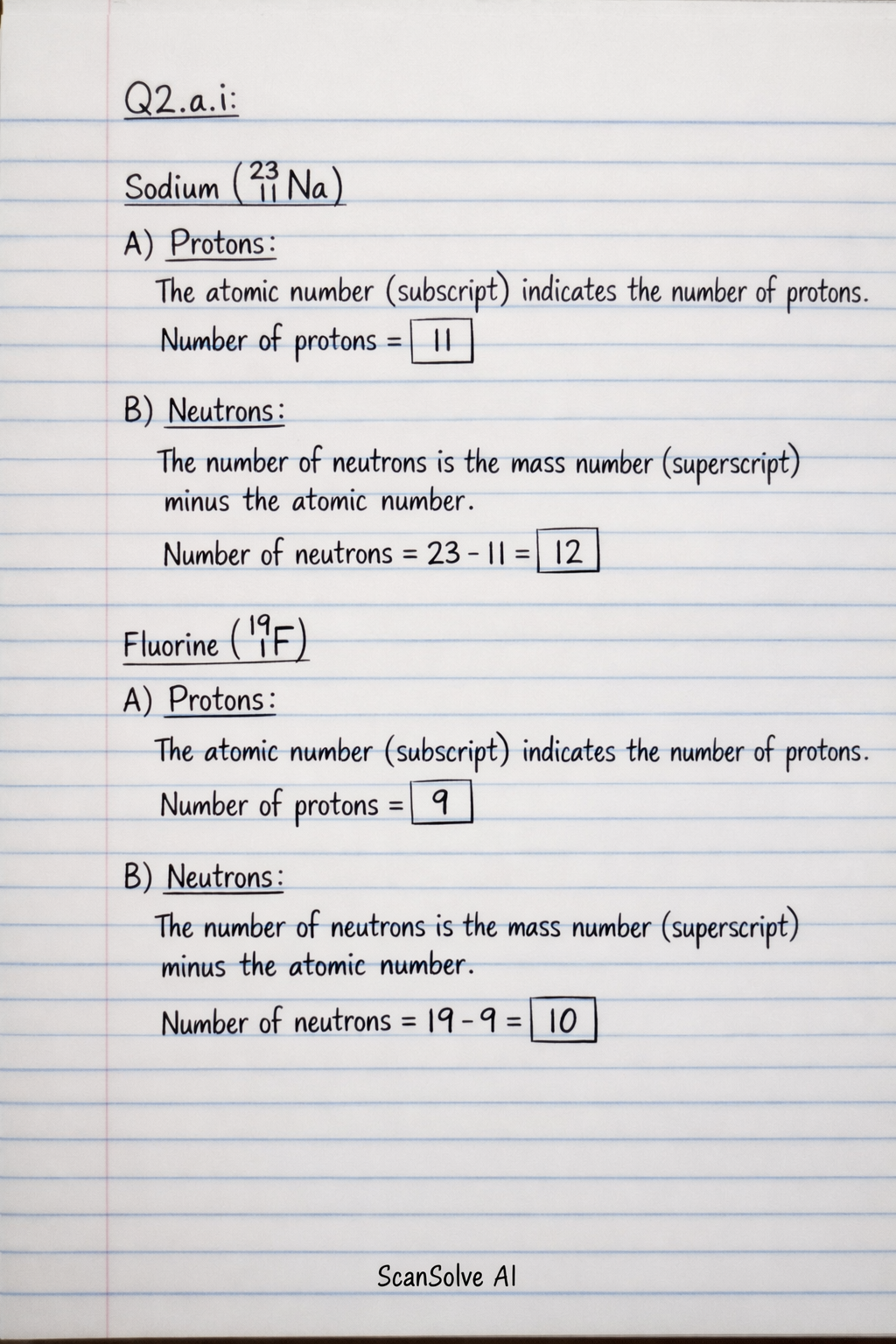
2 stepsQ2.a.i:
- Sodium (
\text{^{23}_{11}Na})- A) Protons: The atomic number (subscript) indicates the number of protons. Number of protons =
- B) Neutrons: The number of neutrons is the mass number (superscript) minus the atomic number. Number of neutrons =
- Fluorine (
\text{^{19}_{9}F})- A) Protons: The atomic number (subscript) indicates the number of protons. Number of protons =
- B) Neutrons: The number of neutrons is the mass number (superscript) minus the atomic number. Number of neutrons =
Q2.a.ii:
-
A) Sodium ion () A sodium atom () has 11 electrons (2, 8, 1). A sodium ion () loses one electron, so it has 10 electrons (2, 8).
(Diagram showing a central nucleus with 11 protons and 12 neutrons, surrounded by two electron shells: the first with 2 electrons and the second with 8 electrons.)
-
B) Fluorine ion () A fluorine atom () has 9 electrons (2, 7). A fluorine ion () gains one electron, so it has 10 electrons (2, 8).
(Diagram showing a central nucleus with 9 protons and 10 neutrons, surrounded by two electron shells: the first with 2 electrons and the second with 8 electrons.)
Q2.b.i: Two reasons why salt is important in the diet of humans are:
- It helps maintain fluid balance and blood pressure in the body.
- It is essential for nerve impulse transmission and muscle contraction.
Q2.b.ii: Two examples of an abiotic factor which is non-climatic in a terrestrial ecosystem are:
- Soil pH
- Soil mineral composition
Q2.c.i: An electrical conductor is a material that allows electric current to flow through it easily due to the presence of free electrons or ions.
Q2.c.ii:
Calculate the equivalent resistance () for two resistors in parallel.
Given and .
Calculate the total current () using Ohm's Law.
Given .
The value of the current supplied by the source is .
Q2.d.i:
- Ear-notching is a permanent method of identification where specific V-shaped cuts are made on the edge of an animal's ear, often following a numbering system.
- Ear-tagging is a semi-permanent method where a plastic or metal tag, usually with an identification number, is clamped onto the ear of an animal.
Q2.d.ii: Three ecto-parasites that infest goats in West Africa are:
- Ticks
- Lice
- Mites
Still stuck on this one?
Ask a follow-up, and the answer starts from this question.
More Chemistry Questions
Handwritten Step-by-Step Solution
Get this as a handwritten image on WhatsApp — like a tutor wrote it for you.
Try on WhatsApp