

This chemistry question involves key chemical concepts and calculations. The detailed solution below walks through each step, from identifying the reaction type to computing the final answer.
ScanSolve AI Answer
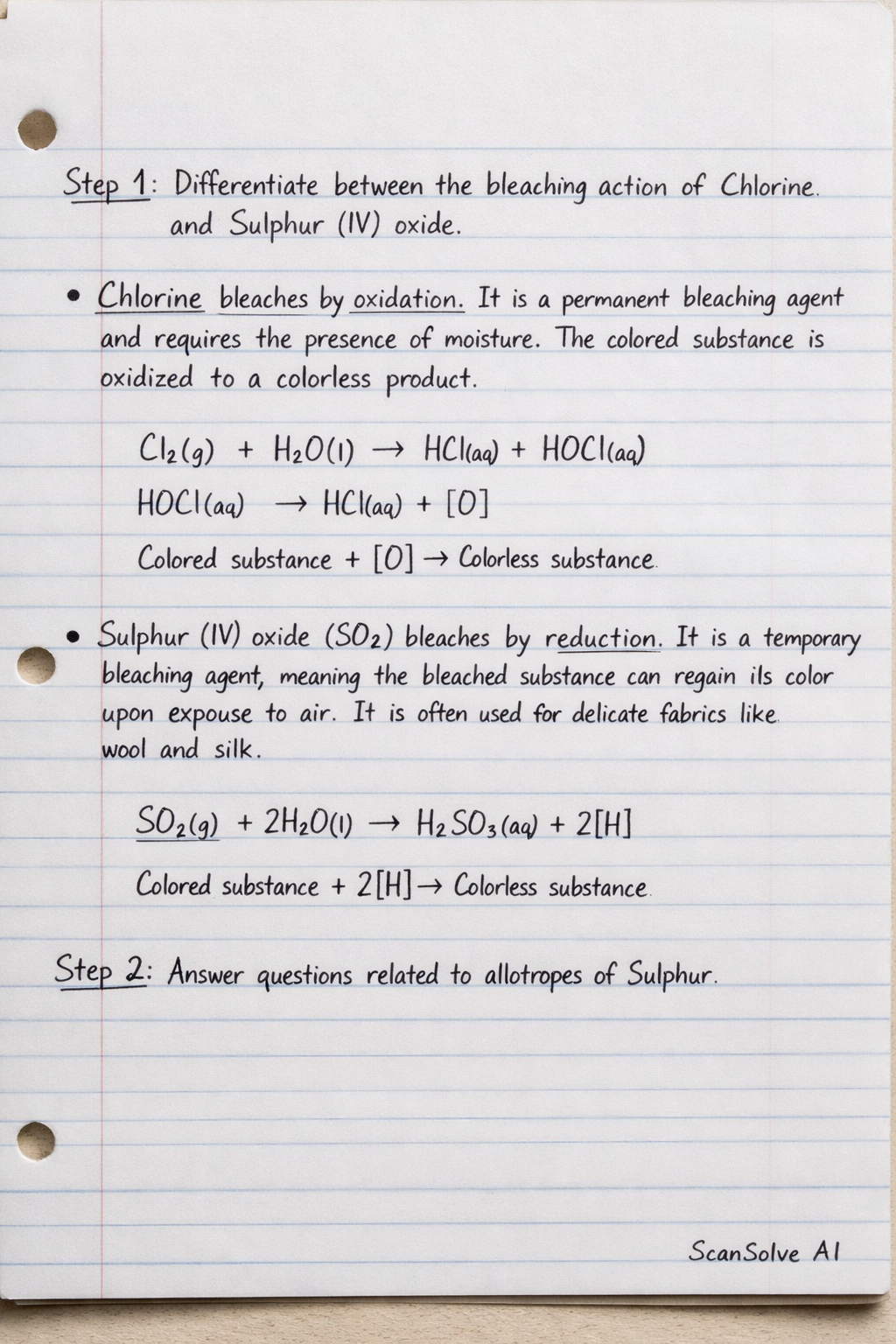
Step 1: Differentiate between the bleaching action of Chlorine and Sulphur (IV) oxide. Chlorine bleaches by oxidation*. It is a permanent bleaching agent and requires the presence of moisture. The colored substance is oxidized to a colorless product. Cl_2(g) + H_2O(l) HCl(aq) + HOCl(aq) HOCl(aq) HCl(aq) + [O] Colored substance + [O] Colorless substance Sulphur (IV) oxide (SO_2) bleaches by reduction*. It is a temporary bleaching agent, meaning the bleached substance can regain its color upon exposure to air. It is often used for delicate fabrics like wool and silk. SO_2(g) + 2H_2O(l) H_2SO_4(aq) + 2[H] Colored substance + 2[H] Colorless substance Step 2: Answer questions related to allotropes of Sulphur. a)* What does the temperature 96^ represent? The temperature 96^ represents the transition temperature at which rhombic sulphur and monoclinic sulphur are in equilibrium and can interconvert. Below 96^, rhombic sulphur is stable. Above 96^, monoclinic sulphur is stable. Transition temperature b)* State the meaning of the term allotrope. An allotrope is one of two or more different physical forms in which an element can exist. These forms differ in their physical and chemical properties due to different arrangements of atoms. c)* Name another substance that shows allotropy. Carbon (Other examples include Oxygen, Phosphorus) Step 3: Name two substances recycled in the Solvay process. The Solvay process is used to produce sodium carbonate. The main substances recycled are: 1. Ammonia (NH_3) 2. Carbon dioxide (CO_2) Ammonia and Carbon dioxide Step 4: Describe how Nitrogen Gas can be separated from air. Nitrogen gas is separated from air primarily through the fractional distillation of liquid air. 1. Air is first filtered to remove dust particles. 2. It is then cooled to very low temperatures to remove water vapor and carbon dioxide, which freeze out. 3. The remaining air is compressed and further cooled until it liquefies. 4. The liquid air, which is a mixture of liquid nitrogen, liquid oxygen, and liquid argon, is then fed into a fractionating column. 5. As the liquid air warms up, nitrogen, having a lower boiling point (-196^), boils off first as a gas and is collected. Oxygen (boiling point -183^) and argon (boiling point -186^) are collected separately at different levels of the column.