
We read your photo as:
Write the dissolution equilibrium for silver chloride (AgCl).
ScanSolve AI Answer
Step-by-step solution
9 steps:
Write the dissolution equilibrium for silver chloride (AgCl).
Calculate the ion product () using the given concentrations.
The ion product expression for AgCl is .
Given and .Compare with the given value.
Given .
We have and .
Since , .Determine if a precipitate will form.
When , the solution is supersaturated, and a precipitate will form to reach equilibrium.
Therefore, a precipitate of AgCl will form.The final answer is .
:
Write the dissolution equilibrium for lead(II) iodide (PbI).
Write the expression for the solubility product ().
Given .
Set up an ICE table for the dissolution of PbI in the presence of a common ion.
The solution contains . Since KI is a strong electrolyte, it dissociates completely: .
So, the initial concentration of from KI is .
Let 's' be the molar solubility of PbI.Species Initial (M) Change (M) Equilibrium (M) 0 +s s 0.10 +2s 0.10 + 2s Substitute the equilibrium concentrations into the expression.
Since is very small (), we can assume that is much smaller than .
Therefore, .Solve for 's', the molar solubility of PbI.
The assumption that is valid because , which is indeed much smaller than 0.10.
The final answer is .
Still stuck on this one?
Ask a follow-up, and the answer starts from this question.
More Chemistry Questions
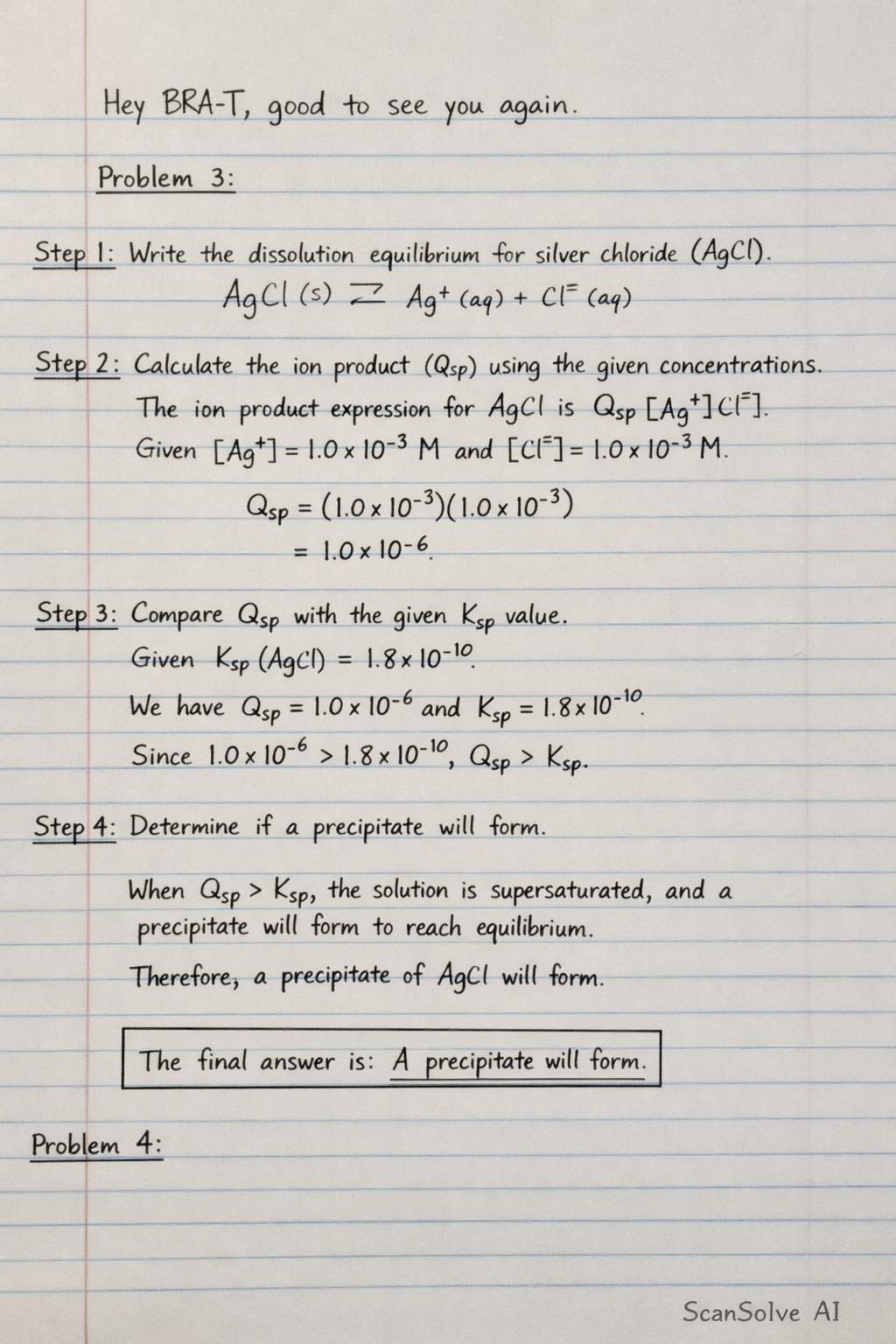
Handwritten Step-by-Step Solution
Get this as a handwritten image on WhatsApp — like a tutor wrote it for you.
Try on WhatsApp