We read your photo as:

Draw and name the structure of polymer formed from propene. Write an ionic equation for the reaction between sodium sulphate solution and lead (II) nitrate solution.

Chemistry

ScanSolve AI Answer

Step-by-step solution

5 steps

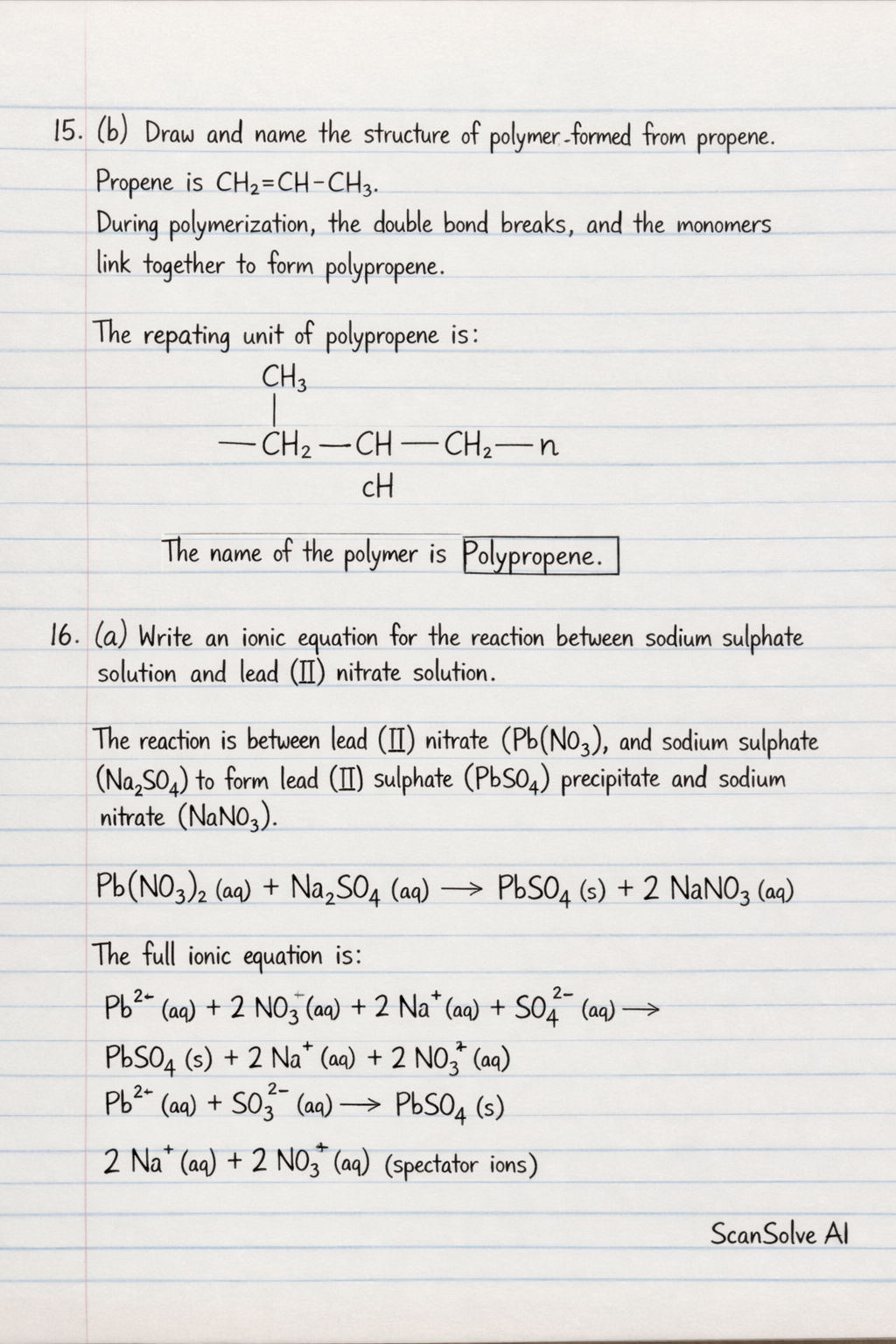
15. (b) Draw and name the structure of polymer formed from propene.
Propene is CH2=CH−CH3\text{CH}_2=\text{CH}-\text{CH}_3. During polymerization, the double bond breaks, and the monomers link together to form polypropene.

The repeating unit of polypropene is:

CH3∣−CH2−CH−n\begin{matrix} & \text{CH}_3 \\ & | \\ - & \text{CH}_2 & - & \text{CH} & - \end{matrix}_n

The name of the polymer is Polypropene\boxed{\text{Polypropene}}.

16. (a) Write an ionic equation for the reaction between sodium sulphate solution and lead (II) nitrate solution.
The reaction is between lead (II) nitrate (Pb(NO3)2\text{Pb(NO}_3)_2) and sodium sulphate (Na2SO4\text{Na}_2\text{SO}_4) to form lead (II) sulphate (PbSO4\text{PbSO}_4) precipitate and sodium nitrate (NaNO3\text{NaNO}_3).

Pb(NO3)2(aq)+Na2SO4(aq)⟶PbSO4(s)+2NaNO3(aq)\text{Pb(NO}_3)_2 \text{(aq)} + \text{Na}_2\text{SO}_4 \text{(aq)} \longrightarrow \text{PbSO}_4 \text{(s)} + 2\text{NaNO}_3 \text{(aq)}

The full ionic equation is:

Pb2+(aq)+2NO3−(aq)+2Na+(aq)+SO42−(aq)⟶PbSO4(s)+2Na+(aq)+2NO3−(aq)\text{Pb}^{2+} \text{(aq)} + 2\text{NO}_3^- \text{(aq)} + 2\text{Na}^+ \text{(aq)} + \text{SO}_4^{2-} \text{(aq)} \longrightarrow \text{PbSO}_4 \text{(s)} + 2\text{Na}^+ \text{(aq)} + 2\text{NO}_3^- \text{(aq)}

The net ionic equation, removing spectator ions, is:

Pb2+(aq)+SO42−(aq)⟶PbSO4(s)\boxed{\text{Pb}^{2+} \text{(aq)} + \text{SO}_4^{2-} \text{(aq)} \longrightarrow \text{PbSO}_4 \text{(s)}}

(b) Determine the mass of the lead salt formed in the reaction in (a) above.
The lead salt formed is lead (II) sulphate (PbSO4\text{PbSO}_4). The initial lead powder (0.63 g) is converted entirely into Pb2+\text{Pb}^{2+} ions, which then form PbSO4\text{PbSO}_4.

  1. Calculate the molar mass of lead (Pb).

    Given Pb=207\text{Pb} = 207.
    Molar mass of Pb=207 g/mol\text{Pb} = 207 \text{ g/mol}.

  2. Calculate the moles of lead (Pb) from the initial sample.

    Moles of Pb=Mass of PbMolar mass of Pb=0.63 g207 g/mol\text{Moles of Pb} = \frac{\text{Mass of Pb}}{\text{Molar mass of Pb}} = \frac{0.63 \text{ g}}{207 \text{ g/mol}}
  3. Determine the moles of lead (II) sulphate (PbSO4\text{PbSO}_4) formed.

    From the ionic equation, 1 mole of Pb2+\text{Pb}^{2+} produces 1 mole of PbSO4\text{PbSO}_4.
    So, Moles of PbSO4=Moles of Pb=0.63207 mol\text{Moles of PbSO}_4 = \text{Moles of Pb} = \frac{0.63}{207} \text{ mol}.

  4. Calculate the molar mass of lead (II) sulphate (PbSO4\text{PbSO}_4).

    Given Pb=207\text{Pb} = 207, S=32\text{S} = 32, O=16\text{O} = 16.

    Molar mass of PbSO4=207+32+(4×16)=207+32+64=303 g/mol\text{Molar mass of PbSO}_4 = 207 + 32 + (4 \times 16) = 207 + 32 + 64 = 303 \text{ g/mol}
  5. Calculate the mass of lead (II) sulphate (PbSO4\text{PbSO}_4) formed.

    Mass of PbSO4=Moles of PbSO4×Molar mass of PbSO4\text{Mass of PbSO}_4 = \text{Moles of PbSO}_4 \times \text{Molar mass of PbSO}_4 Mass of PbSO4=0.63207 mol×303 g/mol\text{Mass of PbSO}_4 = \frac{0.63}{207} \text{ mol} \times 303 \text{ g/mol} Mass of PbSO4=190.89207 g\text{Mass of PbSO}_4 = \frac{190.89}{207} \text{ g} Mass of PbSO4=0.92217... g\text{Mass of PbSO}_4 = 0.92217... \text{ g}

    The mass of the lead salt formed is 0.922 g\boxed{0.922 \text{ g}} (to 3 significant figures).

    17. For each of the following experiments, give the observations and the type of change that occurs (temporary physical or temporary chemical).

    | Experiment | Observation

Was this helpful?

Still stuck on this one?

Ask a follow-up, and the answer starts from this question.

Got a different question?Ask your own question
Handwritten step-by-step solution preview

Handwritten Step-by-Step Solution

Get this as a handwritten image on WhatsApp — like a tutor wrote it for you.

Try on WhatsApp