
We read your photo as:
Draw the electronic diagrams for the bonding in O2 and H2O.
ScanSolve AI Answer
Step-by-step solution
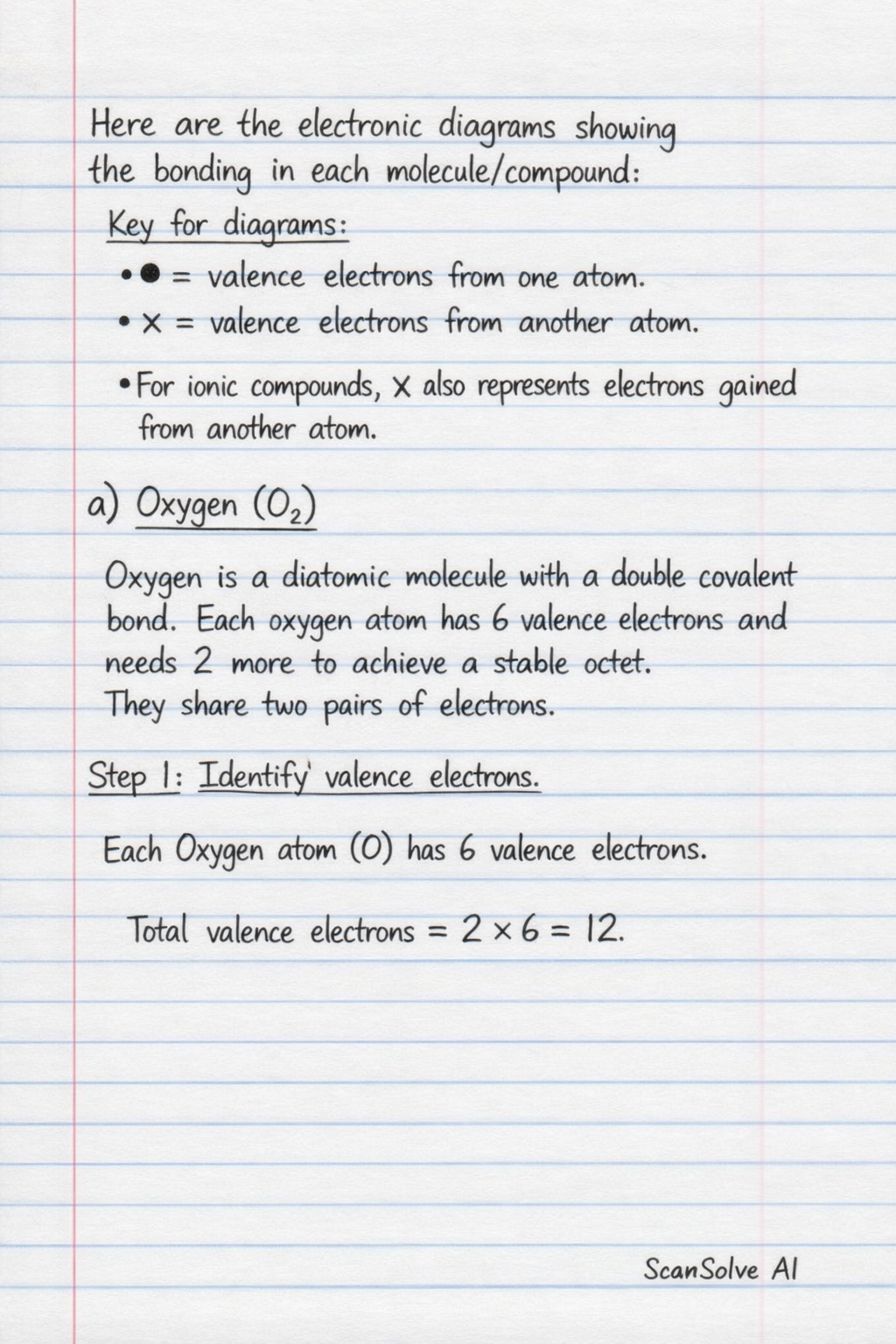
10 stepsHere are the electronic diagrams showing the bonding in each molecule/compound:
- Key for diagrams:
- represents valence electrons from one atom.
- represents valence electrons from another atom.
- For ionic compounds, also represents electrons gained from another atom.
Part a· 2 steps
Oxygen ()
Oxygen is a diatomic molecule with a double covalent bond. Each oxygen atom has 6 valence electrons and needs 2 more to achieve a stable octet. They share two pairs of electrons.
Identify valence electrons.
Each Oxygen atom (O) has 6 valence electrons.
Total valence electrons = .Form a double bond and distribute remaining electrons.
Two oxygen atoms share two pairs of electrons (a double bond). Each oxygen atom then has two lone pairs.
Each oxygen atom has 4 shared electrons and 4 non-shared electrons (2 lone pairs), totaling 8 electrons in its valence shell.
The bonding in oxygen is a double covalent bond.
Part b· 2 steps
Water ()
Water is a covalent molecule where oxygen shares electrons with two hydrogen atoms.
Identify valence electrons.
Oxygen (O) has 6 valence electrons.
Each Hydrogen (H) has 1 valence electron.
Total valence electrons = .Form single bonds and distribute remaining electrons.
The oxygen atom forms a single covalent bond with each hydrogen atom. The remaining electrons on oxygen form two lone pairs.
Each hydrogen atom achieves a stable duet (2 electrons), and the oxygen atom achieves a stable octet (8 electrons: 4 shared, 4 lone pair).
The bonding in water consists of two single covalent bonds.
Part c· 2 steps
Ammonia ()
Ammonia is a covalent molecule where nitrogen shares electrons with three hydrogen atoms.
Identify valence electrons.
Nitrogen (N) has 5 valence electrons.
Each Hydrogen (H) has 1 valence electron.
Total valence electrons = .Form single bonds and distribute remaining electrons.
The nitrogen atom forms a single covalent bond with each of the three hydrogen atoms. The remaining two electrons on nitrogen form one lone pair.
Each hydrogen atom achieves a stable duet (2 electrons), and the nitrogen atom achieves a stable octet (8 electrons: 6 shared, 2 lone pair).
The bonding in ammonia consists of three single covalent bonds.
Part d· 2 steps
Aluminium oxide ()
Aluminium oxide is an ionic compound formed by the transfer of electrons from aluminium (metal) to oxygen (non-metal).
Identify valence electrons and ion formation.
Aluminium (Al) is in Group 13, has 3 valence electrons, and tends to lose them to form ions.
Oxygen (O) is in Group 16, has 6 valence electrons, and tends to gain 2 electrons to form ions.Show electron transfer and resulting ions.
To balance the charges, two aluminium atoms will lose a total of 6 electrons (), and three oxygen atoms will gain a total of 6 electrons ().
Initial atoms:
Electron transfer:
Each Al atom transfers its 3 valence electrons. Each O atom accepts 2 electrons.Resulting ions:
The bonding in aluminium oxide is ionic bonding.
Part e· 2 steps
Magnesium sulphide ()
Magnesium sulphide is an ionic compound formed by the transfer of electrons from magnesium (metal) to sulphur (non-metal).
Identify valence electrons and ion formation.
Magnesium (Mg) is in Group 2, has 2 valence electrons, and tends to lose them to form ions.
Sulphur (S) is in Group 16, has 6 valence electrons, and tends to gain 2 electrons to form ions.Show electron transfer and resulting ions.
One magnesium atom transfers its 2 valence electrons to one sulphur atom.
Initial atoms:
Electron transfer:
The bonding in magnesium sulphide is ionic bonding.
Still stuck on this one?
Ask a follow-up, and the answer starts from this question.
More Chemistry Questions
Handwritten Step-by-Step Solution
Get this as a handwritten image on WhatsApp — like a tutor wrote it for you.
Try on WhatsApp