
We read your photo as:
During electrolysis, 2.70 g of copper is deposited from a copper(II) salt solution using the same quantity of electricity that deposits lead from a lead(II) salt solution. Calculate the mass of lead d
ScanSolve AI Answer
Answer
Step-by-step solution
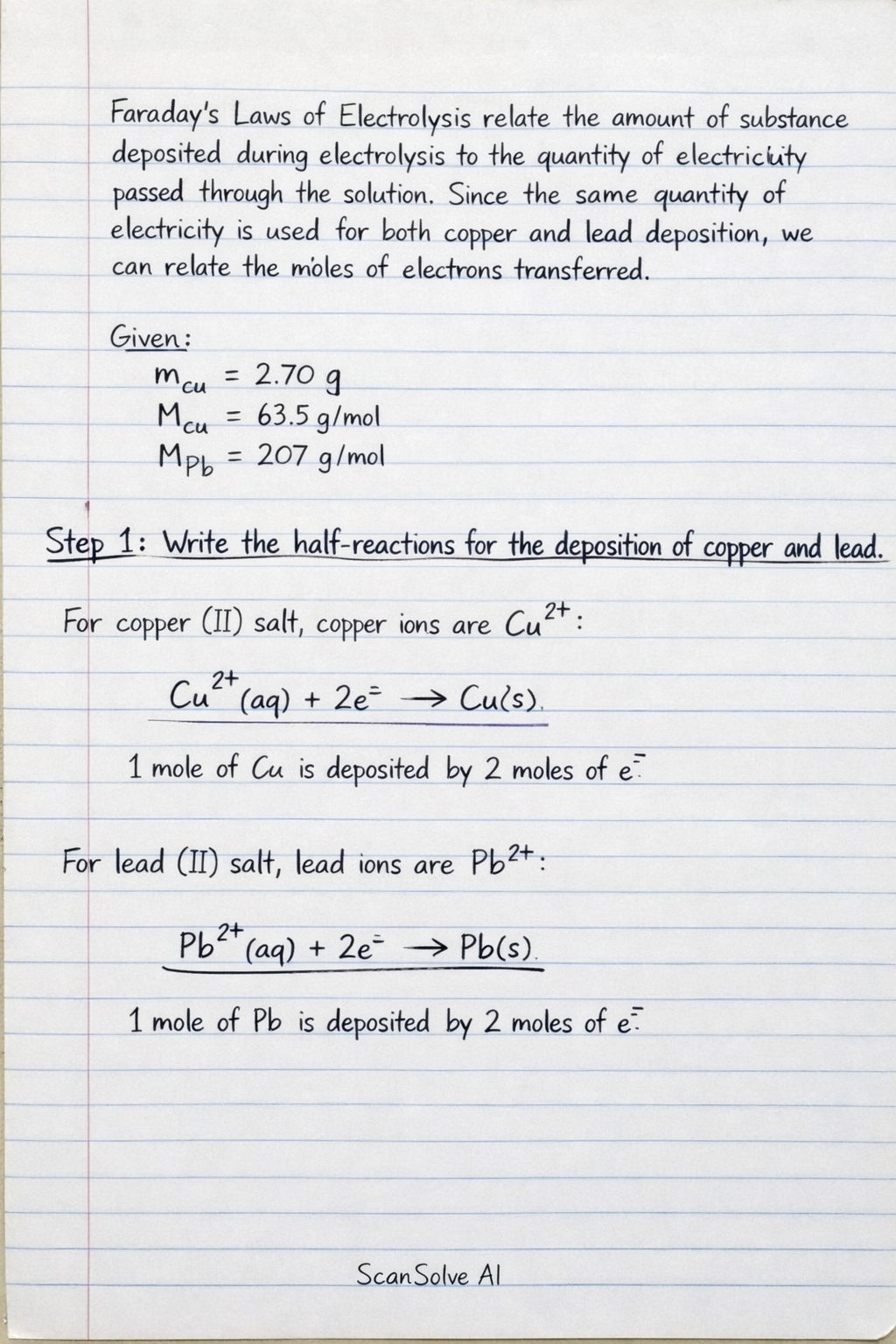
5 stepsThis problem involves Faraday's Laws of Electrolysis, which relate the amount of substance deposited during electrolysis to the quantity of electricity passed through the solution. Since the same quantity of electricity is used for both copper and lead deposition, we can relate the moles of electrons transferred.
Given:
- Mass of copper deposited () = 2.70 g
- Molar mass of copper () = 63.5 g/mol
- Molar mass of lead () = 207 g/mol
Write the half-reactions for the deposition of copper and lead.
For copper (II) salt, copper ions are :
This reaction shows that 1 mole of copper metal is deposited by 2 moles of electrons.
For lead (II) salt, lead ions are :
This reaction shows that 1 mole of lead metal is deposited by 2 moles of electrons.
Calculate the moles of copper deposited.
We use the given mass of copper and its molar mass:
Calculate the moles of electrons required to deposit the copper.
From the copper half-reaction, 1 mole of requires 2 moles of electrons.
This is the quantity of electricity (in moles of electrons) that was passed through the solution.
Calculate the moles of lead that will be deposited by the same quantity of electricity.
Since the same quantity of electricity (i.e., the same moles of electrons) is passed through the lead (II) solution, we use the moles of electrons calculated in Step 3.
From the lead half-reaction, 1 mole of requires 2 moles of electrons.Calculate the mass of lead deposited.
We use the moles of lead and its molar mass:
Rounding to three significant figures (consistent with 2.70 g):
The mass of lead that will be deposited is .
Try one yourself
A new problem that tests the same skill.
Still stuck on this one?
Ask a follow-up, and the answer starts from this question.
More Chemistry Questions
Handwritten Step-by-Step Solution
Get this as a handwritten image on WhatsApp — like a tutor wrote it for you.
Try on WhatsApp