
We read your photo as:
Can you explain the electrochemical series and provide a mnemonic to remember the reactivity of metals?
Chemistry
ScanSolve AI Answer
Answer
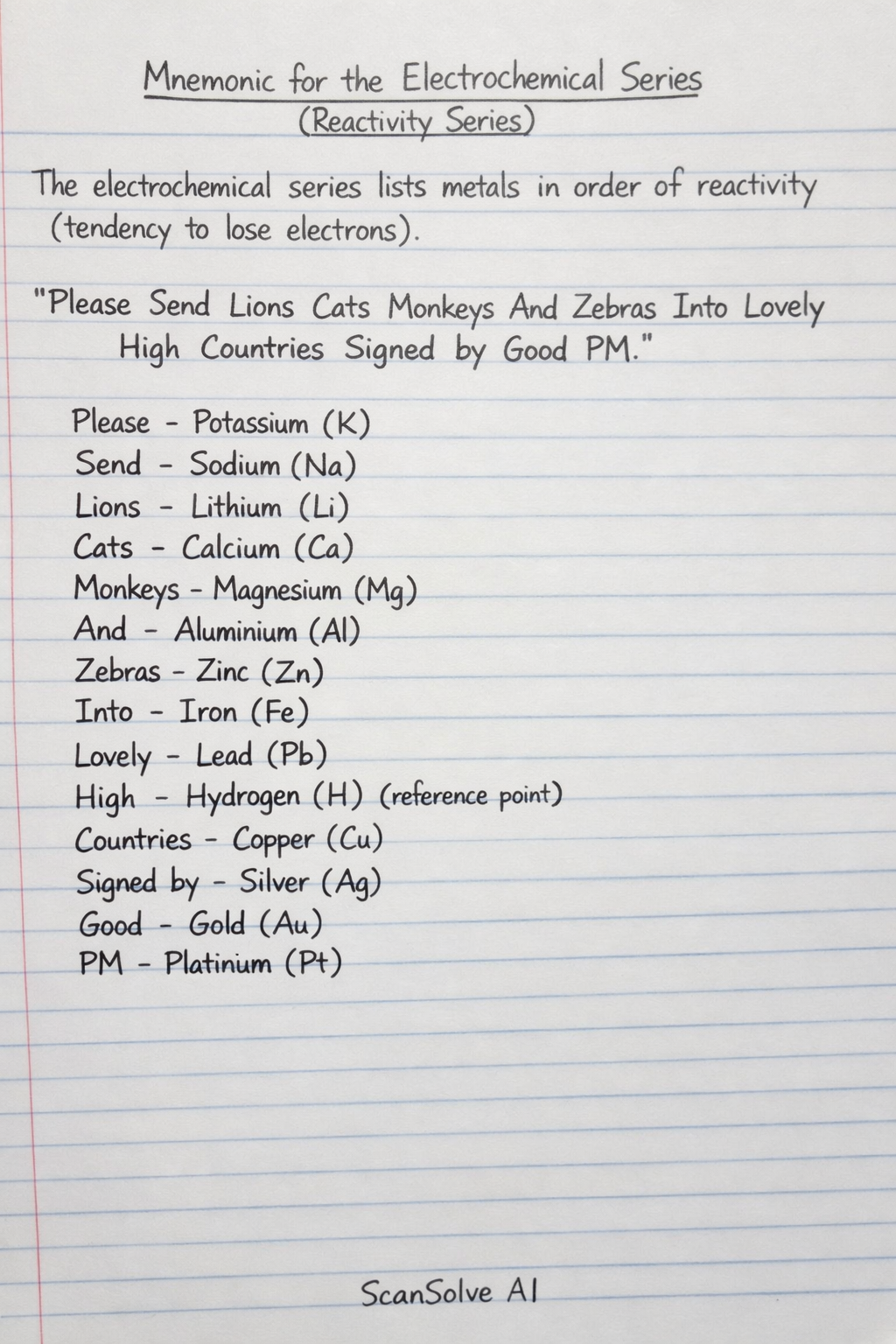
This image displays a mnemonic for remembering the electrochemical series (also known as the reactivity series) of metals.
The electrochemical series arranges metals in order of their reactivity, specifically their tendency to lose electrons and form positive ions.
-
Mnemonic: The phrase "Please Send Lions Cats Monkeys And Zebras Into Lovely High Countries Signed by Good PM" helps to recall the order of metals:
- Please - Potassium (K)
- Send - Sodium (Na)
- Lions - Lithium (Li)
- Cats - Calcium (Ca)
- Monkeys - Magnesium (Mg)
- And - Aluminium (Al)
- Zebras - Zinc (Zn)
- Into - Iron (Fe)
- Lovely - Lead (Pb)
- High - Hydrogen (H) (often included as a reference point)
- Countries - Copper (Cu)
- Signed by - Silver (Ag)
- Good - Gold (Au)
- PM - Platinum (Pt)
-
Properties along the series:
- Reactivity: Metals at the top of the series (like Potassium) are most reactive, meaning they readily lose electrons. Reactivity decreases as you move down the series.
- Reducing Agent Strength: A reducing agent is a substance that causes another substance to be reduced (gains electrons) while itself being oxidized (loses electrons). Metals at the top are good reducing agents because they easily lose electrons. Their strength as reducing agents decreases down the series.
- Standard Reduction Potential (): This measures the tendency of a chemical species to be reduced. For metals, a negative reduction potential indicates a strong tendency to be oxidized (lose electrons) rather than reduced. Metals at the top have more negative (or less positive) reduction potentials, while those at the bottom have more positive reduction potentials. The arrow in the image indicates that reduction potential becomes less negative (more positive) as you go down the series.
Was this helpful?
Still stuck on this one?
Ask a follow-up, and the answer starts from this question.
Got a different question?Ask your own question
More Chemistry Questions
QExplain the trends in metallic character and reactivity of elements, and the properties/uses of…QWhat is an isoelectronic series? Consider the series: Na+, Ne, Mg2+, F− and arrange the species in…QThe questions are about an experiment investigating the reactivity of metals with dilute…QI) Name the Chemical family name in which Elements A, B and C belong. ii) Element X has atomic…QExplain the trends in melting points, reactivity, and bonding for elements based on their position…
Handwritten Step-by-Step Solution
Get this as a handwritten image on WhatsApp — like a tutor wrote it for you.
Try on WhatsApp