
We read your photo as:
Identify the metal and the products formed in each step, providing relevant chemical equations.
ScanSolve AI Answer
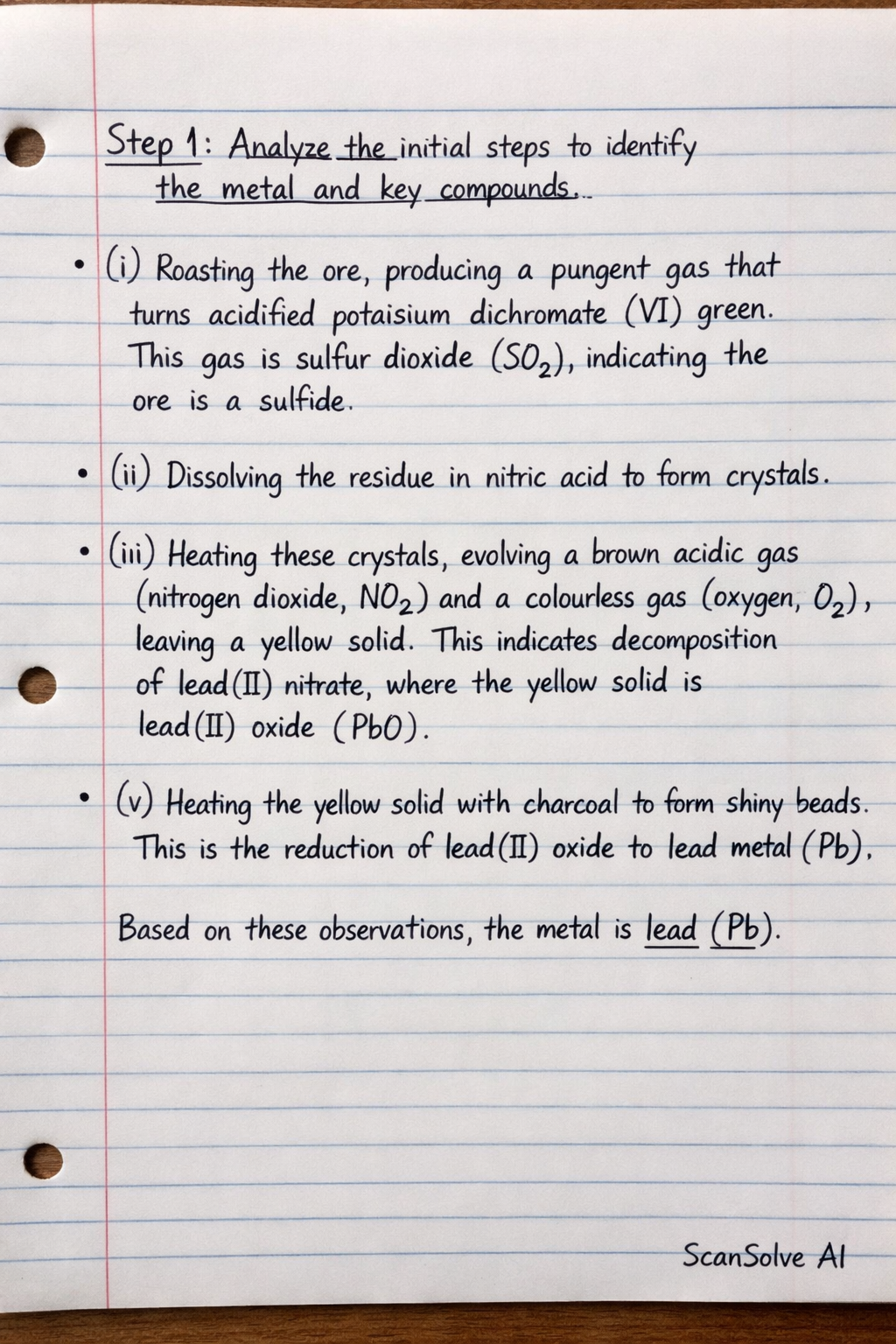
Step 1: Analyze the initial steps to identify the metal and key compounds.
- Step (i) describes roasting an ore, producing a pungent gas that turns acidified potassium dichromate (VI) green. This gas is sulfur dioxide (), indicating the ore is a sulfide.
- Step (ii) describes dissolving the residue in nitric acid to form crystals.
- Step (iii) describes heating these crystals, evolving a brown acidic gas (nitrogen dioxide, ) and a colourless gas (oxygen, ), leaving a yellow solid. This is characteristic of lead(II) nitrate decomposition, where the yellow solid is lead(II) oxide ().
- Step (v) describes heating the yellow solid with charcoal to form shiny beads. This is the reduction of lead(II) oxide to lead metal (). Based on these observations, the metal is lead ().
a)
- (i) The gas formed when the ore was roasted in air is sulfur dioxide, as it has a pungent smell and turns acidified potassium dichromate (VI) green.
- (ii) When the crystals (lead(II) nitrate) were heated, a brown acidic gas and a colourless gas were evolved. These are nitrogen dioxide and oxygen, respectively.
- (iii) The yellow solid that remained after heating the crystals in step (iii) is lead(II) oxide.
- (iv) The shiny beads formed in step (v) by heating lead(II) oxide with charcoal are lead metal.
b) The yellow solid from procedure (iii) is lead(II) oxide (). When melted and electrolysed using graphite electrodes:
- (i) At the cathode (negative electrode), lead ions are reduced to lead metal. At the anode (positive electrode), oxide ions are oxidized to oxygen gas.
- At cathode: Shiny beads of lead metal are formed.
- At anode: A colourless gas (oxygen) is evolved.
- (ii) The reaction at the anode involves the oxidation of oxide ions to oxygen gas.
c) The crystals formed in step (ii) are lead(II) nitrate (). When dissolved in water and reacted with potassium iodide () solution, a yellow precipitate of lead(II) iodide () is formed.
The ionic equation for this reaction is:
d) Assuming "solution from (f)" is a typo and refers to the lead(II) nitrate solution (from dissolving crystals from step (ii)). When sodium hydroxide solution is added drop by drop to lead(II) nitrate solution:
- A white precipitate is formed, which then dissolves in excess sodium hydroxide solution to form a colourless solution. (The white precipitate is lead(II) hydroxide, , which is amphoteric and dissolves in excess strong base to form a soluble plumbate(II) complex.)
e) Assuming "solution from (f)" is a typo and refers to the lead(II) nitrate solution. When a piece of zinc foil is added to lead(II) nitrate solution:
- (i) Zinc is more reactive than lead, so it will displace lead from its salt solution. This is a displacement reaction (or redox reaction).
- (ii) The ionic equation for the reaction is:
Still stuck on this one?
Ask a follow-up, and the answer starts from this question.
More Chemistry Questions
Handwritten Step-by-Step Solution
Get this as a handwritten image on WhatsApp — like a tutor wrote it for you.
Try on WhatsApp