
We read your photo as:
Elements are found in groups and periods. Explain the position of element M in the periodic table and identify it. Also, explain chromatography, including a labelled diagram of a chromatogram and the
ScanSolve AI Answer
Step-by-step solution
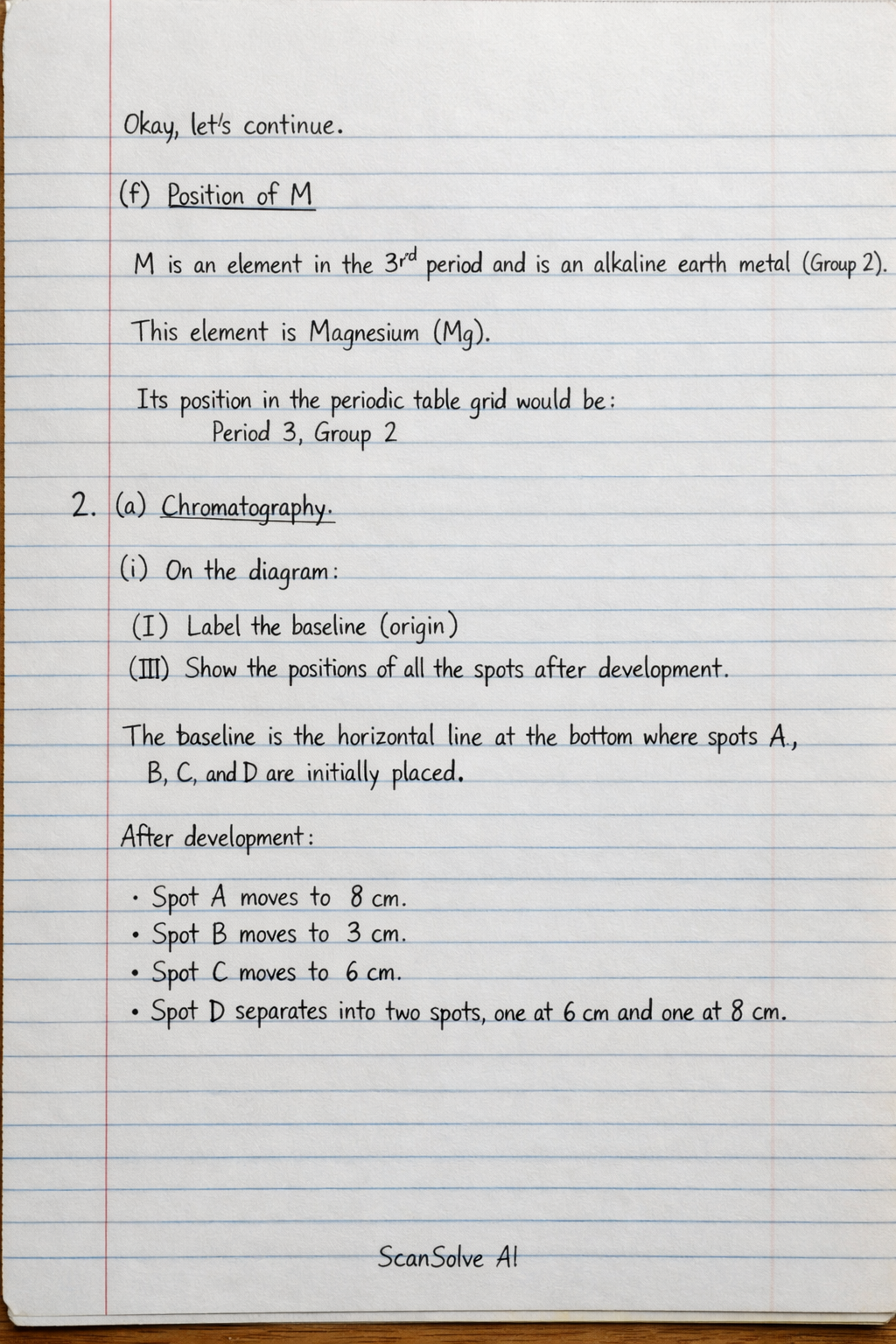
3 stepsOkay, let's continue.
Part f(i)
On the diagram
Position of M
M is an element in the 3rd period and is an alkaline earth metal (Group 2).
This element is Magnesium (Mg).
Its position in the periodic table grid would be: Period 3, Group 2.
2. (a) Chromatography
(I) Label the baseline (origin)
(II) Show the positions of all the spots after development
- The baseline is the horizontal line at the bottom where spots A, B, C, and D are initially placed.
- After development:
- Spot A moves to 8 cm.
- Spot B moves to 3 cm.
- Spot C moves to 6 cm.
- Spot D separates into two spots, one at 6 cm and one at 8 cm.
Here is the diagram with the labels and developed spots:
(Note: In a real diagram, you would draw the spots at the indicated heights above the baseline.)
Part f(ii)· 3 steps
Identify the substances present in mixture D
Mixture D separated into two spots that moved 6 cm and 8 cm.
Substance A moved 8 cm.
Substance C moved 6 cm.
Therefore, mixture D contains substances A and C.
2. (b) Separation of ammonium chloride and anhydrous calcium chloride
Heat the solid mixture gently in an evaporating dish.
Ammonium chloride will sublime (change directly from solid to gas) and then deposit as a solid on a cooler surface (e.g., a watch glass placed over the dish).
Anhydrous calcium chloride will remain in the evaporating dish as it does not sublime.
2. (c) Miscible and immiscible liquids
(The table for this question is not provided in the image.)
Still stuck on this one?
Ask a follow-up, and the answer starts from this question.
More Chemistry Questions
Handwritten Step-by-Step Solution
Get this as a handwritten image on WhatsApp — like a tutor wrote it for you.
Try on WhatsApp