
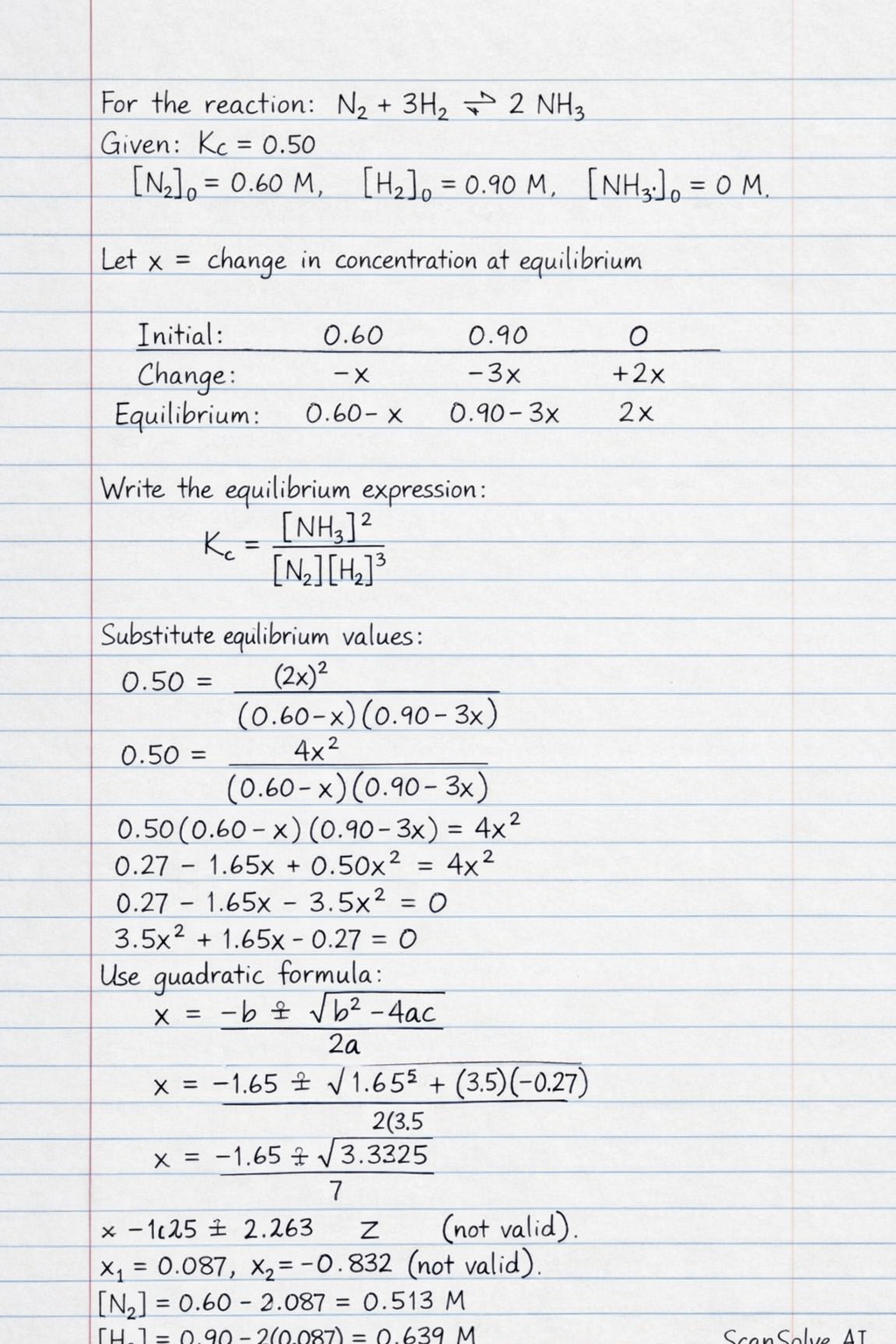
This chemistry question involves key chemical concepts and calculations. The detailed solution below walks through each step, from identifying the reaction type to computing the final answer.
ScanSolve AI Answer
The equilibrium law, also known as the Law of Mass Action, describes the relationship between the concentrations of reactants and products at equilibrium for a reversible reaction. It states that at a constant temperature, the ratio of product concentrations (raised to their stoichiometric coefficients) to reactant concentrations (raised to their stoichiometric coefficients) is constant, known as the equilibrium constant (K). This law provides advance knowledge by allowing prediction of the direction a reaction will shift to reach equilibrium and calculation of equilibrium concentrations. That's 2 down. 3 left today — send the next one.