
We read your photo as:
1 Chemical equilibrium is a dynamic state in a reversible chemical reaction where the rate of the forward reaction is equal to the rate of the reverse reaction, resulting in constant concentrati
ScanSolve AI Answer
Step-by-step solution
7 stepsHere are the solutions to your questions:
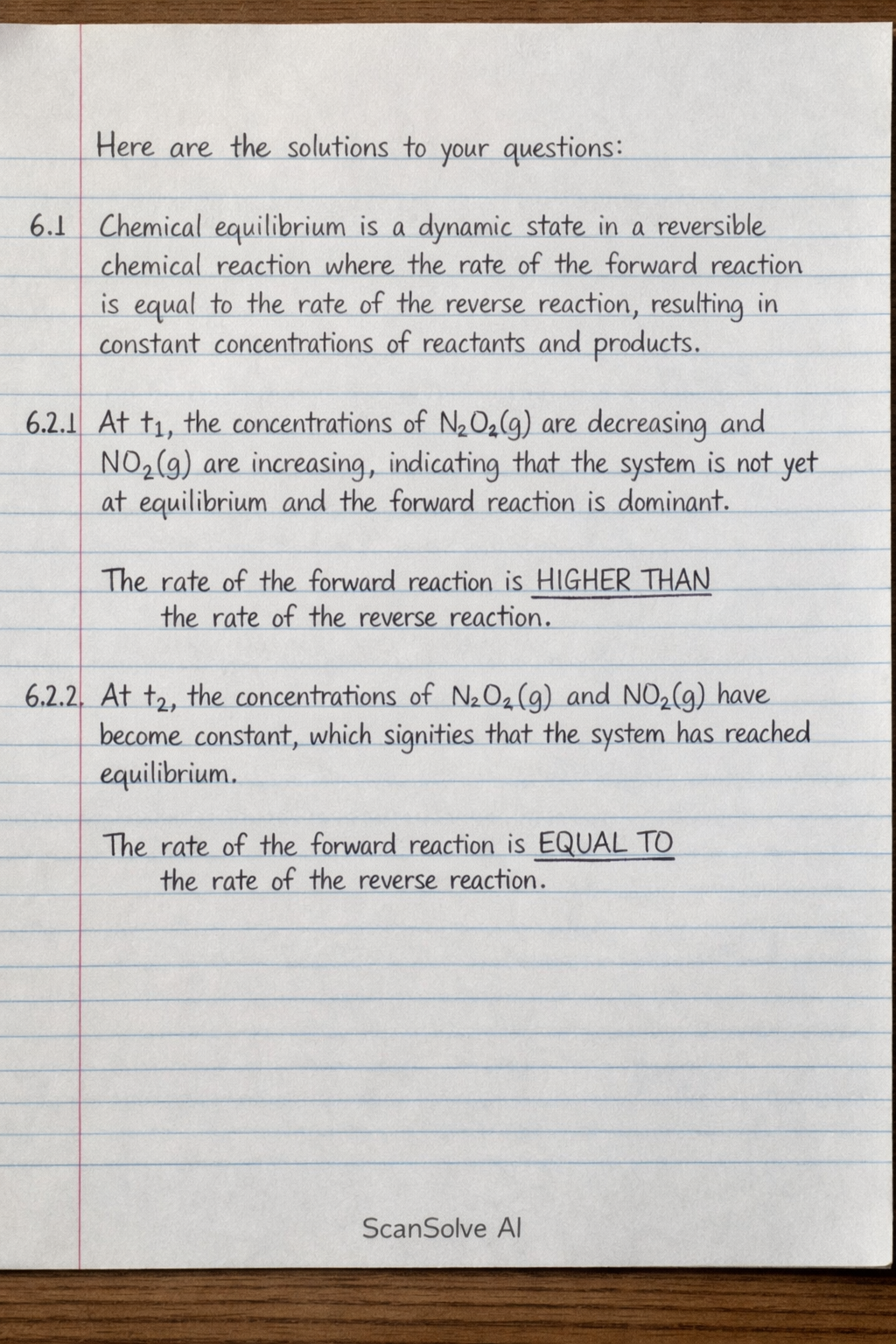
6.1 Chemical equilibrium is a dynamic state in a reversible chemical reaction where the rate of the forward reaction is equal to the rate of the reverse reaction, resulting in constant concentrations of reactants and products.
6.2.1 At , the concentrations of are decreasing and are increasing, indicating that the system is not yet at equilibrium and the forward reaction is dominant.
The rate of the forward reaction is HIGHER THAN the rate of the reverse reaction.
6.2.2 At , the concentrations of both and have become constant, which signifies that the system has reached equilibrium.
The rate of the forward reaction is EQUAL TO the rate of the reverse reaction.
6.3.1 At , there is an instantaneous decrease in the concentrations of both and , followed by a shift in equilibrium where decreases further and increases. Since the equilibrium constant () did not change, the temperature remained constant. An instantaneous decrease in concentration for all species indicates an increase in volume (or decrease in pressure). The equilibrium shifts to the side with more moles of gas () to counteract the pressure decrease.
The change made was an increase in volume (or decrease in pressure).
6.3.2 At , there is an instantaneous increase in the concentrations of both and , followed by a shift in equilibrium where increases further and decreases. Since did not change, the temperature remained constant. An instantaneous increase in concentration for all species indicates a decrease in volume (or increase in pressure). The equilibrium shifts to the side with fewer moles of gas () to counteract the pressure increase.
The change made was a decrease in volume (or increase in pressure).
6.4 The reaction is with .
Identify the nature of the forward reaction.
Since , the forward reaction (decomposition of to ) is endothermic.
Apply Le Chatelier's principle.
According to Le Chatelier's principle, an increase in temperature favors the endothermic reaction to absorb the added heat. In this case, increasing the temperature will favor the forward reaction.
Determine the influence on the yield of .
Favoring the forward reaction means more will decompose to form . Therefore, the yield of will INCREASE.
6.5
The reaction is:Initial moles of
Volume of container =
Percentage decomposed =Calculate the moles of that decomposed.
Calculate the equilibrium moles of and .
From the stoichiometry ():
Calculate the equilibrium concentrations.
Calculate the equilibrium constant ().
The equilibrium constant () for this reaction at is .
Still stuck on this one?
Ask a follow-up, and the answer starts from this question.
More Chemistry Questions
Handwritten Step-by-Step Solution
Get this as a handwritten image on WhatsApp — like a tutor wrote it for you.
Try on WhatsApp