
We read your photo as:
Draw and name the isomers of pentane. (b) Ethane gas was reacted with 1 mole of bromine gas. State one observation made during this reaction.
ScanSolve AI Answer
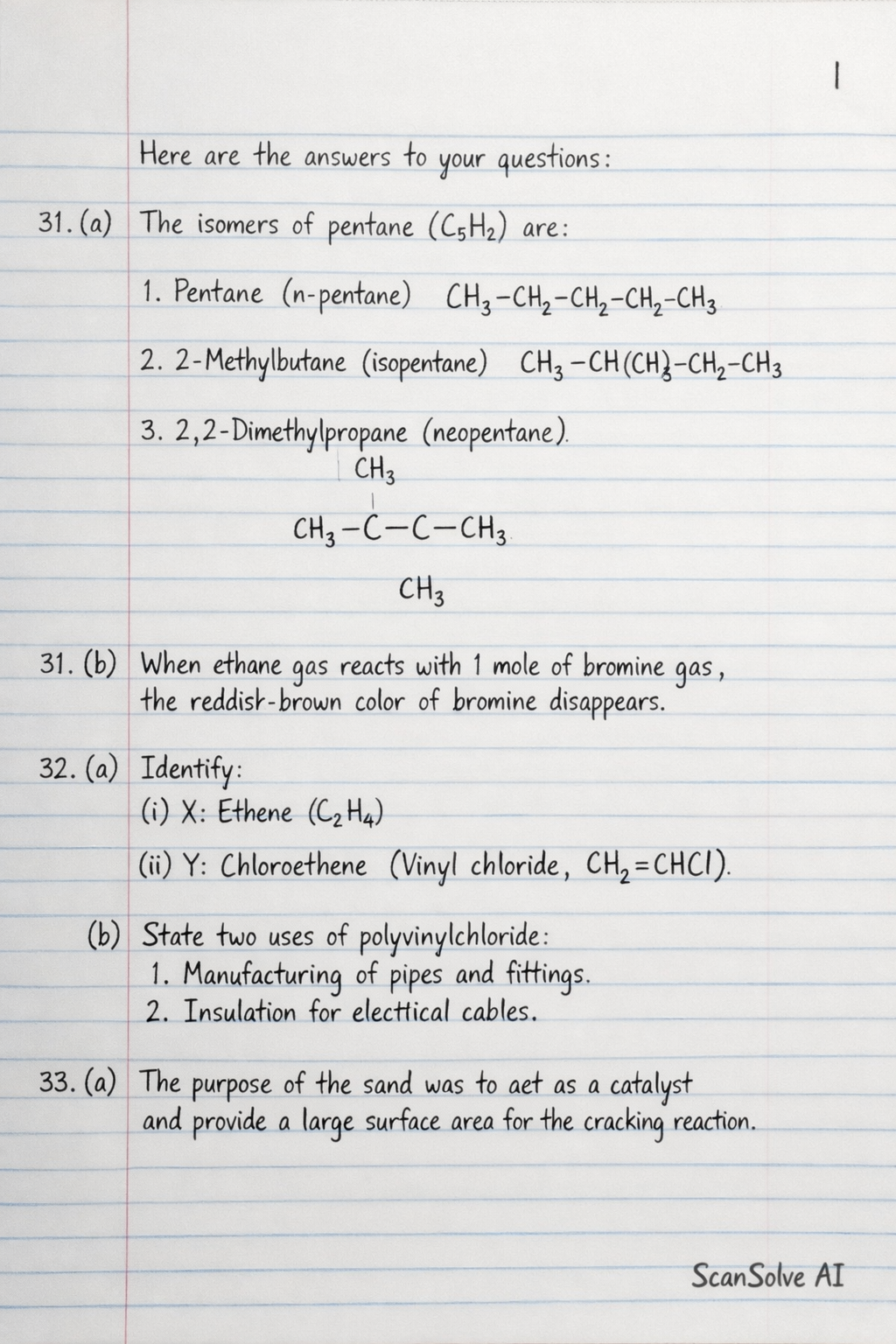
Here are the answers to your questions:
31. (a)
The isomers of pentane () are:
- Pentane (or n-pentane)
- 2-Methylbutane (or isopentane)
- 2,2-Dimethylpropane (or neopentane)
31. (b)
When ethane gas reacts with 1 mole of bromine gas, the observation made is that the reddish-brown color of bromine disappears.
32.
- (a) Identify:
- (i) X: Ethene ()
- (ii) Y: Chloroethene (or Vinyl chloride, )
- (b) State two uses of polyvinylchloride.
- Manufacturing of pipes and fittings.
- Insulation for electrical cables.
33. (a)
The purpose of the sand was to act as a catalyst and provide a large surface area for the cracking reaction.
33. (b)
Gas G is an alkene.
- Chemical test: Add bromine water to gas G.
- Observation: The reddish-brown color of the bromine water disappears.
34. (a)
When excess pentene is reacted with bromine gas, the observation made is that the reddish-brown color of the bromine gas disappears.
34. (b)
The compound formed is 1,2-Dibromopentane (assuming pent-1-ene).
Still stuck on this one?
Ask a follow-up, and the answer starts from this question.
More Chemistry Questions
Handwritten Step-by-Step Solution
Get this as a handwritten image on WhatsApp — like a tutor wrote it for you.
Try on WhatsApp